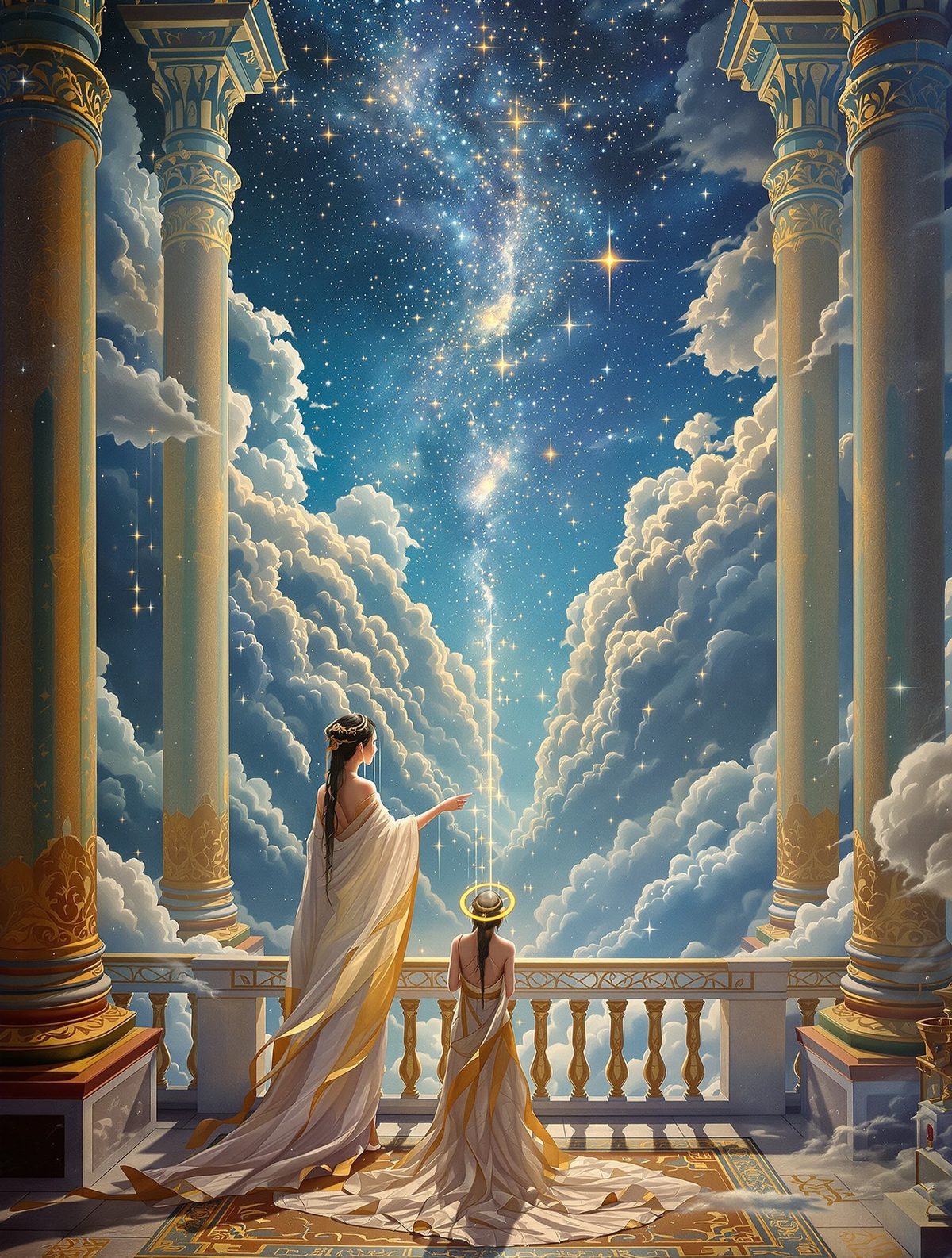
Picture this: high above the celestial realm, delicate fingers work tirelessly at a loom of starlight, weaving clouds that drift across mortal skies and spinning rainbows from threads of pure light. The weaver is Zhinü, daughter of the mighty Jade Emperor, and she has never known anything but the perfection of heaven—until the day she glimpses a lonely cowherd tending his ox beside the Silver River, and her immortal heart learns what it means to break.
What follows is a love story so powerful it literally reshaped the cosmos, creating the star-crossed pattern we see in our night sky and establishing one of China's most enduring festivals. But the version taught in schools barely scratches the surface of this celestial drama that has captivated hearts for over 2,000 years.
The Seventh Daughter of Heaven
In the hierarchical perfection of the Chinese celestial court, Zhinü (織女) held a position of incredible importance. As the seventh daughter of the Jade Emperor—the supreme deity ruling over heaven and earth—she wasn't just another immortal princess lounging in celestial gardens. She was the Weaver Girl, tasked with one of creation's most vital jobs: crafting the very clouds that brought rain to mortal crops and weaving the silk of the heavens that formed auroras and rainbows.
Ancient texts describe her workspace as a palace of crystal and moonbeams, where her loom stretched across entire star systems. Every thread she wove became meteorological phenomena on earth—a responsibility that connected her more intimately with the mortal world than her sisters, who focused on purely celestial duties. This connection would prove to be both her gift and her downfall.
Here's what the textbooks don't tell you: Zhinü wasn't working alone. Historical records from the Han Dynasty (206 BCE – 220 CE) indicate she commanded an entire workforce of celestial maidens, suggesting the weaving of weather was a massive cosmic industry. Some scholars argue that her story represents ancient China's sophisticated understanding of meteorology, disguised as mythology.
The Cowherd Who Caught Heaven's Eye
Meanwhile, in the mortal realm, Niulang (牛郎) lived a life of profound loneliness. Orphaned young and left with nothing but an old ox, he worked as a cowherd, tending cattle for wealthier farmers. But this was no ordinary ox—unbeknownst to Niulang, his bovine companion was actually a fallen star, a former celestial being banished to earth for unknown transgressions.
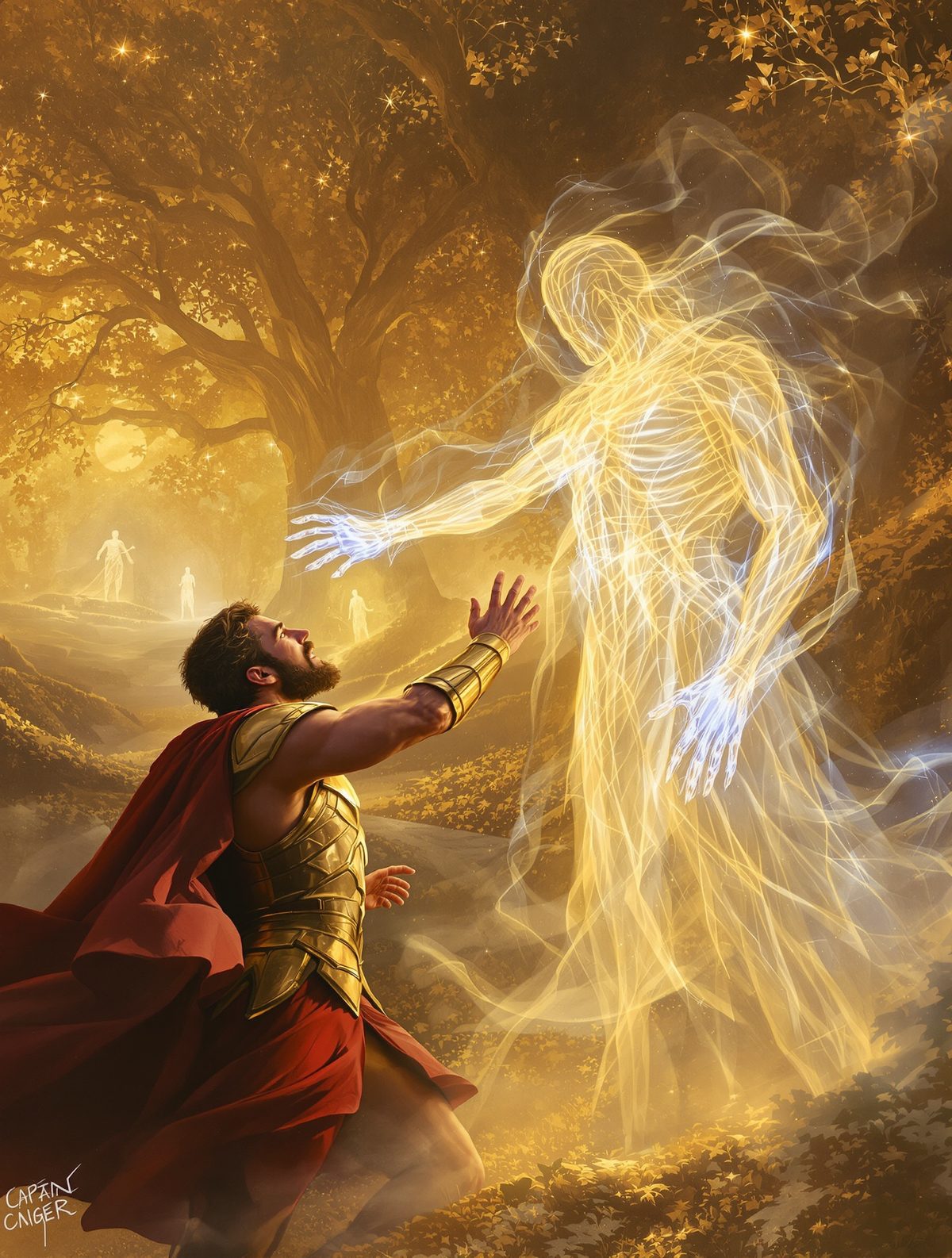
The ox, retaining fragments of its celestial wisdom, could see things hidden from mortal eyes. It watched as the beautiful weaver girl gazed down from heaven, her immortal heart stirring with curiosity about the world below. In various versions of the tale, it was the ox who orchestrated their first meeting, advising Niulang when and where the celestial maidens would descend to bathe in the sacred lake.
When Zhinü first descended to earth with her attendants, she was struck not by the beauty of the mortal realm, but by the genuine kindness she witnessed in Niulang's treatment of his animals and his neighbors. Here was a man who, despite having nothing, shared what little he possessed. For an immortal who had only known the formal perfection of heaven, such authentic goodness was intoxicating.
Love Across the Cosmic Divide
Their courtship defied every natural law. Zhinü began stealing away from her celestial duties, descending to earth in secret. She taught Niulang about the mysteries of weather and seasons, while he showed her the simple pleasures of mortal life—the taste of fresh fruit, the warmth of a fire on cold nights, the satisfaction of work completed by one's own hands.
What many don't realize is that their romance lasted longer than most versions suggest. According to some Ming Dynasty texts, Zhinü lived as a mortal for three full years, during which time they married and had two children—a son and a daughter. She didn't just visit earth; she chose to become human, sacrificing her immortality for love.
During these years, something remarkable happened in the celestial realm: the weather patterns began to shift. Without Zhinü's constant attention, clouds formed irregularly, and seasonal rains became unpredictable. The Jade Emperor, initially unaware of his daughter's disappearance, began investigating the cosmic disorder that was affecting both heaven and earth.
Divine Wrath and Cosmic Punishment
The discovery was inevitable. When the Jade Emperor learned that his daughter had not only abandoned her sacred duties but had also borne children with a mortal, his rage shook the foundations of heaven itself. Ancient texts describe his fury as so intense that it caused solar eclipses and made the stars themselves tremble in their courses.
But the Jade Emperor's punishment went beyond simple separation. Using his power over the fundamental forces of creation, he didn't just create a barrier between the lovers—he created an entirely new cosmic feature. The Tianhe (天河), or "Sky River," sprang into existence, a churning torrent of stars and cosmic energy that we now know as the Milky Way galaxy.
The astronomical accuracy is startling: The stars Vega (representing Zhinü) and Altair (representing Niulang) are actually separated by approximately 16 light-years, with the galactic plane of the Milky Way running between them. Ancient Chinese astronomers somehow encoded real stellar relationships into their mythology thousands of years before modern telescopes confirmed these distances.
The Magpie Bridge and Eternal Hope
Even cosmic punishment couldn't completely extinguish the power of their love. Legend tells us that the magpies of the world, moved by the couple's devotion and the tears of their children, made a extraordinary sacrifice. Once each year, on the seventh day of the seventh lunar month, every magpie in existence flies to heaven to form a bridge across the Milky Way, allowing the lovers a single day of reunion.
This annual reunion became the foundation for Qixi Festival (七夕節), China's Valentine's Day, celebrated for over 2,000 years. But here's a detail that adds poignancy to the celebration: according to tradition, if it rains on Qixi, those aren't ordinary raindrops—they're tears of joy from Zhinü and Niulang's reunion, or tears of sorrow as they part once again.
The festival's customs reveal the story's deep cultural impact. Young women would pray to Zhinü for skill in weaving and embroidery, while couples would look to the night sky, finding the two bright stars that represent eternal love persevering against impossible odds.
A Love Story Written in Stars
The legend of Zhinü and Niulang resonates today because it captures something universally human: the tension between duty and desire, the courage required to defy social expectations for love, and the bittersweet reality that some sacrifices echo through generations. In our modern world of long-distance relationships and career obligations that separate couples, their story feels remarkably contemporary.
But perhaps most remarkably, this ancient tale reveals how our ancestors used storytelling to process scientific observations, embedding astronomical knowledge within emotional narratives that ensured the information would be preserved and passed down. Every time we look up at the summer sky and spot the bright stars Vega and Altair on opposite sides of the Milky Way, we're seeing the same cosmic love story that has captivated hearts for millennia.
In a universe that can seem vast and indifferent, the legend reminds us that love—even when it defies the gods themselves—has the power to create new realities and reshape the very stars.