
Picture this: you can see the future with perfect clarity, but every time you try to warn someone of impending doom, they laugh in your face. You watch helplessly as your beloved city burns, your family dies, and civilizations crumble—all while knowing you could have prevented it if only someone had listened. Welcome to the living hell of Cassandra of Troy, the most tragic prophet in all of ancient mythology.
Her story begins not with doom, but with divine desire. Apollo, the golden god of prophecy, music, and healing, had set his immortal eyes upon the most beautiful princess in all of Troy. What followed was a bargain that would echo through the ages—a tale of divine power, mortal defiance, and a curse so perfectly cruel it would make even the other gods shudder.
The Princess Who Caught a God's Eye
Cassandra was no ordinary mortal. Born to King Priam and Queen Hecuba of Troy around 1200 BCE, she was renowned throughout the ancient world for her extraordinary beauty and keen intelligence. Ancient sources describe her as having hair like spun gold and eyes that seemed to hold the wisdom of ages—ironic, considering what was to come.
Troy itself was at the height of its power during Cassandra's youth. The city controlled the vital trade routes between Europe and Asia, making it one of the wealthiest and most influential kingdoms of the late Bronze Age. Its massive walls, built by the gods Poseidon and Apollo themselves according to legend, seemed impregnable. For a young princess growing up in such splendor, the future must have seemed bright indeed.
But Cassandra possessed something even rarer than beauty or royal blood—she had caught the attention of Apollo, one of the twelve Olympian gods. In the ancient world, this was both the ultimate blessing and the ultimate danger. When gods desired mortals, the results were rarely simple, and never without consequence.
A Divine Bargain Sealed With a Kiss
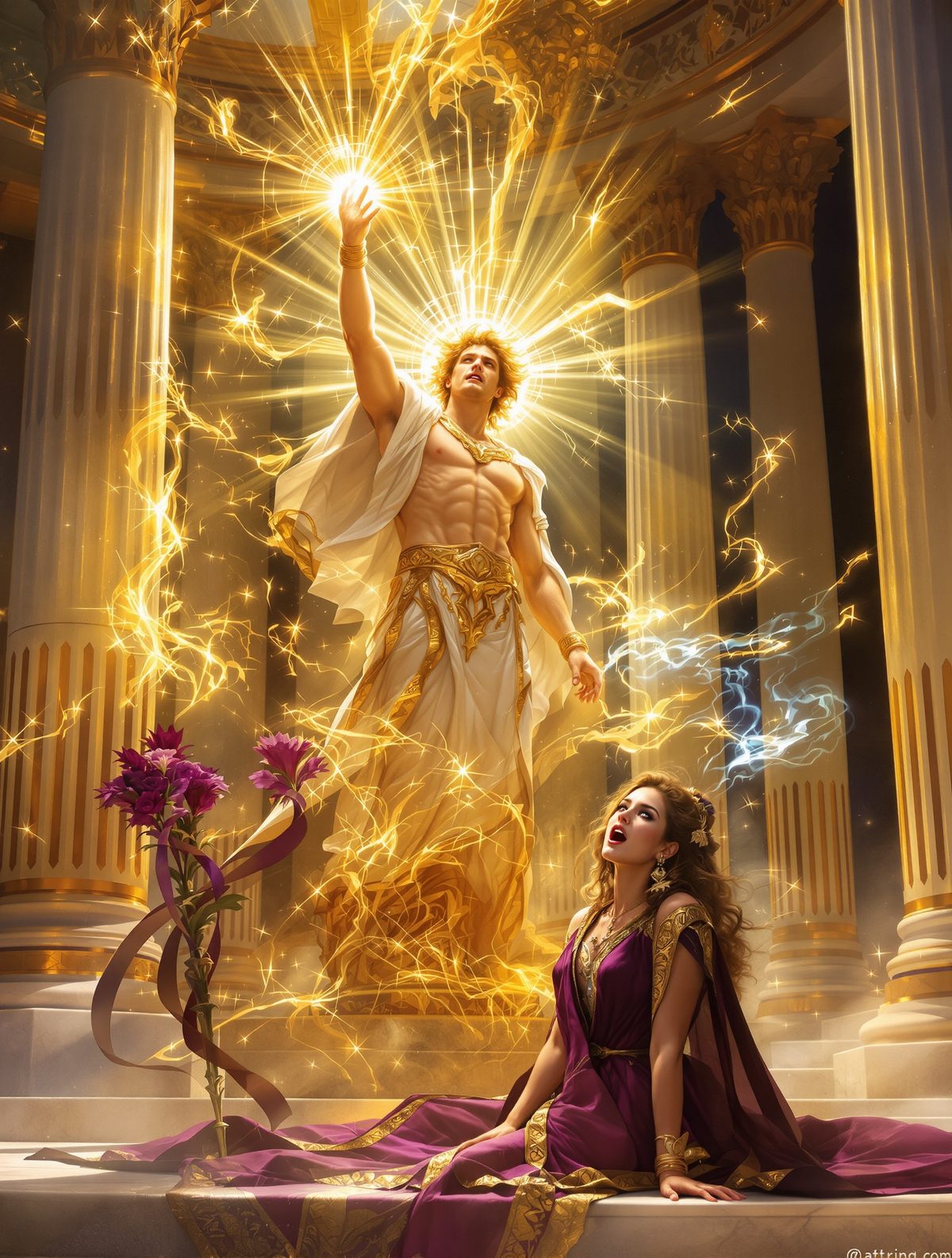
The meeting between Apollo and Cassandra took place in the most sacred spot in Troy—the temple of Apollo itself. According to the most detailed accounts, preserved by writers like Aeschylus and later Hyginus, Cassandra had come to the temple as she did every day to perform her religious duties. It was there, surrounded by flickering oil lamps and the scent of burning incense, that the god materialized before her in all his radiant glory.
Apollo's offer was breathtaking in its generosity. The gift of prophecy was his most precious divine attribute, shared with only a select few mortals throughout all of history. The Pythia at Delphi, his most famous oracle, could only channel his prophetic voice when inhaling sacred vapors in a drug-induced trance. But Apollo offered Cassandra something far greater—the ability to see the future clearly and speak of it in her own voice, whenever she chose.
The price? Her love. Not just physical intimacy, but complete devotion to the god who would make her the most powerful seer who ever lived.
Here's where the story takes its first tragic turn. Cassandra accepted Apollo's gift—but ancient sources disagree on whether she ever intended to honor her side of the bargain. Some say she was genuinely attracted to the golden god but changed her mind after receiving his power. Others suggest she planned the deception from the beginning, knowing that divine gifts, once given, could never be fully taken back.
The moment Apollo kissed her lips, divine fire coursed through Cassandra's mortal form. Suddenly, she could see the threads of fate stretching out before her like a vast tapestry. She saw wars and deaths, births and triumphs, the rise and fall of kingdoms—all crystal clear and absolutely certain. It was intoxicating and terrifying all at once.
And then she pulled away and rejected him.
The Rage of a Scorned God
The fury of a god is a terrible thing to behold, but Apollo's rage was particularly devastating because it was mixed with genuine heartbreak. He had not simply desired Cassandra's body—he had fallen in love with her mind, her spirit, her essential self. Her rejection cut him to his divine core.
But here's a fascinating detail most people don't know: according to divine law, even gods couldn't simply take back gifts once bestowed. The cosmic order that governed even Zeus himself prevented Apollo from stripping Cassandra of her prophetic abilities. So he did something far more creative—and infinitely more cruel.
Apollo couldn't make her prophecies false, but he could make them useless. With another kiss—this one burning with divine wrath rather than love—he cursed her tongue. From that moment forward, every word of prophecy she spoke would be absolutely true, but no one would believe her. Not her family, not her friends, not even strangers who had never heard her name.
The psychological torture was exquisite in its precision. Cassandra would be forced to watch every tragedy unfold exactly as she had foreseen, knowing that her warnings had been dismissed as the ravings of a madwoman. She would live with the knowledge that she could have saved everyone she loved, if only they had listened to the prophet they couldn't trust.
Prophecies of Doom Fall on Deaf Ears
The curse manifested itself almost immediately. Cassandra's first major prophecy concerned her own brother, Paris. She saw him sailing to Sparta and returning with Helen, the most beautiful woman in the world—and the cause of Troy's ultimate destruction. She begged her parents to stop him, describing in vivid detail the ten-year war that would follow, the deaths of her brothers, the fall of their mighty city.
King Priam and Queen Hecuba exchanged worried glances. Their daughter had always been imaginative, but this seemed like something more serious. They consulted physicians and priests, who all agreed: Cassandra was clearly suffering from some form of divine madness. Her prophecies were dismissed as delusions, and Paris sailed to Sparta right on schedule.
For ten long years of the Trojan War, Cassandra's warnings went unheeded. She predicted which battles would be lost, which heroes would fall, which strategies would fail. She saw the wooden horse before it was even built, describing in perfect detail how Greek warriors would hide inside while the Trojans dragged their own doom within the city walls.
"Do not bring it inside!" she screamed on that fateful night, clawing at the horse's wooden flanks. "Warriors hide within! It will be the death of us all!" The Trojans laughed at the mad princess and continued their celebration. By dawn, Troy was burning, just as she had foreseen.
The Final Prophecy
Even in Troy's final hours, Cassandra's curse continued to torment her. As Greek soldiers ransacked the city, she took refuge in Athena's temple, clinging to the goddess's statue in a desperate bid for sanctuary. It was there that Ajax the Lesser found her and committed an act so sacrilegious it would doom his entire fleet.
When King Agamemnon claimed Cassandra as his prize of war, she saw their shared fate with crystal clarity. She would die in his homeland of Mycenae, murdered alongside him by his vengeful wife Clytemnestra. She even saw the method—an ax, wielded by a queen mad with grief over her daughter's sacrifice.
Did Cassandra try to warn Agamemnon? Ancient sources suggest she did, but her words fell on deaf ears once again. The great king, drunk on victory, couldn't imagine that his homecoming would end in blood. As they sailed toward Greece, Cassandra must have counted down the days to her own death, powerless to change a fate she could see approaching like storm clouds on the horizon.
The Prophet Who Still Speaks to Us
Today, we use the term "Cassandra complex" to describe the psychological phenomenon of making accurate predictions that no one believes. Climate scientists, economic analysts, and public health experts often find themselves in Cassandra's position—possessing unwelcome truths that society would rather ignore.
But perhaps the real lesson of Cassandra's story isn't about the pain of being right when everyone else is wrong. Maybe it's about the dangerous seductiveness of divine power and the price of trying to outsmart the gods. Cassandra thought she could accept Apollo's gift without paying his price, but the gods of ancient Greece were nothing if not experts at ensuring debts were eventually collected.
Her tale reminds us that knowledge without the ability to act on it is perhaps the cruelest curse of all. In our age of information overload, when we can see problems approaching from years away but seem powerless to prevent them, Cassandra's torment feels remarkably modern. She remains trapped in her temple, warning us of disasters we're not quite ready to believe—until it's far too late to listen.