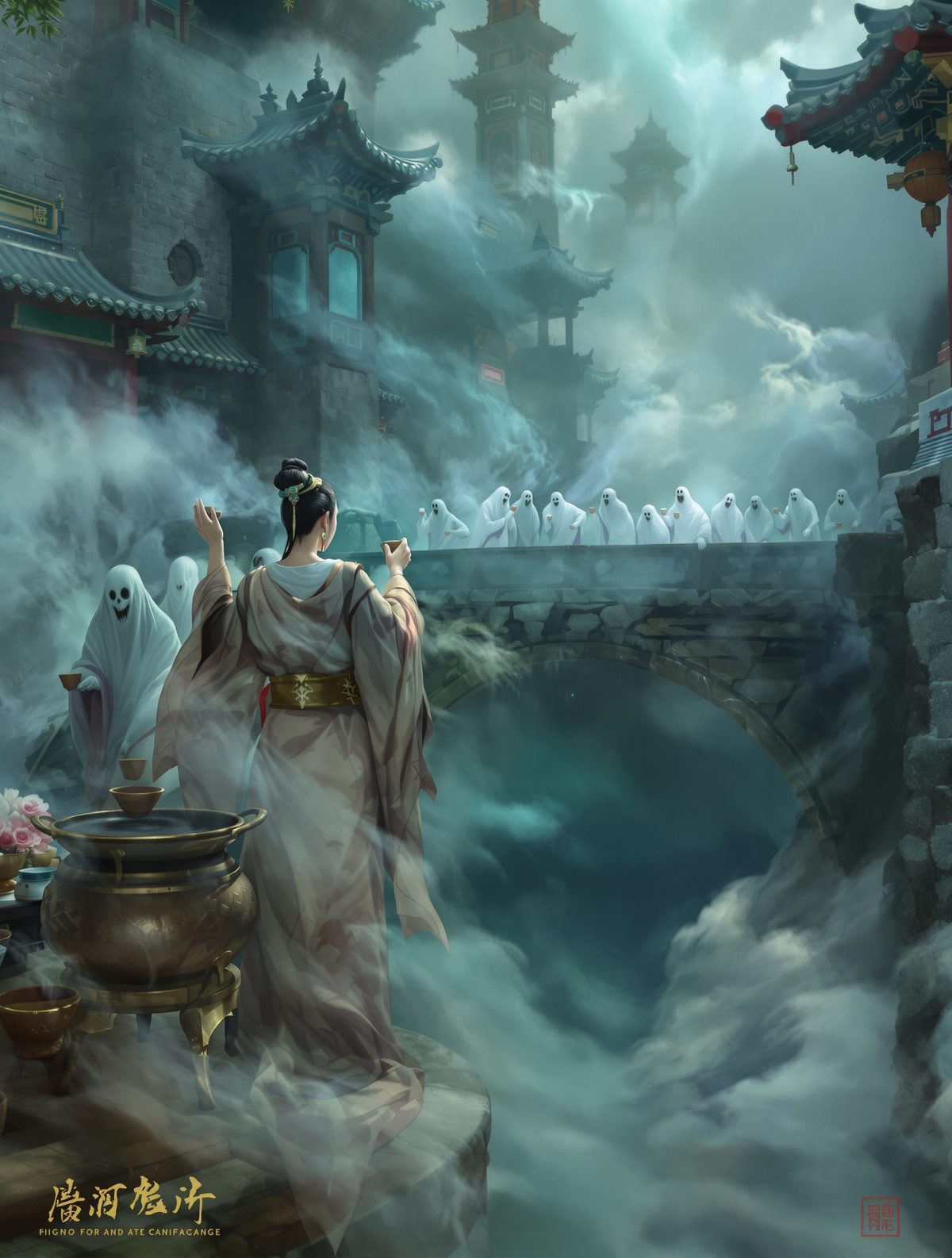
Imagine standing at the edge of eternity, your entire life spread before you like pages in a book you're about to burn. The woman before you appears ancient beyond measure, her weathered hands stirring a massive iron cauldron that bubbles with tea the color of forgotten dreams. This is your final moment of remembering—the face of your first love, your mother's lullaby, the taste of your wedding feast, the weight of grief when death took those you cherished. In seconds, it will all vanish like smoke. This is Meng Po, the Lady of Forgetfulness, and every soul must drink from her cup.
For over two millennia, Chinese mythology has whispered of this mysterious goddess who guards the most crucial crossing in human existence—the bridge between death and rebirth. Her story reveals not just ancient beliefs about the afterlife, but profound questions about memory, identity, and what makes us human that resonate powerfully today.
The Grandmother of Oblivion
Meng Po appears in Chinese texts as early as the Han Dynasty (206 BCE - 220 CE), though her most detailed descriptions emerge during the Song Dynasty (960-1279 CE). Unlike the fierce demon-judges of the Chinese underworld, she presents herself as a kindly old woman, her gray hair pulled back, wearing simple robes that suggest humble origins. Yet this grandmother figure wields perhaps the most absolute power in the cosmos—the ability to erase existence itself.
According to the Yulanpen Sutra and later Buddhist texts that blended with Taoist traditions, Meng Po dwells at the Yellow Spring, the mythical river that separates the world of the dead from the realm of rebirth. Here, spanning the rushing waters, stands the Bridge of Helplessness—a structure described as being made of pure white jade that gleams with otherworldly light. Every soul, regardless of their earthly status or spiritual achievements, must cross this bridge to reach their next incarnation.
But crossing requires a price that no amount of worldly wealth can pay: complete amnesia of everything that came before. Meng Po's tea, known as Po Meng Tang or "Five-Flavored Tea of Forgetfulness," contains ingredients that sound like a recipe from a fever dream: tears of joy and sorrow collected over lifetimes, spring water from the River of Forgetfulness, herbs that grow only in the soil of graveyards, and—according to some versions—drops of blood from every creature that ever lived.
The Ingredients of Forgetting
The mythology describes five distinct flavors in Meng Po's brew, each corresponding to fundamental human experiences: sweet for love and joy, sour for regret and disappointment, bitter for hatred and resentment, spicy for fear and anxiety, and salty for tears and grief. When combined, these create a taste that encompasses the entirety of human emotional experience—and then destroys it.
What makes Meng Po's story particularly fascinating is its precision about the forgetting process. Unlike Western concepts of memory loss, her tea doesn't simply blur recollections—it performs what ancient texts describe as "complete extraction." The soul drinks, and within moments, not only do specific memories vanish, but even the emotional impressions they left behind dissolve entirely. A person tortured to death forgets not just the pain, but the capacity to feel traumatized by it. A mother separated from her children loses not only their faces, but the particular way love felt when she held them.
Medieval Chinese texts describe souls attempting various strategies to circumvent this cosmic reset. Some tried hiding memories in physical objects, only to discover that Meng Po's servants searched every soul thoroughly. Others attempted to refuse the tea, but the texts make clear that consumption wasn't optional. The most tragic stories tell of lovers trying to mark themselves—cutting identical symbols into their skin or hands—hoping to recognize each other in the next life, only to find that the tea erased even the significance of such marks.
When Gods Forget to Forget
The most compelling legends involve the rare souls who somehow avoided Meng Po's tea entirely. These stories, scattered throughout Chinese folklore from the Tang Dynasty (618-907 CE) onward, describe individuals born with complete memories of previous lives—a condition portrayed not as a blessing, but as a terrible curse.
One famous tale from the Strange Stories from a Chinese Studio collection describes a scholar named Liu Chengyou who remembered seventeen previous incarnations in vivid detail. He could recall being a farmer who died in a famine, a merchant murdered by bandits, a woman who died in childbirth, and a child who succumbed to plague. Each death remained as traumatic as when it first occurred. He recognized former lovers in new bodies, now married to others, and grieved repeatedly for children who had died centuries ago. The story ends with Liu deliberately seeking Meng Po to beg for her tea, having learned that forgetting was mercy, not punishment.
These narratives reveal a sophisticated understanding of trauma and memory that feels remarkably modern. Ancient Chinese storytellers seemed to grasp that emotional memories can be as burdensome as physical pain, and that the accumulation of lifetimes worth of loss, betrayal, and grief would eventually crush the human spirit.
The Philosophy of Fresh Starts
But Meng Po's mythology goes deeper than simple erasure—it explores the fundamental question of whether we are our memories or something more essential. Chinese philosophers of the Song and Ming periods wrote extensively about the "original spirit" that survived her tea. If someone drinks away all their memories, experiences, and learned behaviors, what remains?
The answer, according to these traditions, was pure potential. Meng Po's tea didn't destroy the soul—it liberated it from the accumulated weight of experience, allowing each incarnation to be truly fresh. A person who had been cruel in one life wasn't doomed to cruelty forever; stripped of the memories that shaped their behavior, they could discover completely different aspects of their essential nature.
This concept influenced Chinese approaches to justice and redemption in profound ways. If even the most virtuous person might become evil without their guiding memories, and the most wicked could become saints when freed from their traumatic conditioning, then moral judgment became more complex. The mythology suggested that what we call "character" might be more fragile and circumstantial than we'd like to believe.
Variations Across the Celestial Kingdom
Interestingly, different regions of China developed distinct variations of Meng Po's story. In southern provinces, she was sometimes portrayed as a younger woman who had volunteered for this duty after experiencing profound loss in her earthly life. Northern traditions more often depicted her as an ancient goddess who had never been human at all. Tibetan Buddhist adaptations described multiple attendants helping her serve different teas for different types of rebirth—animals received a cruder brew, while those destined for human birth got her finest blend.
During the Yuan Dynasty (1271-1368), when Mongol rule brought new cultural exchanges, some versions began incorporating elements from shamanic traditions, describing Meng Po as having the ability to selectively erase only certain types of memories. These stories told of exceptional souls who bargained with her to keep specific knowledge while losing personal attachments—preserving artistic skills or wisdom while forgetting individual relationships.
The Memory Merchant's Eternal Question
Perhaps Meng Po's most profound gift to human understanding isn't her mythical tea, but the questions her story raises about memory, identity, and renewal. In an age where we increasingly understand trauma's lasting effects and debate the ethics of memory modification, her ancient legend feels remarkably prescient.
Would you drink Meng Po's tea if it were offered today? Would you trade your painful memories for a completely fresh start, knowing you'd also lose every moment of joy and connection? Her mythology suggests that this choice—between the burden of remembering and the freedom of forgetting—might be the most fundamentally human dilemma of all. Every night when we sleep and dream, every time we choose to let go of a grudge or cling to a cherished memory, we're echoing the eternal moment at her bridge between worlds, deciding what of ourselves we're willing to carry forward and what we're finally ready to release into the flowing waters below.