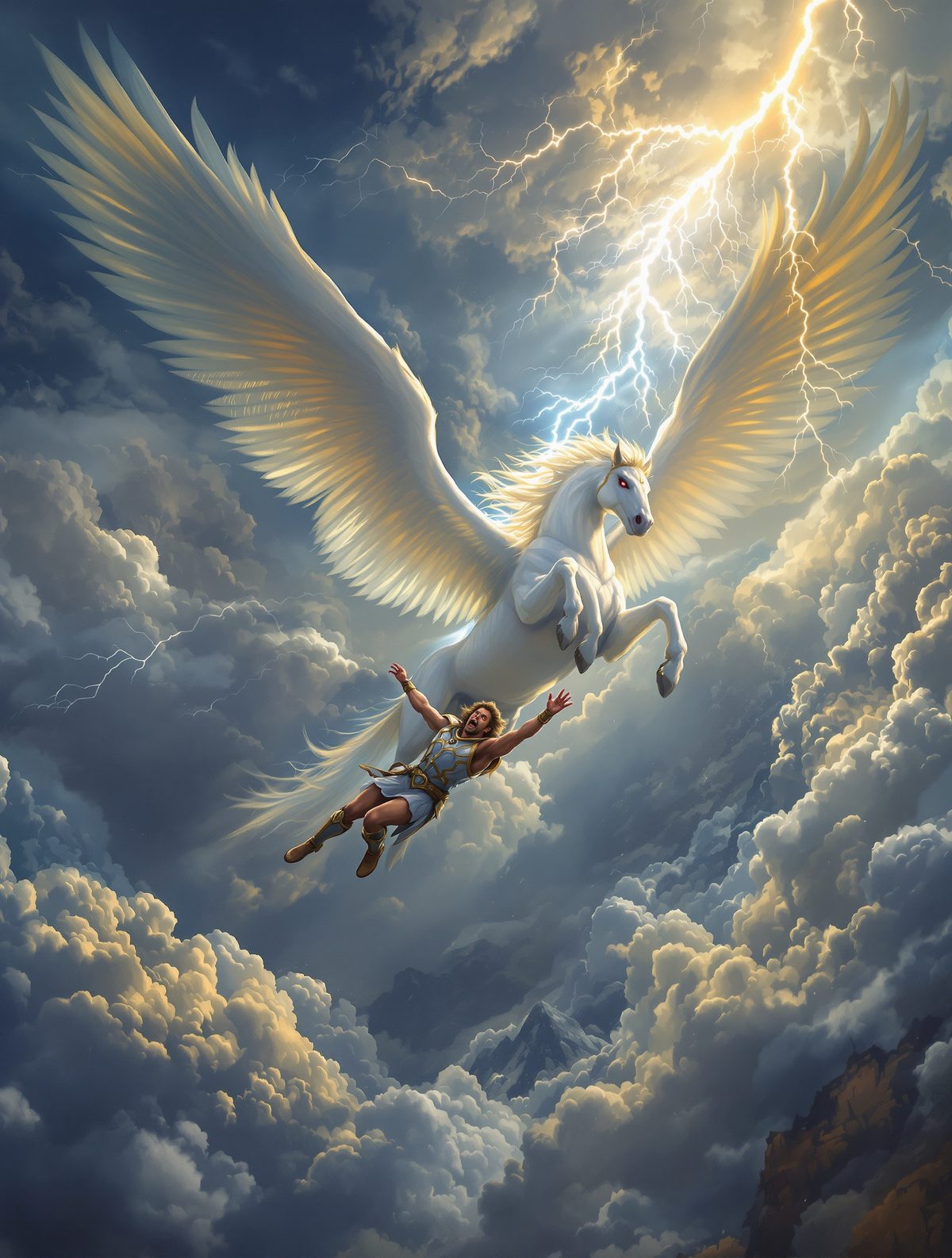
Picture this: the greatest hero of his age, mounted on a creature of pure legend, soaring through clouds that no mortal had ever touched. Below him, the entire world spreads out like a map drawn by the gods themselves. Above him, the golden gates of Olympus gleam with divine light. This is Bellerophon's moment of ultimate triumph—and the beginning of his absolute destruction.
In all the tales of hubris that echo through Greek mythology, none captures the intoxicating danger of unchecked pride quite like the story of Bellerophon and his catastrophic final flight. Here was a man who had done the impossible, conquered the unconquerable, and slain monsters that made grown warriors weep in terror. But when he dared to storm heaven itself, the gods reminded him—and us—that some boundaries should never be crossed.
The Making of a Monster Slayer
Bellerophon's path to glory began not with triumph, but with exile and disgrace. Born Prince Hipponous of Corinth, he accidentally killed his own brother during a hunting expedition—a tragedy that would haunt him and drive him to seek redemption through impossible deeds. Fleeing to the court of King Proetus in Tiryns, he unknowingly walked into a trap that would define his destiny.
The king's wife, Anteia, became obsessed with the handsome young exile. When Bellerophon rejected her advances—demonstrating the noble character that would both elevate and ultimately destroy him—she accused him of attempted assault. Furious but bound by the sacred laws of hospitality that prevented him from directly killing a guest, Proetus devised what he thought was the perfect solution: he would send Bellerophon to his father-in-law, King Iobates of Lycia, bearing a sealed letter that contained his own death warrant.
The message was simple and brutal: "The bearer of this letter has wronged me beyond forgiveness. Kill him, and avenge my honor." But Iobates, perhaps seeing something special in the young hero, chose a different path. Rather than outright murder, he would send Bellerophon on a mission so impossible that death was inevitable—he commanded him to slay the Chimera.
When Gods Intervene: The Gift of Pegasus
The Chimera was no ordinary monster. Part lion, part goat, part serpent, it breathed flames that could melt bronze armor and had claws that could tear through solid rock. It had terrorized the Lycian countryside for years, leaving nothing but ash and bone in its wake. No warrior had ever faced it and lived to tell the tale.
But Bellerophon possessed something his predecessors lacked: divine favor. The goddess Athena, perhaps moved by his plight or recognizing his potential, appeared to him in a dream. When he awoke, beside him lay a golden bridle of impossible craftsmanship—a gift that would allow him to tame the untameable.
That untameable creature was Pegasus, the magnificent winged stallion born from the blood of the Medusa when Perseus severed her head. Wild, proud, and free as the wind itself, Pegasus had never bowed to mortal will. Yet when Bellerophon approached with Athena's bridle, the great horse submitted—creating a partnership that would become the stuff of legend.
From the air, mounted on Pegasus, Bellerophon transformed from merely another doomed hero into something unprecedented: a flying warrior. The Chimera, for all its terrible power, had never faced an enemy it couldn't see. Bellerophon's spear, guided by divine blessing and launched from above, found its mark. The monster that had seemed invincible lay dead in the Lycian dust.
The Impossible Made Routine
King Iobates, rather than being pleased, was astounded and perhaps a little worried. This was not how the story was supposed to end. So he doubled down, sending Bellerophon against the Solymi, a tribe of warrior-priests who had never known defeat in battle. Once again, Pegasus gave Bellerophon the advantage of aerial combat, and once again, the impossible became routine.
Next came the Amazons—those legendary warrior women who had humbled heroes and toppled kingdoms. Their queen, Penthesilea, commanded forces that had never retreated from any battlefield. Yet against a flying warrior, their famous tactics proved useless. The Amazons fell, and with them, another supposedly insurmountable challenge crumbled before Bellerophon's might.
What's particularly fascinating—and often overlooked in retellings—is how Bellerophon's victories changed the very nature of heroism itself. Before him, heroes fought monsters on the ground, matching strength against strength, courage against terror. Bellerophon introduced a new paradigm: the hero who fought from above, who used divine gifts not just for strength or protection, but for a fundamental advantage that transcended traditional combat.
King Iobates, running out of impossible tasks, tried one final gambit. He sent his own elite guard—his strongest warriors—to ambush and kill Bellerophon outright. The hero didn't even dismount. From Pegasus's back, he called upon Poseidon, his divine ancestor, and the sea god responded by flooding the Lycian plain. As the waters rose, Iobates finally admitted defeat and not only spared Bellerophon's life but gave him his daughter in marriage and half his kingdom.
The Fatal Flight: When Success Becomes Poison
Here's where the story takes its most tragic turn, and where we encounter one of the most profound psychological insights in all of Greek mythology. Bellerophon had achieved everything a mortal hero could dream of: wealth, power, a beautiful wife, a magnificent steed, and most importantly, glory that would echo through the ages. But instead of satisfaction, his unprecedented success bred something far more dangerous—the belief that he was no longer bound by mortal limitations.
The ancient sources tell us that Bellerophon began to brood on a single, poisonous question: if he could defeat every monster the gods sent against him, if he could accomplish every impossible task, what exactly separated him from the gods themselves? Why should he remain earthbound when Olympus beckoned? After all, hadn't he earned his place among the immortals?
This wasn't mere arrogance—it was a kind of existential crisis brought on by too much success. Bellerophon had transcended every boundary placed before him, and now the ultimate boundary, the line between mortal and divine, seemed like just another challenge to overcome.
So one fateful morning, he mounted Pegasus and turned the horse's head not toward earth, but toward the heavens themselves. The winged stallion, perhaps sensing his rider's intent, hesitated. But Bellerophon, drunk on his own invincibility, spurred Pegasus upward, higher and higher, until they pierced the clouds and soared toward the golden halls of Olympus.
The Gadfly and the Fall
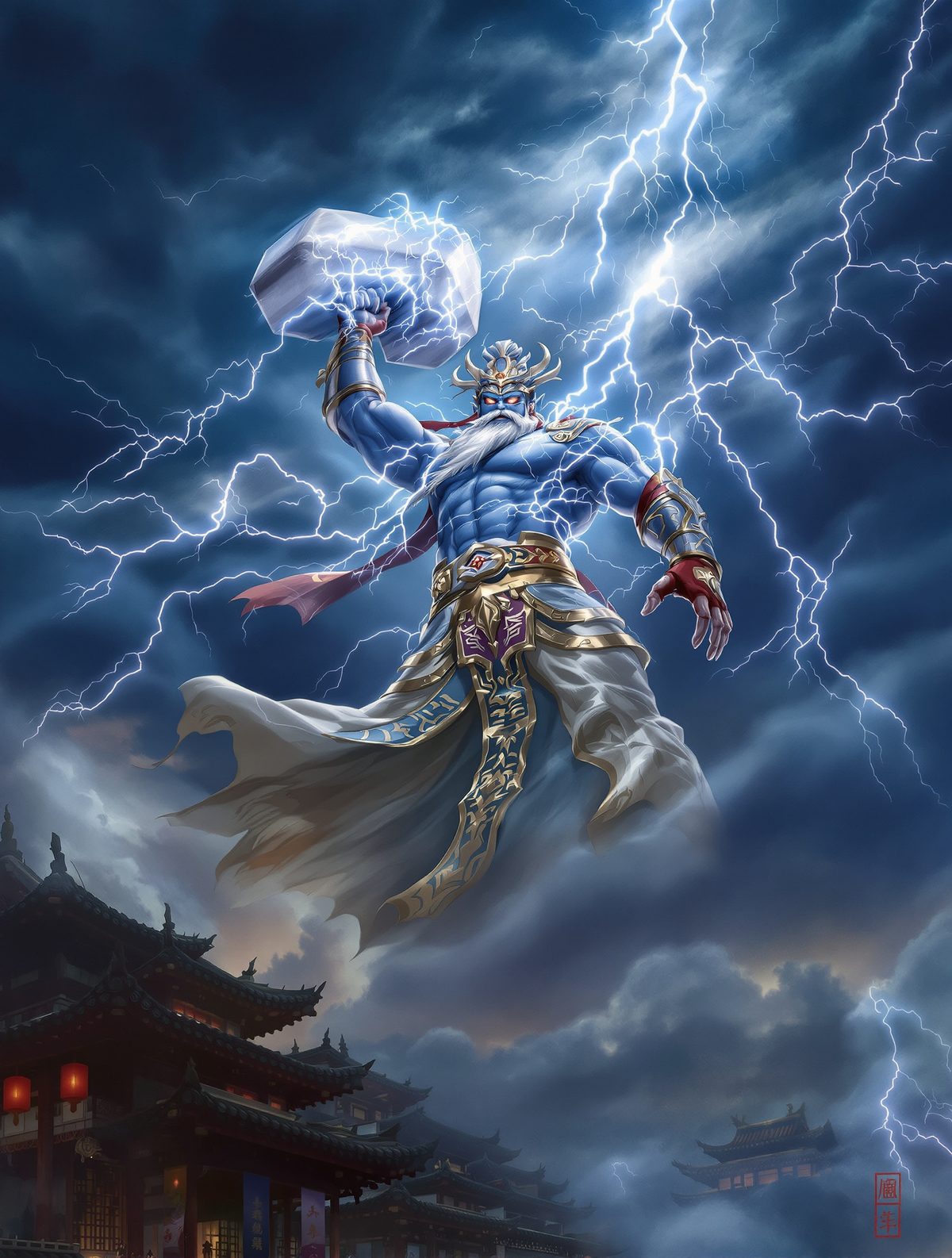
Zeus, watching from his throne, felt something that gods rarely experience: genuine surprise. The audacity was breathtaking. Here was a mortal, granted divine gifts, using those very gifts to storm heaven itself. The king of the gods could have struck Bellerophon down with a thunderbolt, could have turned him to ash in an instant. Instead, Zeus chose a response that was both more subtle and more devastating.
He sent a gadfly—a tiny, insignificant insect that most people would barely notice. But to Pegasus, already nervous about their forbidden flight, the sudden sharp sting was the final provocation. The magnificent stallion, who had never bucked beneath his master's weight, who had carried him safely through every battle, suddenly reared and twisted in the air.
Bellerophon, caught completely off-guard, lost his seat. For a moment that seemed to stretch into eternity, the greatest hero of his age fell through empty air, watching his divine companion disappear into the clouds above while the earth rushed up to meet him below.
He didn't die—that would have been too merciful. Instead, he crashed into a thorn bush that left him alive but broken, blinded in one eye, and lamed in one leg. Pegasus, meanwhile, completed the journey to Olympus alone, where he became Zeus's own mount—a final, bitter irony for the fallen hero.
The Wanderer's End
The man who returned to earth was no longer Bellerophon the hero. Broken in body and spirit, he became a wanderer, limping across the very lands where he had once triumphed. The people who had once cheered his name now whispered behind his back, some in pity, others in the cruel satisfaction that comes from watching the mighty fall.
He spent his remaining years seeking a way back to divine favor, but the gods had made their point. There would be no redemption, no final quest to restore his glory. He had crossed the one line that should never be crossed, and the punishment was not death, but the far crueler fate of living with the consequences.
What makes Bellerophon's story so enduringly powerful isn't just its drama, but its psychological accuracy. We've all seen this pattern repeated throughout history: the successful leader who begins to believe their own mythology, the entrepreneur who thinks normal rules don't apply to them, the celebrity who crashes spectacularly because they forgot their own limitations.
Bellerophon's fall reminds us that our greatest strengths, when taken to extremes, become our greatest weaknesses. His courage became recklessness, his confidence became arrogance, and his divine favor became a ladder he tried to climb all the way to heaven. The Greeks called it hubris—the pride that goes before a fall—but they understood something we often forget: sometimes it's not our failures that destroy us, but our successes.
In our modern age of social media and instant fame, when ordinary people can become global celebrities overnight, Bellerophon's story feels more relevant than ever. It's a reminder that no matter how high we soar, no matter how many impossible things we accomplish, gravity—literal or metaphorical—always wins in the end. The question isn't whether we'll fall, but whether we'll have the wisdom to know when we're flying too close to the sun.