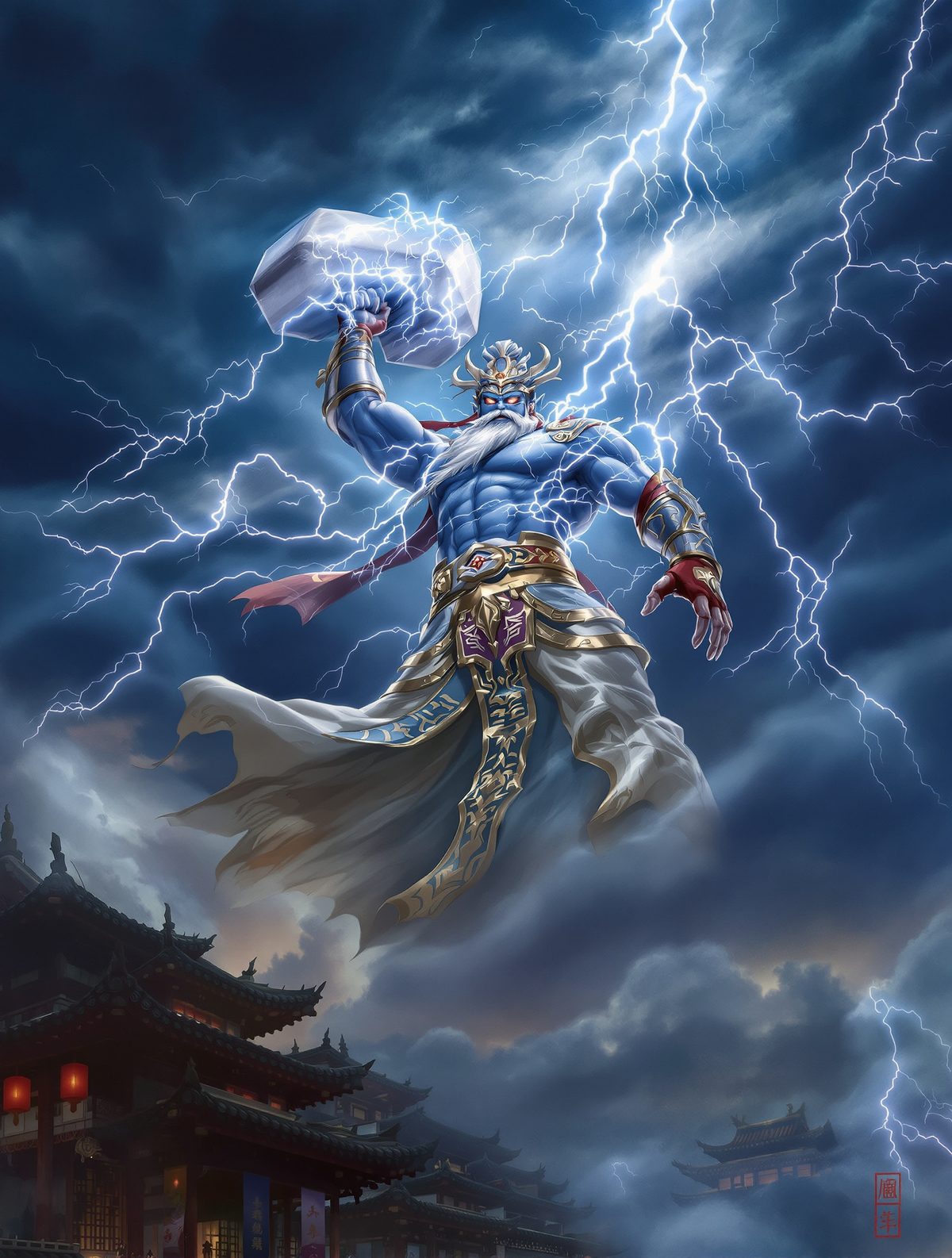
The summer storm of 1127 CE descended upon Lin'an with supernatural fury. Lightning split the sky in jagged silver veins while thunder shook the wooden houses of the Song Dynasty capital. But amid the chaos, witnesses swore they saw something impossible: a blue-skinned giant riding the storm clouds, his muscled arms wielding an enormous hammer that sparked with each swing. When dawn broke and the tempest cleared, the corrupt magistrate who had been extorting rice from starving peasants lay dead in his courtyard—struck by lightning with surgical precision while his family slept untouched mere feet away.
The people whispered that Lei Gong had come calling.
The Blue-Skinned Executioner of Heaven
Lei Gong, whose name literally means "Thunder Duke," stands as one of ancient China's most fearsome and fascinating deities. Unlike the distant, philosophical gods who governed abstract concepts, Lei Gong was immediate and personal—a cosmic enforcer who took direct action against human wickedness. Classical texts describe him as a terrifying blue-skinned giant with the face of a monkey, sporting a pair of wings and claws like an eagle. His chest was bare except for a drum suspended from his neck, and in his hands he carried the tools of divine justice: a hammer and chisel with which he could split both clouds and skulls.
But Lei Gong's appearance varied dramatically across China's vast regions. In some provinces, artists depicted him with the head of a pig, symbolizing his ability to root out corruption hidden in dark places. Tibetan influences showed him with multiple arms, each wielding a different instrument of storm and judgment. The Taoist tradition gave him a more human appearance—still blue-skinned and mighty, but recognizably divine rather than monstrous.
What remained constant was his role: Lei Gong served as Heaven's assassin, dispatched by the Jade Emperor to eliminate those whose crimes had grown too great for mortal justice to handle.
The Divine Court's Most Brutal Agent
According to the Fengshen Yanyi (Investiture of the Gods), a 16th-century novel that codified many Chinese mythological traditions, Lei Gong originally lived as a human warrior named Wen Zhong during the Shang Dynasty (1600-1046 BCE). A master of thunder magic, he wielded supernatural whips that could summon lightning and rode a black qilin—a chimeric creature resembling a dragon-scaled horse. When Wen Zhong died in battle defending his kingdom, the gods recognized his fierce loyalty to justice and elevated him to divine status as Lei Gong.
In Heaven's bureaucracy—for Chinese mythology imagined the celestial realm as the ultimate imperial court—Lei Gong served under the Ministry of Thunder, one of many departments that managed the cosmos. His immediate superior was Lei Zhenzi, the Thunder God's more merciful older brother, while the entire thunder division answered to the Jade Emperor himself. This divine chain of command meant that every lightning strike had been approved by the highest authority in the universe.
The process of divine justice was surprisingly methodical. Earthbound spirits called City Gods (Chenghuang) would monitor their assigned territories and compile reports on human behavior. These reports traveled up through layers of celestial bureaucracy until the worst offenders reached Lei Gong's desk. The Thunder Duke would then don his storm robes, summon the clouds, and descend to earth with his hammer raised.
When Lightning Strikes the Wicked
Historical records from the Tang Dynasty (618-907 CE) through the Qing Dynasty (1644-1912 CE) are filled with accounts of Lei Gong's interventions. The Taiping Guangji, a 10th-century collection of supernatural tales, records dozens of instances where corrupt officials, abusive landlords, and cruel merchants met sudden death by lightning under suspicious circumstances.
One particularly detailed account from 834 CE describes a grain merchant in Chang'an who had been selling moldy rice to refugees during a famine. On a clear autumn day, witnesses reported seeing storm clouds gather directly above his warehouse while the rest of the sky remained blue. A single bolt of lightning struck the merchant dead while leaving his terrified assistants unharmed. When authorities investigated, they discovered that the man had been mixing sawdust with rice flour and selling it at full price to desperate families.
The Song Dynasty scholar Shen Kuo (1031-1095 CE) collected over forty such cases in his scientific journal Mengxi Bitan (Dream Pool Essays). What fascinated Shen wasn't the supernatural aspect—he accepted Lei Gong's existence as fact—but rather the precision of divine lightning. In case after case, the strikes killed only the intended target while leaving innocent bystanders unharmed, even when they stood within arm's reach.
During the Ming Dynasty (1368-1644 CE), Lei Gong's reputation grew so fearsome that criminals would sometimes confess their crimes during thunderstorms, begging for mercy before the Thunder Duke could find them. Court records from Nanjing show a 300% increase in voluntary confessions during the summer monsoon season.
The Terrible Arithmetic of Divine Justice
But Lei Gong's justice operated by celestial mathematics that mortals could not always comprehend. The Yuanshi (Origin History), a Taoist text from the 12th century, explains that the Thunder Duke calculated guilt not just by immediate actions, but by the accumulated weight of a person's entire moral history. Someone might appear righteous to human eyes while carrying hidden sins that made them worthy of thunder's judgment.
This divine accounting system led to cases that seemed tragically unjust to mortal observers. The most famous involves Lady Chen, a merchant's wife from Kaifeng whose story was recorded in the 13th-century text Yijian Zhi (Record of the Listener). Lady Chen was known throughout her neighborhood for her charity and kindness, regularly feeding beggars and caring for orphaned children. When lightning struck her down during a festival in 1203 CE, the entire city was shocked.
Only later did the truth emerge: Lady Chen had been secretly poisoning her elderly mother-in-law with small doses of arsenic over many months, planning to inherit the family's silk business. Her public charity had been calculated to build an alibi of virtue. Lei Gong's hammer had seen through her deception, but to human eyes, the Thunder Duke had killed an innocent woman.
Such cases created a theological crisis. If divine justice could appear unjust to mortal understanding, how could people trust in Heaven's righteousness? Taoist and Buddhist scholars spent centuries debating this paradox, ultimately concluding that human perception was simply too limited to comprehend cosmic justice.
The Thunder Duke's Modern Echoes
Lei Gong's influence extended far beyond ancient China. When Chinese immigrants carried their traditions overseas during the 19th and 20th centuries, the Thunder Duke traveled with them. In San Francisco's Chinatown, elderly residents still warn children to behave during storms, lest Lei Gong mistake their mischief for genuine wickedness. Malaysian Chinese communities built shrines to the Thunder Duke that double as lightning rods—both spiritual and practical protection against his visits.
Even today, when lightning strikes with suspicious precision, Chinese communities around the world whisper the ancient question: Was this Lei Gong's work? In 1987, when a massive lightning bolt killed a notorious loan shark in Hong Kong while leaving his bodyguards untouched, local newspapers ran the story with barely concealed references to divine justice. Similar incidents in Taiwan, Singapore, and Vancouver have kept Lei Gong's legend alive in the modern world.
The Thunder Duke has also found new life in contemporary Chinese literature and film. The 2019 movie "Gods of Thunder" reimagined Lei Gong as a reluctant supernatural detective, using lightning strikes to solve crimes that baffle human authorities. Video games like "Legends of the Storm King" let players wield Lei Gong's hammer to battle corruption in both ancient and modern settings.
Divine Justice in an Age of Doubt
In our era of satellites and weather radar, of scientific explanations for every flash of lightning, what relevance does an ancient Thunder Duke hold? Perhaps more than we might expect. Lei Gong represents humanity's eternal hunger for perfect justice—for a universe where the wicked cannot escape consequences simply because they hold power or hide their crimes cleverly.
Every time we see corrupt officials escape prosecution, every time wealth and influence shield the guilty from accountability, we feel the absence of Lei Gong's hammer. The Thunder Duke embodied the dream that somewhere, somehow, perfect justice still exists—even if we cannot always see or understand its workings.
Whether we believe in literal divine intervention or see Lei Gong as a powerful metaphor, his legend reminds us that justice delayed is not always justice denied. Sometimes the storm clouds gather slowly, but when they finally break, the lightning finds its mark with devastating precision. In a world where human justice often fails, perhaps we still need the terrible comfort of believing that somewhere in the thunder, Lei Gong's hammer is still raised, ready to fall upon those who deserve it most.