The year was 1695. Deep in the emerald forests of what is now Ghana, a crowd of warriors, chiefs, and common people stood in hushed anticipation. Above them, storm clouds gathered despite the clear morning sky. The air crackled with an energy that made hair stand on end and set hearts racing. At the center of it all stood Okomfo Anokye, a priest whose reputation for wielding divine power had spread across the scattered Akan kingdoms like wildfire.
What happened next would forge an empire from fragments, create a symbol more powerful than any crown, and establish one of the most sophisticated civilizations in pre-colonial Africa. But first, the heavens had to split open.
The Priest Who Spoke to Gods
Okomfo Anokye wasn't just any ordinary priest. Standing nearly seven feet tall with piercing eyes that seemed to see through the veil between worlds, he served as the chief spiritual advisor to Osei Tutu, a young chief with ambitious dreams of uniting the fractured Akan peoples. The Akan had been scattered across the Gold Coast region for generations, their various clans—the Mampon, Nsuta, Bekwai, Kokofu, and others—constantly feuding and vulnerable to attacks from the powerful Denkyira kingdom that dominated the region.
Anokye possessed what the Akan called sunsum—spiritual power so potent that witnesses claimed he could make rivers flow backward, cause trees to dance, and summon rain from cloudless skies. But his greatest feat was yet to come, and it would require calling upon Nyame, the supreme sky god of Akan cosmology.
The priest understood something that would make modern nation-builders envious: symbols matter more than swords. You can conquer people with weapons, but to truly unite them, you need something that speaks to their souls.
Thunder Split the Sky
On that fateful Friday—for the Akan, Friday was sacred to the earth goddess—Anokye raised his arms toward the heavens and began to chant in the ancient language that predated written memory. The gathered crowd of thousands watched as his voice grew louder, more commanding, until it seemed to shake the very foundations of the earth.
"Nyame!" he called out. "Creator of all things! Send us the symbol that will bind these people as one!"
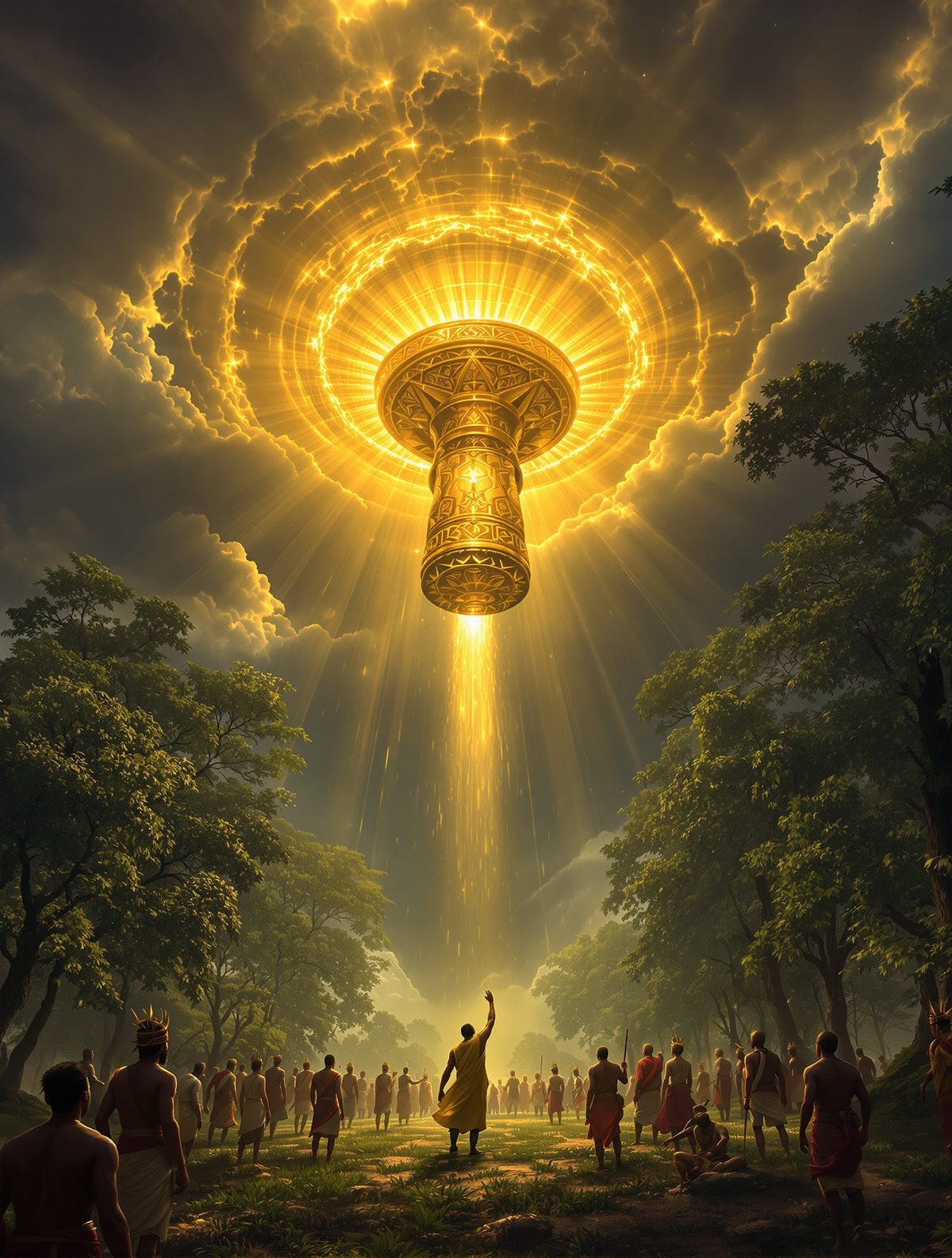
What witnesses described next sounds like something from a fantasy novel, yet it was recorded in oral traditions so detailed and consistent across multiple sources that historians treat it as historical fact wrapped in spiritual interpretation. The sky darkened to an unnatural golden hue. Lightning that gleamed like molten metal rather than silver began to dance between the clouds. Then, with a sound like divine laughter mixed with thunder, the heavens opened.
A magnificent object descended through the golden light—a three-legged stool carved from what appeared to be solid gold, its surface adorned with intricate symbols and precious ornaments. But this wasn't merely gold as the Europeans understood it. This was sika, metal that had been touched by divine hands and infused with spiritual power beyond measure.
More Than Gold—The Soul of a People
As the Golden Stool—the Sika Dwa Kofi in the Twi language—settled gently onto a specially prepared bed of sacred kente cloth, Anokye made a proclamation that would echo through the centuries: "This stool contains the soul of the Ashanti nation. So long as it remains in our hands, the Ashanti will be strong and free."
But here's what makes this story remarkable from a historical perspective: the stool didn't make Osei Tutu a king in the European sense. Instead, it made him the Asantehene—the soul's guardian. The true ruler wasn't the man but the stool itself, which contained the sunsum (collective spirit) of all Ashanti people, living and dead.
This wasn't just brilliant political theater—it was revolutionary social engineering. By declaring that the stool contained everyone's soul, Anokye had created the world's first true constitutional monarchy, where even the king was subordinate to a higher spiritual authority. The Asantehene could rule, but he could never own the source of his power.
The physical stool itself is extraordinary. Standing 18 inches high and measuring 24 inches long, it's adorned with golden bells that were said to ring out warnings when the kingdom faced danger. The surface bears symbols including the moon, stars, and various Adinkra designs that represent concepts like unity, strength, and divine protection. Most remarkably, it's designed so that it can never actually be sat upon—it rests on its own special throne, emphasizing that even the king serves the symbol rather than possessing it.
The Empire That Gold Built
The psychological effect was immediate and profound. Within months of the stool's arrival, chiefs who had fought each other for generations knelt before Osei Tutu and pledged their allegiance—not to him personally, but to the stool and what it represented. The Ashanti Empire officially came into existence on that day in 1695, and it would grow to become one of the most powerful and sophisticated states in pre-colonial Africa.
Under the divine authority of the Golden Stool, the Ashanti developed innovations that wouldn't be seen in Europe for decades. They created a complex federal system where local chiefs maintained autonomy while contributing to a central government. They established one of the world's first merit-based civil services, where positions were earned through demonstrated ability rather than inherited. They built extensive road networks, developed sophisticated metallurgy, and created a legal system so advanced that British colonial administrators would later adopt many of its principles.
The empire's military might was legendary. Ashanti armies, fighting under the spiritual protection of the Golden Stool, defeated the powerful Denkyira kingdom and expanded Ashanti control across much of present-day Ghana and parts of neighboring countries. They were so formidable that when the British finally encountered them in the 19th century, it took multiple wars and decades of effort to subdue them.
The Stool That Defied an Empire
The true test of the Golden Stool's power came during the colonial period. In 1900, British Governor Frederick Hodgson made a catastrophic cultural blunder that nearly ignited a revolution. During a meeting with Ashanti leaders, he demanded to sit on the Golden Stool, declaring that as the representative of Queen Victoria, he should possess the symbol of Ashanti authority.
The reaction was explosive. Queen Mother Yaa Asantewaa, whose fierce spirit embodied the protective power of the stool, stood up and delivered one of history's most powerful speeches about resistance and dignity. Her words sparked the War of the Golden Stool, a conflict so fierce that it took the British Empire—at its height—nearly a year and thousands of troops to suppress it.
What the British never understood was that they weren't just fighting for political control—they were battling a people defending their collective soul. The Ashanti had successfully hidden the real Golden Stool throughout the conflict, ensuring that their spiritual center remained intact even as their political independence was temporarily lost.
A Legacy Written in Gold
Today, more than three centuries after Okomfo Anokye called down divine thunder, the Golden Stool remains the most powerful symbol in Ghanaian culture. The current Asantehene, Otumfuo Osei Tutu II, still derives his authority from serving as the stool's guardian. When Ghana gained independence in 1957, the first president, Kwame Nkrumah, made a pilgrimage to pay respects to the stool, acknowledging its role as the spiritual foundation of Ghanaian identity.
The story of the Golden Stool offers profound lessons for our modern world struggling with questions of identity, authority, and unity. In an age where nations are often held together by little more than shared economic interests, the Ashanti created something far more powerful: a symbol that made millions of people feel genuinely connected to something larger than themselves.
Perhaps most remarkably, they achieved this not through conquest or coercion, but through the power of shared belief and collective purpose. The Golden Stool didn't create unity by demanding submission—it created unity by offering belonging. In our fractured modern world, that might just be the most revolutionary idea of all.