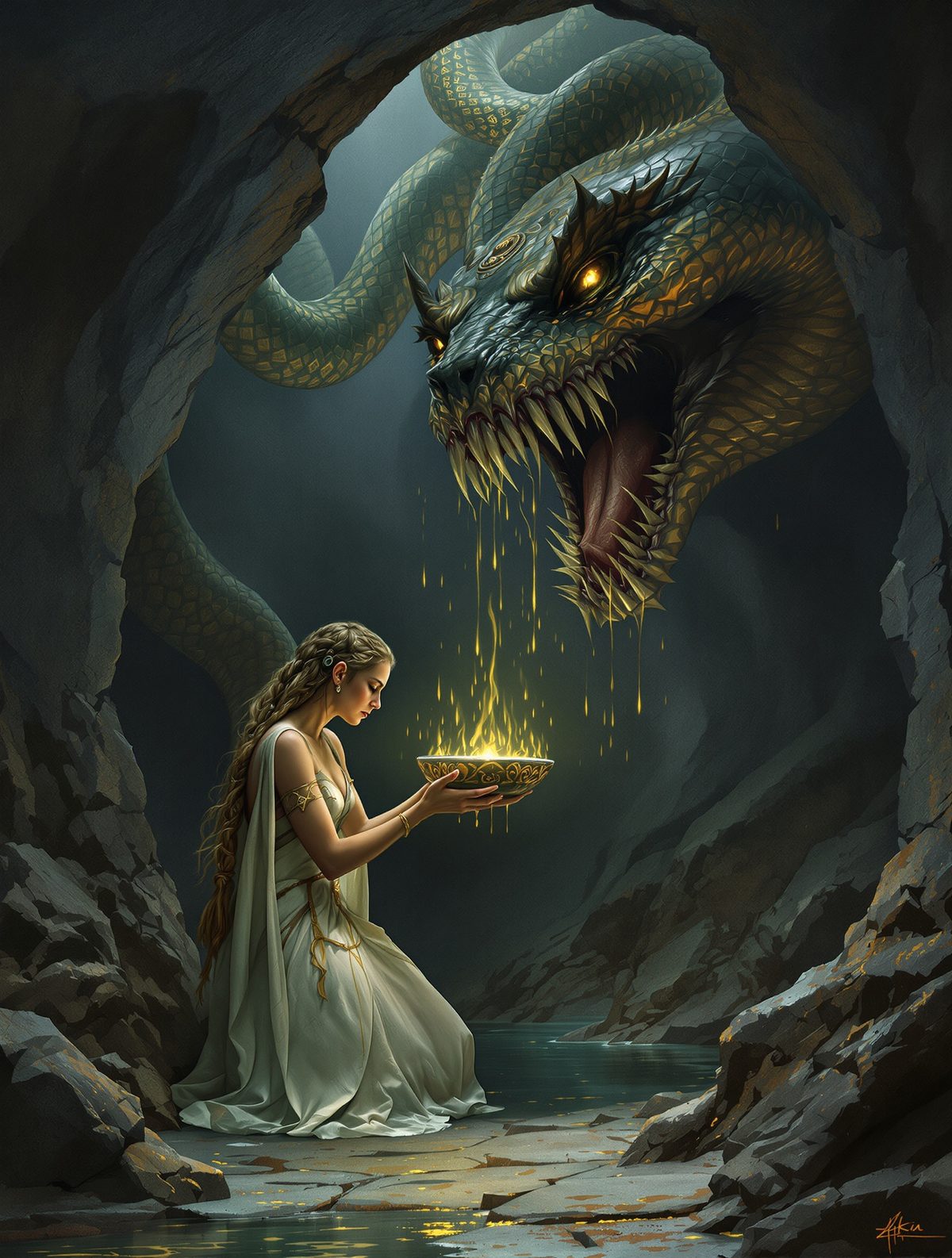

Picture this: Death himself, the cosmic force that has claimed every soul since the beginning of time, is being followed. Not by another god, not by some supernatural entity, but by a mortal woman who refuses to take "no" for an answer. For three relentless days, she walks in the footsteps of Yama, Lord of Death, her bare feet matching his divine stride across realms that no living human should ever see. This is no fairy tale—this is the story of Savitri, and it comes from the Mahabharata, the world's longest epic poem, where it's told as absolute truth.
What makes this legend extraordinary isn't just that a mortal woman challenged Death and won. It's that she did it through sheer, unrelenting devotion—and a cleverness that would make any modern negotiator weep with envy.
The Princess Who Chose Love Over Luxury
Our story begins with Princess Savitri, daughter of King Ashvapati of Madra. Unlike most royal daughters of ancient India, Savitri wasn't content to accept an arranged marriage. Her father, perhaps recognizing his daughter's formidable will, gave her unprecedented freedom: choose your own husband.
Savitri traveled across kingdoms for months, rejecting prince after prince. Then, in a forest ashram, she met Satyavan—the son of a blind, exiled king named Dyumatsena. Satyavan had everything Savitri wanted: nobility of character, wisdom, and a heart that matched her own. There was just one problem that would have sent any sensible person running: the sage Narada informed her that Satyavan was destined to die within exactly one year.
Here's where the story takes its first fascinating turn. Most ancient tales would have the heroine either flee this fate or remain ignorant of it. But Savitri, with full knowledge of what awaited her, chose love anyway. "I have chosen once," she declared, "and I will not choose again." She married Satyavan and moved to the forest, trading her silks for rough bark cloth, her palace for a simple hut.
The Day Death Came Calling
Savitri knew the exact day her husband would die, and as it approached, she began a three-day fast so intense it worried even her father-in-law. On the fateful morning, she insisted on accompanying Satyavan as he went to gather wood—something she had never done before.
The moment arrived with terrifying mundanity. Satyavan was cutting wood when he suddenly complained of a headache and lay down under a banyan tree, resting his head in Savitri's lap. As she stroked his hair, she saw him—Yama, Lord of Death, approaching in his true form. Ancient texts describe him as dark as storm clouds, wearing red garments, with eyes like burning coals, carrying the noose that binds souls.
Here's a detail most people don't know: Yama typically sends his messengers, the Yamadutas, to collect souls. But he came personally for Satyavan out of respect for Savitri's devotion, which he had been observing throughout the year. Even Death, it seems, was curious about this remarkable woman.
Yama bound Satyavan's soul—described as thumb-sized and radiant—and began his journey toward the realm of the dead. That's when Savitri did the unthinkable: she stood up and followed.
The Journey No Mortal Should Make
What happened next defies every cosmic law. Savitri, still in her mortal body, began walking behind Death himself through realms that existed beyond physical reality. The ancient texts are remarkably specific about this journey: it lasted three days and nights, covering impossible distances across planes of existence.
Initially, Yama tried to dissuade her gently. "Return, Savitri. Your duties to your husband are complete. Go perform his funeral rites." But Savitri had a response that reveals the sophisticated philosophy underlying this story: "Where my husband goes, I must go. This is eternal dharma. Through devotion, austerity, and truth, I have earned the right to follow."
Here's where the story becomes a masterclass in ancient Indian philosophy. Yama, impressed by her words, granted her a boon—any wish except her husband's life. Savitri immediately asked for her father-in-law's sight and kingdom to be restored. Granted, said Yama, assuming this would satisfy her. But Savitri kept walking.
This pattern repeated. Yama offered blessing after blessing: prosperity for her father's lineage, long life for her parents, fame that would last through the ages. Each time, Savitri accepted gracefully—then kept following. For three days, the cosmic order itself was held hostage by one woman's refusal to give up.
The Negotiation That Defeated Death
On the third day, Yama's respect had transformed into something approaching awe. "I am pleased with your devotion," he said. "Ask for one final boon—anything except Satyavan's life." This is when Savitri revealed the brilliant trap she had been laying for three days.
"Grant me a hundred sons through Satyavan," she requested.
The text describes Yama pausing—perhaps the only time in cosmic history when Death hesitated. Savitri had created a logical paradox that would make any philosophy professor proud. As a virtuous wife, she could not have children with any man other than her husband. But if Satyavan remained dead, the boon was impossible. If Yama wanted to grant her wish—and having praised her virtue, he was bound to—he had no choice but to restore Satyavan's life.
Even more fascinating is Yama's reaction. Rather than being angry at being outmaneuvered, he laughed with genuine delight. "Clever Savitri," he said, "you have won through wit what force could never achieve." He restored Satyavan's life and even threw in additional blessings: long life for the couple, the restoration of Dyumatsena's kingdom, and yes, those hundred sons she'd requested.
The Return of the Impossible
When Satyavan awakened under the banyan tree, he had no memory of death—to him, it was as if he'd simply taken a nap. But Savitri had been gone for three days, walking through realms beyond mortal comprehension, negotiating with Death himself.
The reunited couple returned home to find messengers arriving with incredible news: Dyumatsena's sight had been restored, and the usurper of his kingdom had died, clearing the way for his return to the throne. Every boon Savitri had won was already manifesting in the physical world.
But perhaps the most remarkable detail is this: the story doesn't end with "and they lived happily ever after." Instead, it matter-of-factly states that Savitri and Satyavan lived for four hundred years and had exactly one hundred sons, just as promised. In the world of the Mahabharata, this isn't presented as metaphor—it's recorded as history.
Why Death Surrendered to Love
Modern readers might wonder: why would the cosmic principle of death yield to one woman's devotion? The answer reveals something profound about ancient Indian philosophy. Savitri didn't defeat death through supernatural power—she defeated it through dharma, righteous duty taken to its absolute extreme.
In Hindu philosophy, dharma isn't just about following rules—it's about maintaining cosmic balance. Savitri's devotion was so perfect, so complete, that it created a force even Death couldn't oppose. She had transcended ordinary mortality not through magic, but through the sheer intensity of her virtue.
Today, in an age where we often view love as mere emotion, Savitri's story offers a different perspective: love as cosmic force, devotion as a power that can reshape reality itself. Whether taken as literal truth or profound metaphor, her legend asks us a challenging question: In a world that constantly tells us to be practical, to accept limitations, to "move on," what might we achieve if we simply refused to give up on what matters most?
Perhaps that's why, thousands of years later, Savitri's story still has the power to make us believe that sometimes—just sometimes—love really can conquer death.