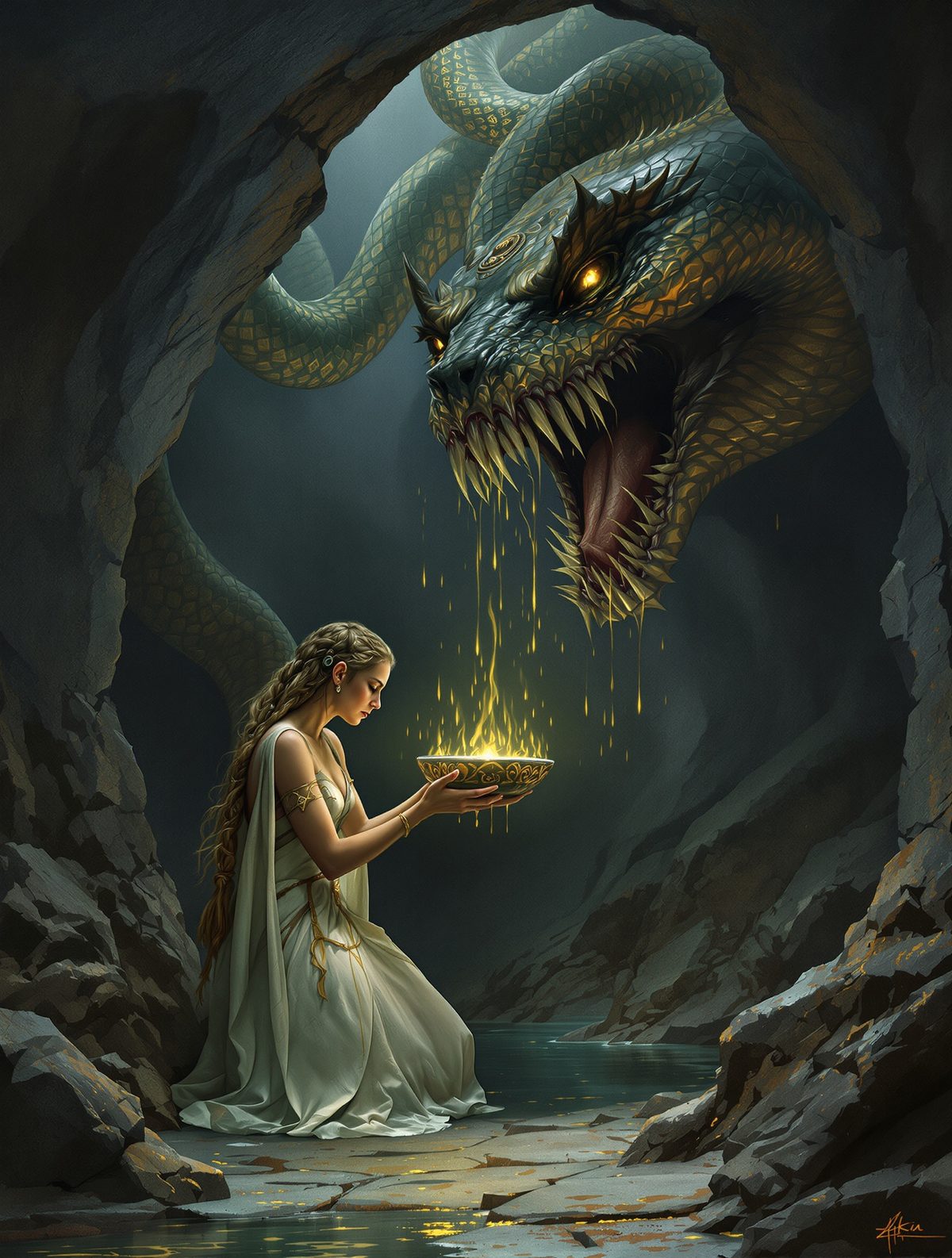
Deep beneath the roots of Yggdrasil, in a cave that knows neither dawn nor dusk, a woman sits in darkness. Her arms ache from centuries of holding them above her head. Her hands grip a wooden bowl, catching drops of venom that fall like liquid fire from the fangs of a serpent suspended above her husband's tortured face. This is Sigyn, and she has not moved from this spot for over a thousand years.
When the bowl grows heavy with poison, she must turn away to empty it. In those few seconds, the venom strikes Loki's flesh, and his screams of agony reverberate through the nine realms. The earth trembles. Mortals above feel what they call earthquakes, never knowing they're feeling the convulsions of a god in torment.
The Crime That Shook Asgard
To understand Sigyn's vigil, we must first understand the crime that led to this eternal punishment. The year was mythologically reckoned as sometime before Ragnarök, when the god Baldr—beloved by all—began having prophetic dreams of his own death. His mother Frigg traveled across the nine realms, extracting oaths from every creature, plant, and object never to harm her son. She missed only one thing: mistletoe, deeming it too young and harmless to pose a threat.
Loki, the shape-shifting god of mischief, discovered this oversight. At a feast where the gods amused themselves by hurling weapons at the now-invulnerable Baldr, Loki fashioned a dart from mistletoe. He placed it in the hands of Baldr's blind brother Höðr, guiding his aim. The dart pierced Baldr's heart, and the brightest of the gods fell dead.
But even this wasn't Loki's gravest sin in the gods' eyes. When they attempted to retrieve Baldr from Hel's realm, the goddess of death agreed to release him—but only if every being in all the realms wept for him. All did, save one: an old giantess named Þökk, who refused to shed a tear. Þökk was Loki in disguise. With his refusal to weep, Loki sealed Baldr's fate forever.
The Binding of the Trickster
The gods' patience with Loki's schemes had finally reached its limit. At a feast in Ægir's hall, Loki arrived uninvited and launched into a vicious verbal assault, revealing the gods' secrets and shames in what scholars now call the Lokasenna—Loki's flyting or verbal duel. When Thor arrived with hammer in hand, Loki fled.
The gods pursued him relentlessly. Loki transformed into a salmon and hid in a waterfall, but the gods captured him with a net—ironically, one Loki had invented himself while hiding in a fisherman's hut. They dragged him to a cave deep underground, where they prepared a punishment that would make even the cruelest medieval torturer blanch.
The gods took Loki's own son, Narfi, and transformed his brother Váli into a wolf. In his feral state, Váli tore his brother apart. The gods then used Narfi's entrails—still warm with life—to bind Loki to three sharp stones. The goddess Skaði, seeking revenge for her father's death at the hands of the gods, hung a venomous serpent above Loki's face. Its fangs dripped poison that would burn through stone, let alone flesh.
The Faithful Wife Who Stayed
Here's where the story takes an unexpected turn. While every other god abandoned Loki to his fate, one figure remained: Sigyn, his wife, whose name means "victorious girlfriend." In some accounts, she was his second wife, after the giantess Angrboda who bore him three monstrous children: Fenrir the wolf, Jörmungandr the world serpent, and Hel, goddess of death.
What makes Sigyn's loyalty even more remarkable is that she wasn't bound by the gods' punishment—she chose this fate freely. She could have walked away, returned to Asgard, and lived in comfort among the gods. Instead, she took her place beside her husband's bound form and began her eternal vigil.
Archaeological evidence from the Viking Age (793-1066 CE) shows that Sigyn's devotion resonated powerfully with Norse society. Runic inscriptions from Sweden dating to the 11th century invoke her name in marriage blessings, asking that wives might show "Sigyn's steadfastness." Wedding rings from the period have been found inscribed with her name, suggesting she became a patron goddess of marital fidelity.
The Physics of Divine Torment
The Norse sources provide surprisingly specific details about this torture. The Prose Edda, written by Snorri Sturluson around 1220 CE, describes the serpent's venom as so potent it would eat through stone. Modern scholars have noted the sophistication of this torture device—it's not meant to kill, but to ensure eternal suffering.
When Sigyn holds her bowl steady, Loki experiences relief. But the torture's genius lies in its inevitability: the bowl must be emptied. No container could hold an eternity's worth of venom. Those moments when Sigyn turns away—perhaps lasting only seconds—stretch into infinities of agony for Loki.
The earthquake connection is particularly fascinating. Medieval Scandinavian texts consistently link seismic activity to Loki's torment. The 13th-century Gylfaginning states that he "writhes so violently in his anguish that the whole earth shakes—these are what you call earthquakes." Remarkably, this predates modern understanding of tectonic activity by centuries, yet provides a mythological framework that treats earthquakes as regular, natural phenomena rather than random divine anger.
A Marriage Forged in Unimaginable Circumstances
What transforms this story from mere mythology into something profoundly human is its exploration of love under impossible conditions. Sigyn doesn't just stay with Loki—she actively participates in reducing his suffering, knowing that her brief absences cause him agony.
Some lesser-known sources suggest Sigyn occasionally speaks to Loki during their underground imprisonment. The 14th-century Flateyjarbók contains fragments suggesting she tells him stories, sings songs, or simply whispers words of comfort. Imagine the intimacy of these conversations: a marriage conducted entirely in whispers in the darkness, where the only respite from pain comes from a wooden bowl and unwavering love.
The torment isn't just physical—it's psychological. Loki, the god who could talk his way out of any situation, who could transform into any shape, is rendered completely helpless. His silver tongue can only scream. His shapeshifting powers are useless against bonds made from his own son's entrails. Only Sigyn's presence stands between him and complete despair.
The Vigil That Outlasted Empires
This punishment was designed to last until Ragnarök—the end of the world. While the gods feast in Valhalla and humans live their brief lives above, Sigyn maintains her impossible vigil. She has held that bowl longer than Rome ruled its empire, longer than any human civilization has existed, longer than our species has practiced agriculture.
The story raises profound questions about justice, loyalty, and love. Was Loki's punishment proportionate to his crimes? Should Sigyn have stayed, or does her loyalty enable a criminal? These questions don't have easy answers, which is precisely why this myth has endured.
In our age of disposable relationships and conditional love, Sigyn's endless vigil offers something both beautiful and troubling: a vision of love that transcends justice, reason, and self-preservation. She represents the terrifying devotion of someone who chooses love over comfort, loyalty over social acceptance, presence over safety.
When the bowl fills and she must turn away, when Loki's screams shake the earth and we feel the tremors above, we're witnessing not just divine punishment, but the physics of unconditional love: sometimes, even our best efforts to protect those we love still leave them vulnerable to pain. Sometimes, fidelity itself becomes a form of torment. And sometimes, the most profound act of love is simply staying present in the darkness, bowl in hand, ready to catch whatever falls.