In the mists of ancient Ireland, where myth bleeds into memory, there once lived a king whose very gaze could end worlds. Balor of the Poisonous Eye ruled the chaotic Fomorians with an eyelid so massive that four warriors were required to lift it—and when they did, everything his eye fell upon withered and died. Yet on the blood-soaked plains of Magh Tuireadh, this terrible weapon would become his undoing when prophecy twisted the threads of fate, and grandfather faced grandson in the ultimate confrontation between order and chaos.
This is the story they don't teach in school—the legend of how death itself learned to die.
The King of the Poisonous Gaze
Balor wasn't born a monster. The ancient Irish texts tell us he was once merely a prince of the Fomorians, those primordial beings who represented the wild, untamed forces of nature—storms, earthquakes, and the churning chaos of the sea. But curiosity, as it so often does, transformed him into something far more terrible.
As a young man, Balor spied upon his father's druids as they prepared a powerful spell. The toxic vapors rising from their cauldron seeped into his eye, transforming it into an instrument of instant death. From that moment forward, he could never open his eye without bringing destruction. The lid grew heavy as a boulder, requiring four strong men with ropes and pulleys to lift it in battle.
What makes this legend particularly fascinating is how it reflects ancient Celtic beliefs about the evil eye—a concept that appears in cultures worldwide but held special significance in Ireland. Unlike the Mediterranean version, which brought bad luck, the Irish evil eye was literally lethal. Archaeological evidence from sites like Newgrange shows eye symbols carved into stone, suggesting these weren't just stories but deeply held spiritual beliefs about the power of sight itself.
Balor ruled from his fortress on Tory Island, off the coast of Donegal. Even today, locals call certain jagged rocks "Balor's Throne," and fishermen speak of strange mists that rise from the waters on calm days—as if the old king's poisonous breath still lingers.
The Prophecy That Changed Everything
Power breeds paranoia, and Balor's grew when druids delivered a prophecy that would haunt him: his own grandson would be the instrument of his death. The king's response was swift and brutal—he locked his only daughter, Ethniu, in a crystal tower on Tory Island, guarded by twelve women with orders to kill any man who approached.
But prophecy, as any student of mythology knows, has a way of fulfilling itself through the very attempts to prevent it. Balor's greed led him to steal a magical cow from the mainland—a cow that belonged to a craftsman named Cian. Determined to reclaim his property, Cian disguised himself as a woman and infiltrated the tower. There he met Ethniu, and their union produced not one child, but triplets.
When Balor discovered the births, he ordered the infants drowned. Two were lost to the waves, but the third—a boy named Lugh—was saved by the sea god Manannán mac Lir and raised in secret. Here's where the story becomes even more intriguing: ancient Irish genealogies suggest Lugh wasn't just a mythical figure but may have been based on a historical Celtic deity whose worship spread from Ireland to Gaul, where the city of Lyon (Lugdunum, "fortress of Lugh") bears his name.
Lugh grew up to become Samildánach—the "Equally Skilled in All Arts." He was simultaneously a warrior, poet, craftsman, and king. While Balor represented destructive chaos, Lugh embodied creative order. The stage was set for a confrontation that would determine the fate of Ireland itself.
The Second Battle of Magh Tuireadh
The showdown came at the Second Battle of Magh Tuireadh (modern-day Moytura in County Mayo), fought sometime in the mythical period before recorded Irish history began. This wasn't just another tribal skirmish—it was cosmic warfare between two completely different ways of being.
On one side stood the Tuatha Dé Danann, the "People of the Goddess Danu," representing civilization, order, and the productive arts. On the other were the Fomorians under Balor, embodying the raw, destructive forces of nature that could either nurture or annihilate.
The battle raged across the boggy plains of Connacht. Ancient texts describe supernatural warriors wielding magical weapons: spears that never missed their mark, swords that cut through any armor, cauldrons that could resurrect the dead overnight. But none of these mattered when Balor entered the fray.
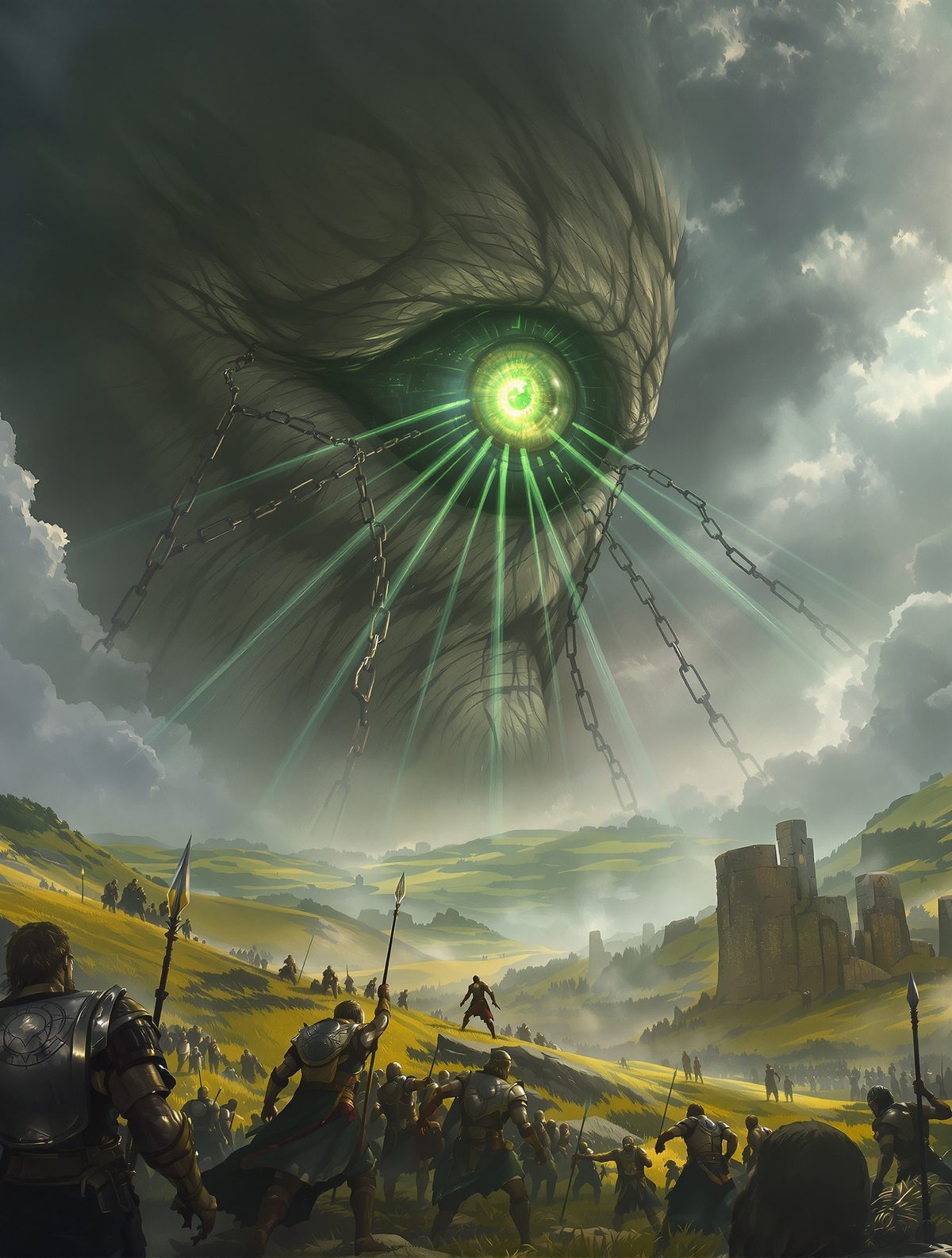
As his four attendants strained to lift his massive eyelid, panic spread through the ranks of the Tuatha Dé Danann. Warriors who had never known fear began to flee. The very ground withered where his gaze fell, and the sky darkened as if the sun itself recoiled in terror. Victory seemed certain for the Fomorians.
Then Lugh stepped forward.
When Death Met Its Match
What happened next defies easy categorization—it's part family tragedy, part cosmic reset, part philosophical statement about the nature of power itself. Lugh didn't charge with sword or spear. Instead, he reached for his sling, the same simple weapon that would later make another giant-killer famous in Hebrew tradition.
The parallels aren't coincidental. Both stories tap into the universal human fascination with the idea that humble tools, guided by righteousness, can overcome seemingly invincible evil. But there's a crucial difference: David fought a stranger. Lugh was about to kill his grandfather.
As Balor's eye opened fully, its deadly gaze sweeping the battlefield like a lighthouse of doom, Lugh took careful aim. The stone he launched wasn't just any projectile—some versions of the legend claim it was a tathlum, a mystical sling-stone made from the brains of fallen enemies mixed with lime, a weapon that appears in several Irish myths as particularly effective against supernatural foes.
The stone struck Balor's eye with such force that it drove the orb clean through the back of his skull. But here's the detail that makes this legend truly memorable: the eye remained open as it exited Balor's head, and its deadly gaze fell upon his own army. In an instant, the Fomorian ranks were decimated by their own king's dying weapon.
It was poetic justice of the highest order—the instrument of Balor's power became the agent of his destruction and that of his forces.
The Archaeological Echoes
Modern archaeology has revealed fascinating connections to these ancient stories. Excavations at the Hill of Tara and other sacred sites have uncovered evidence of massive ceremonial complexes dating to the Bronze Age—exactly the period when these legends claim the Tuatha Dé Danann ruled Ireland.
Even more intriguing are the weapons. Bronze Age slings weren't the simple toys we might imagine. Archaeological experiments have shown that a skilled slinger could launch stones with the force of a modern bullet, effective at ranges up to 400 meters. Lead sling-bullets found at Celtic battle sites often bore inscriptions—some containing curses against enemies, transforming humble stones into weapons both physical and spiritual.
The Battle of Magh Tuireadh itself may preserve folk memories of real conflicts between different waves of settlers in prehistoric Ireland. The contrast between the civilization-building Tuatha Dé Danann and the chaos-bringing Fomorians mirrors what archaeologists see in the transition from hunter-gatherer to agricultural societies—a process that wasn't always peaceful.
The Eye That Still Watches
Why does this ancient story still matter? Because it speaks to something deeper than mythology—it's about the price of power and the inevitability of change. Balor's eye represents the ultimate weapon, the power to destroy at will. Yet this very power becomes his weakness, requiring attendants to operate, limiting his mobility, and ultimately providing his grandson with a target.
In our age of weapons that can end civilization, the legend of Balor offers a sobering reminder: the most terrible powers often carry within them the seeds of their own destruction. Like nuclear arsenals that protect and threaten simultaneously, Balor's eye was both his greatest strength and his fatal vulnerability.
The story also explores the tragic theme of family conflict escalated to cosmic proportions. Grandfather and grandson, separated by prophecy and paranoia, meet in battle not as kin but as representatives of opposing forces. It's a theme that resonates through history—from the Greek Titans to Star Wars—because it captures something essential about how progress often requires the old order to give way to the new, sometimes violently.
Today, visitors to Tory Island can still see the rocks they call Balor's Fort, where locals claim you can hear the wind whistling differently than anywhere else—as if the old king's breath still haunts his ancient stronghold. Whether you believe in the literal truth of such legends matters less than recognizing their deeper truths: that power without wisdom becomes self-destructive, that prophecies often fulfill themselves through our attempts to avoid them, and that even the most terrible evils contain within themselves the possibility of their own redemption.
In the end, Balor's eye closes forever, but what it witnessed—the eternal struggle between chaos and order, the price of unchecked power, and the bittersweet necessity of change—continues to watch us still.