Picture this: two villages that had lived in perfect harmony for over three centuries, their children playing together in the fields that bordered their lands, their elders sharing wisdom across imaginary lines. Then, in a single afternoon, they were ready to spill blood over the color of a hat. This wasn't madness—this was divine intervention of the most cunning kind.
In the heart of what we now call southwestern Nigeria, sometime during the height of the great Yoruba kingdoms between the 12th and 15th centuries, the trickster god Eshu decided to conduct one of his most famous experiments in human nature. What happened next would echo through African storytelling for generations, carrying a truth so profound that griots still whisper it around flickering fires today.
The Threshold Between Worlds
Eshu wasn't your typical deity. While other orishas (divine spirits in Yoruba religion) governed obvious domains like thunder, rivers, or harvests, Eshu ruled the spaces between things. Crossroads. Doorways. The moment between sleeping and waking. The pause between question and answer. In Yoruba cosmology, these liminal spaces held immense power—and immense danger.
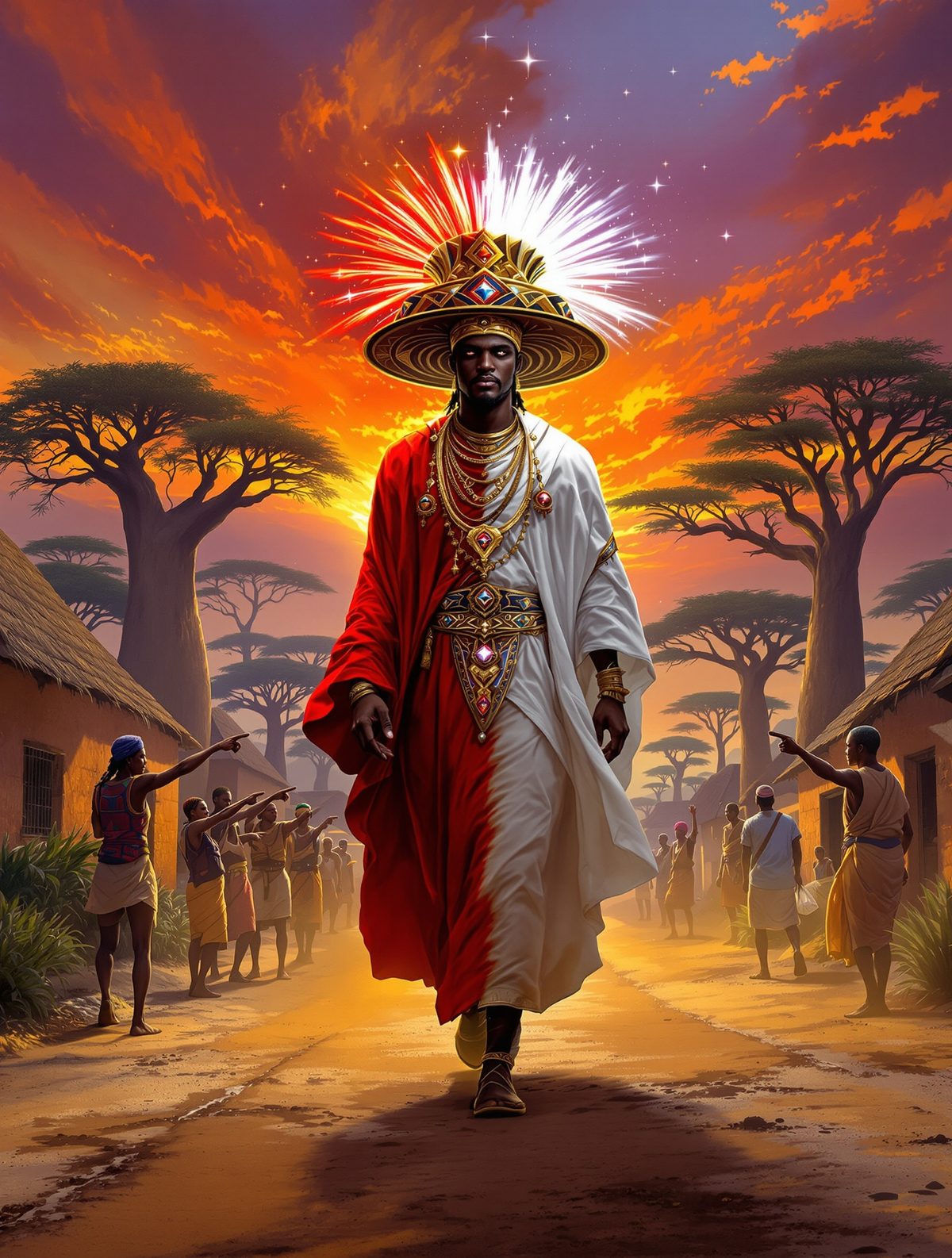
Standing barely four feet tall but radiating an presence that could fill a valley, Eshu was known for his mischievous grin and his collection of extraordinary garments. His most prized possession was a hat that defied the very nature of reality itself. Woven from the dreams of opposing forces, one half blazed crimson like the setting sun over the savanna, while the other gleamed white as polished ivory. But here's what the textbooks never tell you: this wasn't simply a hat with two colors. According to oral traditions preserved by the Ifa priests of Ile-Ife, the hat existed in a state of perpetual contradiction—each side was simultaneously the "true" color, depending on the observer's position in both physical and spiritual space.
The two villages in our story—let's call them by their ancient names, Agbara-Odo (Village of the Riverside Power) and Agbara-Oke (Village of the Mountain Power)—had maintained peaceful relations for exactly 347 years, according to the praise songs still sung in modern Yorubaland. Their boundary wasn't marked by walls or fences, but by a simple dirt path where children from both communities would meet to trade palm nuts and stories.
The Divine Masquerade Begins
On the day that would fracture their peace, Eshu disguised himself as an elderly traveler. He waited until the sun reached its zenith—that moment when shadows disappear and perspective becomes tricky—then began his slow, deliberate walk along the border path. But this wasn't a casual stroll. Eshu moved with the precision of a master choreographer, ensuring that villagers from Agbara-Odo could see only the white side of his hat, while those from Agbara-Oke witnessed only the blazing red.
The first to notice was Folake, a young mother drawing water from the border well. She called out to her neighbor across the path, "Sister Bimpe, do you see that strange old man with the beautiful white hat?" Bimpe, tending her garden on the Agbara-Oke side, looked up in confusion. "White hat? Sister, your eyes must be tired from the sun. That man wears the finest red hat I've ever seen—bright as fresh blood!"
What happened next reveals something fascinating about human psychology. Instead of walking around to see the hat from different angles—a journey of perhaps twenty steps—both women became immediately defensive of their own perception. This wasn't unusual. In traditional Yoruba culture, one's ability to accurately perceive and interpret signs was directly connected to their spiritual authority and social standing. To admit error in observation could mean losing face in a way that might affect everything from marriage prospects to trade relationships.
When Truth Becomes War
Word spread through both villages with the speed of wildfire. Within hours, crowds had gathered on each side of the border path, all staring at Eshu's slowly retreating figure. The debates grew heated. Elders who had never raised their voices to each other were suddenly shouting across the path. Children who had played together that very morning found themselves on opposite sides of an impossible divide.
By evening, both villages had held emergency assemblies. In Agbara-Odo, the council declared that their neighbors had either been cursed with blindness or were deliberately spreading lies. The people of Agbara-Oke reached similar conclusions about their former friends. What's particularly tragic is that both communities were acting from identical motivations: a sincere desire to defend truth and maintain their integrity.
Here's a detail that sends chills down your spine: according to the preserved oral histories, some villagers actually did try to walk to the other side to verify what they were seeing. But Eshu's divine magic was too powerful. The moment they crossed the boundary, they saw exactly what the other village saw—but their memories of the original color remained vivid and unchanged. This only convinced each side that the other village was practicing some form of malevolent sorcery.
Within three days, both communities were sharpening spears and fortifying their borders. These weren't warrior peoples—they were farmers, artisans, and traders whose greatest previous conflict had been a disagreement over water rights that was resolved with a shared feast. Yet here they stood, ready to destroy centuries of friendship over the color of a hat that no longer even existed in their sight.
The Revelation at Dawn
Just as the first warriors began to advance toward the border path, Eshu reappeared. But this time, he materialized in full divine glory at the exact center of the boundary, visible to both sides simultaneously. The air itself seemed to shimmer around his small form, and when he spoke, his voice carried the weight of cosmic authority.
"Foolish children," he said, slowly removing his hat and holding it high. "You would spill blood over this?" As both villages watched in stunned silence, Eshu began to turn the hat in his hands. The impossible truth revealed itself: red flowing into white, white melting back into red, both colors existing fully and authentically depending on the angle of observation.
"You have both spoken truth," Eshu continued. "And you have both been blind. In your certainty, you forgot the most fundamental wisdom: that truth is often larger than what any one perspective can contain."
The god then delivered what would become one of the most quoted teachings in Yoruba philosophy: "He who knows only his own side of a matter knows little of that. When you see only red, seek out the white. When you see only white, search for the red. Only then will you begin to see the hat as it truly is."
The Deeper Game
But here's where the story becomes even more fascinating. As Eshu prepared to depart, one brave elder from Agbara-Odo called out: "Great Eshu, why did you do this to us? We were peaceful people." The god's response reveals the profound wisdom hidden within his apparent mischief: "I did nothing to you that you did not do to yourselves. I merely wore a hat and walked a path. Everything else—the anger, the accusations, the preparing for war—that was your choice."
This wasn't cruelty; it was divine education. Eshu had diagnosed a dangerous weakness in both communities: their inability to hold multiple truths simultaneously, their quickness to assume malicious intent in others, and their willingness to choose conflict over curiosity. By creating an impossible situation, he forced them to confront these flaws before they could cause real damage.
The aftermath was remarkable. Both villages not only reconciled but established new traditions based on Eshu's lesson. They created a annual festival called the "Festival of Two Truths," where community members would deliberately take opposing positions on various matters and then work together to find the larger truth that contained both perspectives. Archaeological evidence from sites in modern-day Ogun State suggests these festivals continued for centuries, influencing diplomatic practices throughout the Yoruba kingdoms.
The Hat We Still Wear Today
In our hyperconnected age of social media echo chambers and tribal politics, Eshu's lesson feels more urgent than ever. Every day, we encounter our own versions of his two-colored hat: complex issues viewed from different angles, producing genuinely different—and genuinely true—perspectives. Like those villagers, we often choose certainty over curiosity, defending our viewpoint rather than expanding our vision.
The genius of this ancient story lies not just in its warning about the dangers of perspective, but in its deeper insight about the nature of truth itself. Eshu wasn't teaching relativism—the idea that all perspectives are equally valid. Instead, he was demonstrating that reality is often richer and more complex than our individual viewpoints can capture. The hat really was both red and white. Both villages were right. And both were incomplete.
Perhaps most remarkably, this tale suggests that our disagreements might not always be the problem we think they are. Sometimes, they're invitations—divine tests asking us whether we're brave enough to walk around to the other side, curious enough to seek the larger truth, and humble enough to admit that our perspective, however genuine, might be only part of the story.
The next time you find yourself absolutely certain that someone else is absolutely wrong, remember Eshu's hat. Remember two peaceful villages on the edge of war. And remember that somewhere between your red and their white, there might be a truth beautiful enough to end the fighting and wise enough to change the world.