Picture this: before time began, before the first star ignited, before matter itself existed, there was only the vast cosmic ocean of nothingness—the primordial waters that Hindu sages called the Garbhodaka. In this infinite void, floating serenely on the coils of a thousand-headed serpent, lay a figure whose very breath would birth universes. This was Vishnu, the great preserver, locked in the cosmic sleep known as Yoga Nidra—a slumber so profound that galaxies would be born from his dreams.
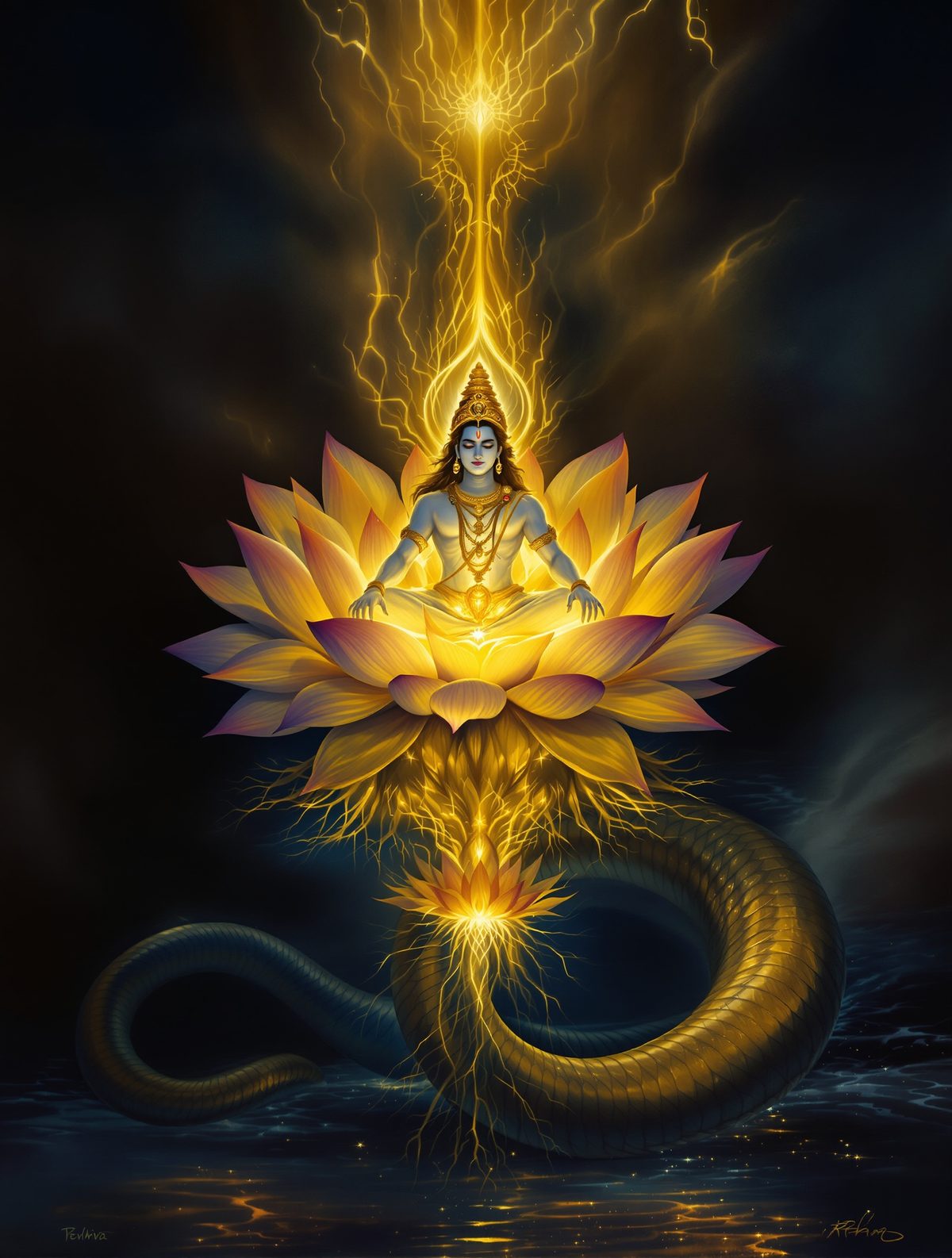
What happened next defies our understanding of creation itself. From the god's navel, as he lay cradled by the serpent Shesha, began to grow something extraordinary: a golden lotus of impossible beauty, its stem stretching through the cosmic waters like a bridge between non-existence and reality. And within that flower's radiant petals, consciousness stirred. A new deity was awakening—Brahma, the four-faced creator god, destined to transform his father's divine visions into the tangible universe we inhabit today.
The Serpent's Embrace: Vishnu's Cosmic Slumber
The ancient texts, particularly the Matsya Purana and the Bhagavata Purana dating back to the 3rd-4th centuries CE, paint an otherworldly picture of existence before creation. Vishnu reclines on Ananta Shesha—literally meaning "endless serpent"—whose thousand cobra heads form a magnificent canopy over the sleeping god. This isn't merely a comfortable resting place; Shesha represents time itself, coiled and infinite, while his thousand mouths continuously chant the glories of Vishnu, creating a cosmic lullaby that maintains the universe's equilibrium.
Here's something that might surprise you: this cosmic sleep isn't dreamless. Ancient Sanskrit texts describe Vishnu's slumber as Yoga Nidra—a state of conscious sleep where the mind remains alert while the body rests. Modern sleep researchers have identified similar states in advanced meditation practitioners, suggesting the ancient sages understood consciousness in ways we're only beginning to rediscover. During this divine sleep, Vishnu's dreams become the blueprint for entire universes, each thought containing the potential for billions of stars, planets, and life forms.
The primordial waters surrounding them, known as the Karana Ocean or Causal Ocean, weren't empty space as we might imagine. According to the Brahma Vaivarta Purana, these waters contained all possibilities—every potential universe floating in quantum-like superposition, waiting for consciousness to collapse them into reality. The ocean's depth was immeasurable, its darkness complete, yet it pulsed with creative potential.
The Golden Lotus: A Bridge Between Worlds
From Vishnu's navel—the nabhi, considered the center of cosmic energy in Hindu tradition—emerged what Sanskrit texts describe as a padma of extraordinary brilliance. This wasn't merely a flower; it was a cosmic lotus whose golden petals contained the architectural plans of creation itself. The lotus stem, according to detailed descriptions in the Shrimad Bhagavatam, grew with such radiance that it illuminated the entire cosmic ocean, creating the first light in a universe that had known only darkness.
The symbolism here runs deeper than most realize. The lotus in Hindu tradition represents purity emerging from murky waters, but this cosmic lotus embodies something far more profound: the emergence of form from the formless, of something from nothing. Its roots remained connected to Vishnu's divine essence, while its flower opened into the realm of potential creation—literally bridging the gap between the unmanifest and manifest realities.
What makes this image particularly striking is its precise anatomical reference. The navel, or manipura in yogic tradition, is considered the seat of personal power and creation in human beings. Ancient texts suggest that just as humans create life through their core energy, Vishnu creates universes through this same cosmic center. The Devi Bhagavatam, compiled around the 6th century CE, describes the lotus as containing 14 different worlds (lokas), each petal representing a different dimension of existence.
Brahma's Awakening: Consciousness Blooms
Inside the lotus's heart, something unprecedented occurred. Brahma—whose name derives from the Sanskrit root brh meaning "to expand"—opened his eyes for the first time. But here's where the story becomes truly fascinating: Brahma awoke with no memory of his origin, no understanding of his purpose. The Matsya Purana describes his initial confusion as he found himself alone in a flower floating in an endless ocean.
The texts describe Brahma's appearance in vivid detail: four faces looking in the cardinal directions, symbolizing his omniscient awareness; four arms representing his power over the four Vedas (the ancient scriptures that would guide creation); and a meditation posture that would become the template for spiritual seekers throughout history. Each face, according to the Kurma Purana, speaks a different Veda continuously—the Rig Veda from the east-facing mouth, the Yajur Veda from the south, the Sama Veda from the west, and the Atharva Veda from the north.
What's remarkable is Brahma's immediate response to his awakening. Rather than panic at finding himself alone in an infinite ocean, he began to meditate—turning inward to understand his purpose. The Brahmanda Purana tells us this meditation lasted for what we would consider millions of years, during which Brahma contemplated the very nature of existence itself. This period, known as Sandhya Kala, represents the pause between potential and manifestation—the cosmic breath before creation begins.
The Cosmic Blueprint: Vision Becomes Reality
When Brahma finally opened his eyes from that epochal meditation, everything changed. The ancient texts describe how Vishnu's dreams began flowing into Brahma's consciousness like a cosmic download. Every star, every planet, every form of life that would ever exist was revealed to him in perfect detail. The Vayu Purana, dating to the 4th century CE, describes this moment as Srishti Pravartana—the commencement of creation itself.
But here's a detail that often gets overlooked: Brahma didn't create from nothing. Instead, he acted as a cosmic architect, taking the raw materials of consciousness provided by Vishnu's dreams and organizing them into the structured reality we experience. Think of it like a master programmer receiving source code from the universe's operating system and compiling it into a functional reality.
The creation process followed a specific sequence that mirrors our modern understanding of cosmic evolution. First came space (akasha), then air (vayu), followed by fire (agni), water (jal), and finally earth (prithvi). Each element emerged from Brahma's meditation on different aspects of Vishnu's cosmic dream. The Padma Purana provides precise timing: each element's creation took 1,000 divine years—roughly 360,000 human years by ancient calculations.
The most fascinating aspect? Brahma created by speaking. The word Om—considered the primordial sound—emerged from his meditation and became the vibrational foundation of all existence. Modern physics tells us that matter is essentially crystallized vibration; the ancient seers seemed to understand this principle millennia ago, encoding it into their creation stories.
The Eternal Cycle: Creation, Preservation, and Renewal
What makes this creation story unique among world mythologies is its cyclical nature. Unlike linear creation myths that describe a single beginning, Hindu cosmology envisions an eternal cycle where universes are born, exist, and dissolve repeatedly. Each cycle, known as a Kalpa, lasts for 4.32 billion years—remarkably close to modern estimates of Earth's actual age.
The relationship between Vishnu, Brahma, and the third member of the cosmic trinity, Shiva, creates an elegant system of cosmic governance. Vishnu provides the dreams and sustaining power; Brahma organizes and creates; and eventually, Shiva dissolves everything back into the primordial state, allowing the cycle to begin anew. This isn't destruction in the Western sense—it's renewal, like a cosmic breath that inhales universes back into potential before exhaling them into existence once again.
The Linga Purana describes how, at the end of each cosmic day (lasting 4.32 billion years), Brahma returns to the lotus, the lotus withdraws into Vishnu's navel, and the great god returns to his cosmic sleep. The universe doesn't end—it simply returns to its unmanifest state, waiting for the next cosmic dawn when the lotus will bloom again and creation will resume.
Why This Ancient Vision Still Matters
In our age of scientific materialism, it's easy to dismiss such stories as primitive mythology. But consider this: these ancient texts describe a universe that emerges from quantum fluctuations (the cosmic ocean), guided by consciousness (Vishnu's dreams), and organized by intelligence (Brahma's creation). They envision reality as fundamentally mental rather than material—a view that's gaining ground in modern physics as scientists grapple with the role of consciousness in quantum mechanics.
The image of Brahma awakening in the lotus offers a profound metaphor for human potential. Each of us carries within us the same creative consciousness that birthed the universe. The lotus represents our capacity to emerge from the murky waters of unconscious existence and bloom into aware creators of our own reality. When we meditate, when we create, when we transform dreams into reality, we're participating in the same cosmic process that Brahma embodied billions of years ago.
Perhaps most importantly, this ancient story reminds us that creation and destruction are not opposites but partners in an eternal dance. In a world facing environmental crisis and social upheaval, the Hindu vision of cyclical renewal offers hope: endings are always beginnings in disguise, and from every dissolution emerges the possibility of a more beautiful world. The lotus blooms eternal, and consciousness—like Brahma awakening in the flower's heart—always finds a way to transform potential into the magnificent reality we call existence.