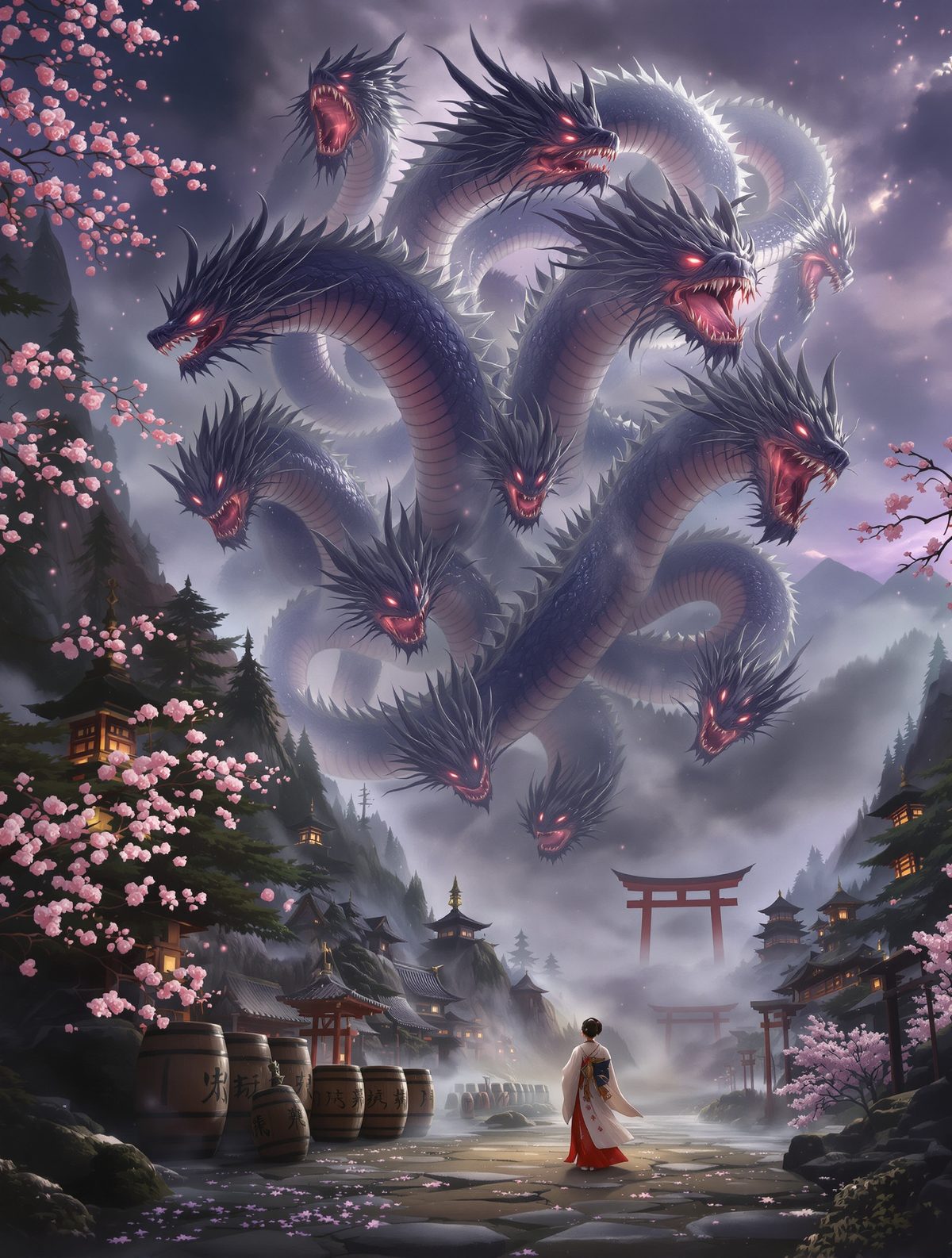
The autumn moon hung heavy over the mountains of ancient Japan, its pale light casting long shadows across the valley where terror had ruled for seven long years. In a humble dwelling, an old couple named Ashinazuchi and Tenazuchi clutched their final daughter close, knowing that with the dawn would come the thunderous approach of eight massive heads, each the size of a small mountain, and sixteen eyes burning like crimson suns. Yamata-no-Orochi, the great serpent whose body stretched across eight valleys and eight hills, was coming to claim what he considered his due—the last of their daughters.
But this time, something was different. This time, a god walked among mortals, and he carried both cunning and steel.
Seven Years of Terror, One Daughter Per Harvest
The nightmare had begun seven harvests ago, when the monstrous Yamata-no-Orochi first emerged from the primordial chaos to terrorize the land of Izumo. This wasn't merely a large snake—ancient texts describe a creature so vast that moss and cypress trees grew upon its back, whose belly was always bloody, and whose eight heads moved independently, each capable of swallowing a house whole. The beast's name itself reveals its terrifying nature: "yamata" meaning eight-forked, and "orochi" indicating a serpent of supernatural size and power.
Each year, as the rice grew golden and the harvest moon rose, the creature would descend upon the family of Ashinazuchi and Tenazuchi, earthly deities who had been reduced to cowering mortals by the serpent's overwhelming power. One by one, their daughters vanished into the creature's maw—not quickly, but slowly, as if the monster savored both their terror and their parents' anguish. The names of the first six daughters have been lost to time, but their sacrifice was not forgotten. By the seventh year, only young Kushiinada-hime remained, described in the Kojiki as a maiden of such beauty that her name meant "wondrous rice field princess."
What makes this legend particularly chilling is its methodical nature. Yamata-no-Orochi wasn't a mindless beast striking randomly—it was a calculating predator that understood the cruelest torture wasn't just death, but anticipation. Each year, the family knew exactly when the monster would come, and exactly what it would take.
Enter the Storm God: Susanoo's Unlikely Arrival
Into this scene of despair stumbled Susanoo-no-Mikoto, the tempestuous storm god who had just been banished from the celestial realm by his sister, the sun goddess Amaterasu. Susanoo's exile hadn't come from any noble quest—he had been cast out for his violent tantrums and destructive behavior in heaven, including the infamous incident where he threw a flayed horse through the roof of his sister's weaving hall, causing the death of one of her attendants.
Now, wandering the earthly realm in disgrace, Susanoo encountered the weeping family. When he learned of their plight, something remarkable happened: the chaotic storm god, known for his impulsiveness and rage, devised a plan that required patience, cunning, and precise timing. Perhaps it was his immediate infatuation with the beautiful Kushiinada-hime, or perhaps even gods can be moved by such profound injustice—but Susanoo decided to face the eight-headed terror.
Interestingly, ancient sources suggest this wasn't entirely altruistic. Susanoo immediately asked for Kushiinada-hime's hand in marriage as payment for his services, transforming her into a hair ornament to keep her safe during the coming battle. Even in Japanese mythology, heroism often came with a price.
The Trap: Eight Vats for Eight Heads
Susanoo's plan was as brilliant as it was simple, relying on one crucial weakness that even the mightiest monsters possess: pride and gluttony. He instructed the desperate parents to brew the strongest sake possible—not just any rice wine, but yashiori no sake, a potent alcohol that had been refined eight times over until it could fell even supernatural beings.
The trap's construction was elaborate and specific: eight platforms were built, each supporting a massive wooden vat filled to the brim with the intoxicating brew. Eight separate entrances were created in the family's fence, each positioned so that one of the serpent's heads could comfortably reach a vat. The sake wasn't just poured carelessly—it was allowed to age until its aroma could be detected from miles away, creating an irresistible lure for the approaching monster.
What many don't realize is that this trap reveals sophisticated understanding of serpent behavior. Real snakes are attracted to fermented fruits and the alcohol they contain, and ancient Japanese observers had likely noticed this. The myth may preserve actual knowledge about dealing with large serpents, magnified to supernatural proportions.
The Night of Eight Heads
When Yamata-no-Orochi finally arrived, the earth trembled beneath its massive coils. Ancient texts describe the moment with visceral detail: the creature's eight heads rose above the mountains like terrible towers, each eye blazing like a winter cherry, casting an eerie red glow across the landscape. The serpent's body was so vast that it filled eight valleys, while moss and fir trees grew on its back as if it were a living mountain range.
But the trap worked exactly as Susanoo had planned. The aroma of the refined sake overwhelmed even the monster's usual caution. Each of the eight heads, acting with independent hunger, plunged into a separate vat. The creature drank deeply, greedily, each head competing with the others to drain its portion fastest. Within moments, the supernatural alcohol took effect, and the terror that had plagued the region for seven years began to sway and stumble like any common drunk.
As Yamata-no-Orochi collapsed into unconsciousness, Susanoo drew his sword—the ten-span Totsuka-no-Tsurugi—and began his grisly work. He methodically severed each massive head, then began cutting the body into pieces. The monster's blood flowed so profusely that it stained the nearby Hi River red for days, giving the waterway a name that some scholars believe still influences place names in modern Shimane Prefecture.
The Sacred Sword Hidden Within
The most surprising twist came as Susanoo continued dismembering the carcass. When his blade struck the creature's middle tail, it met unexpected resistance—inside the serpent's body, he discovered another sword, one that would become even more famous than his own weapon. This was Kusanagi-no-Tsurugi, the "Grass-Cutting Sword," which would later become one of the three sacred imperial regalia of Japan.
The discovery raises fascinating questions that ancient storytellers likely intended. Had Yamata-no-Orochi devoured another hero in ages past? Was the sword a remnant from some earlier cosmic battle? The Kojiki doesn't explain, simply noting that Susanoo, recognizing the blade's superior quality and supernatural nature, presented it to his sister Amaterasu as an offering of reconciliation.
This sword, extracted from the monster's corpse over two millennia ago in mythological time, allegedly still exists today as part of the Japanese imperial regalia, housed at Atsuta Shrine in Nagoya. Whether the physical blade exists or not, the symbolic power of a weapon won through cleverness rather than brute strength continues to resonate in Japanese culture.
Legacy of the Eight-Headed Dragon
The defeat of Yamata-no-Orochi represents far more than a simple monster-slaying tale. In an age when communities lived in constant fear of natural disasters—floods, earthquakes, volcanic eruptions—the eight-headed serpent embodied the terrifying unpredictability of nature itself. The monster's methodical consumption of the daughters mirrors how natural disasters can systematically destroy families, taking one member at a time until nothing remains.
Susanoo's victory established a template that still influences how we think about confronting overwhelming challenges. He didn't win through superior strength or divine magic alone—he won through careful planning, understanding his enemy's weaknesses, and having the patience to execute a complex strategy. In modern Japan, this legend continues to inspire everything from business strategies to disaster preparedness, embodying the principle that even the mightiest challenges can be overcome through intelligence and perseverance.
Perhaps most importantly, the story reminds us that even gods must earn redemption through service to others. Susanoo began as a destructive, selfish deity and found purpose only when he chose to protect the innocent. In our own age of seemingly impossible challenges—climate change, pandemics, social upheaval—the tale of the eight-headed serpent suggests that our monsters, too, might have unexpected weaknesses, waiting for someone clever enough to exploit them.