Picture this: a wall so massive it can be seen from space, built by the blood and bones of over a million workers. Now imagine a single woman's tears bringing it crashing down. In the annals of Chinese folklore, no story captures the raw power of human emotion quite like that of Meng Jiangnu—a young bride whose grief literally moved mountains and toppled the greatest architectural achievement of ancient China.
While Western audiences know the Great Wall as an ancient wonder, few have heard the legend that Chinese mothers have whispered to their children for over two millennia: the tale of how love's anguish proved mightier than imperial might, and how one woman's sorrow shook the very foundations of the Qin Dynasty.
The Bride Who Defied an Empire
The story begins during the reign of China's first emperor, Qin Shi Huang, around 220 BCE. This was a man so obsessed with legacy that he buried scholars alive, burned books, and conscripted nearly every able-bodied man in his empire to build the ultimate defensive barrier. The Great Wall wasn't just a construction project—it was a death sentence wrapped in imperial decree.
Enter Meng Jiangnu, a young woman whose very name has become synonymous with faithful devotion. Historical accounts describe her as beautiful beyond measure, with skin like white jade and eyes that sparkled like morning dew. She had just married Fan Qiliang, a scholar who had been hiding in her family's garden to escape the brutal conscription sweeps that regularly terrorized villages across China.
Their wedding lasted exactly one night. Before the rooster could crow twice, imperial soldiers hammered on their door. Fan Qiliang was dragged away in chains, destined for the killing fields they called a construction site. What the emperor's men didn't count on was the iron will of the woman they left behind.
A Journey Through Hell Itself
Here's where the story takes a turn that would make even the most hardened Hollywood screenwriter weep. Meng Jiangnu didn't simply accept her fate like countless other wives of the era. Instead, she embarked on what historians estimate was a 1,000-mile journey across some of the most treacherous terrain in ancient China.
For months, she walked through scorching deserts where the sand burned through her cloth shoes, climbed mountains so steep that eagles feared to nest there, and forded rivers swollen with the tears of other grieving families. She carried with her a bundle of winter clothes she had sewn by hand—thick cotton jackets lined with silk, boots made from the finest leather their modest savings could buy.
The most haunting detail? Chinese oral tradition holds that she could hear the wall being built from fifty miles away. The constant pounding of hammers, the groans of dying men, the crack of whips against bare flesh—a symphony of suffering that grew louder with each step toward her destination.
What makes this legend particularly fascinating is its historical accuracy regarding the wall's construction. Archaeological evidence confirms that workers were indeed dying at catastrophic rates—some estimates suggest one death for every meter of wall built. The phrase "a life for every brick" wasn't poetic exaggeration; it was brutal mathematics.
The Wall of Bones and Broken Dreams
When Meng Jiangnu finally reached the construction site, she discovered a truth more horrifying than her worst nightmares. The Great Wall wasn't just built with stone and earth—it was literally constructed from human remains. Workers who died from exhaustion, starvation, or accidents weren't given proper burials. They were simply incorporated into the foundation, their bones becoming mortar, their flesh becoming part of the emperor's grand vision.
The foreman's response to her inquiries about Fan Qiliang's whereabouts has been preserved in multiple versions of the tale: "Your husband? Which husband? We lose ten men a day here. They all become part of the wall eventually."
After days of frantic searching, questioning every surviving worker she could find, Meng Jiangnu made a discovery that would echo through Chinese culture forever. A fellow laborer, himself barely clinging to life, pointed to a section of recently completed wall and whispered: "Your husband rests there. His bones hold up that very stone."
When Grief Shook the Earth
What happened next depends on which version of the legend you encounter, but all agree on the essential facts: Meng Jiangnu's weeping was so profound, so earth-shaking in its intensity, that it literally brought down a section of the Great Wall.
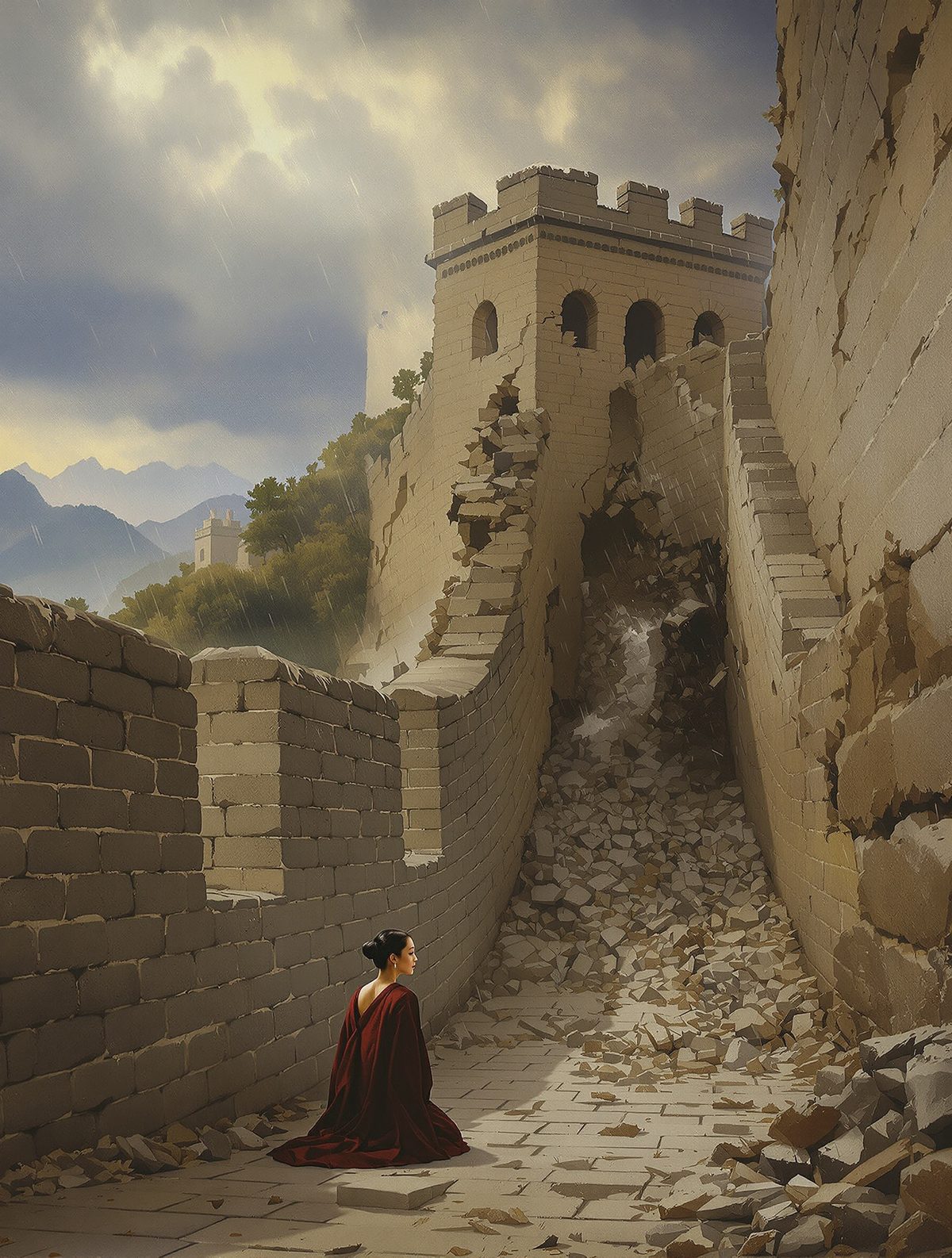
The most detailed accounts describe her sitting before the wall for three days and three nights, her tears falling like monsoon rain. She didn't scream or wail—instead, she wept with the quiet, terrible intensity of a woman whose world had been completely shattered. The sound, witnesses claimed, was like water dripping in a vast, empty cave—soft but impossibly penetrating.
On the third night, something extraordinary occurred. The earth began to tremble. Birds fled from the mountains. Even the hardened soldiers who had been ordered to watch her stepped back in fear. Then, with a sound like thunder splitting the sky, a massive section of the wall—over 400 meters long, according to some accounts—simply crumbled to dust.
There, in the rubble, lay the bones of Fan Qiliang and hundreds of other workers, finally freed from their stone prison.
The Emperor's Ultimate Defeat
The legend takes an even more dramatic turn when word of this miraculous collapse reached Emperor Qin Shi Huang himself. Furious that a mere woman had damaged his greatest achievement, he ordered Meng Jiangnu brought before him in chains. But when he saw her beauty—even after months of travel and days of weeping—his anger transformed into obsession.
The emperor demanded that she become his concubine, promising riches beyond imagination. Meng Jiangnu's response reveals the cunning behind her grief: she agreed, but only if he would give her husband a proper burial, build a memorial in his honor, and personally attend the funeral ceremony.
The emperor, drunk on desire and confident in his power, agreed. But Meng Jiangnu had one final surprise. At the funeral ceremony, standing on a high platform overlooking the river, she delivered a speech that historians consider one of the earliest recorded examples of political resistance in Chinese literature. She condemned the emperor's cruelty, his waste of human life, and his hubris in believing that stone could ever be stronger than the human spirit.
Then, before anyone could stop her, she threw herself into the churning waters below.
Echoes Across Eternity
The legend of Meng Jiangnu has endured for over 2,000 years, but its relevance has never been more profound than it is today. In an era when we're constantly reminded of the human cost of grand political projects, her story serves as a powerful reminder that behind every monument to power lie countless individual tragedies.
Modern archaeologists have discovered evidence that supports key elements of the legend. Human remains have indeed been found incorporated into various sections of the Great Wall, and historical records confirm the massive loss of life during its construction. Whether or not tears can literally topple walls, Meng Jiangnu's grief represents something far more powerful: the unbreakable human spirit's ability to bear witness to injustice and demand accountability from those in power.
Perhaps most remarkably, this ancient Chinese legend resonates across cultures and centuries because it captures a universal truth—that individual human dignity will always triumph over imperial ambition, even if victory comes at the ultimate price. In a world where walls are still being built and lives are still being sacrificed for political gain, Meng Jiangnu's tears continue to fall, and stone monuments continue to crumble before the simple, devastating power of authentic human emotion.