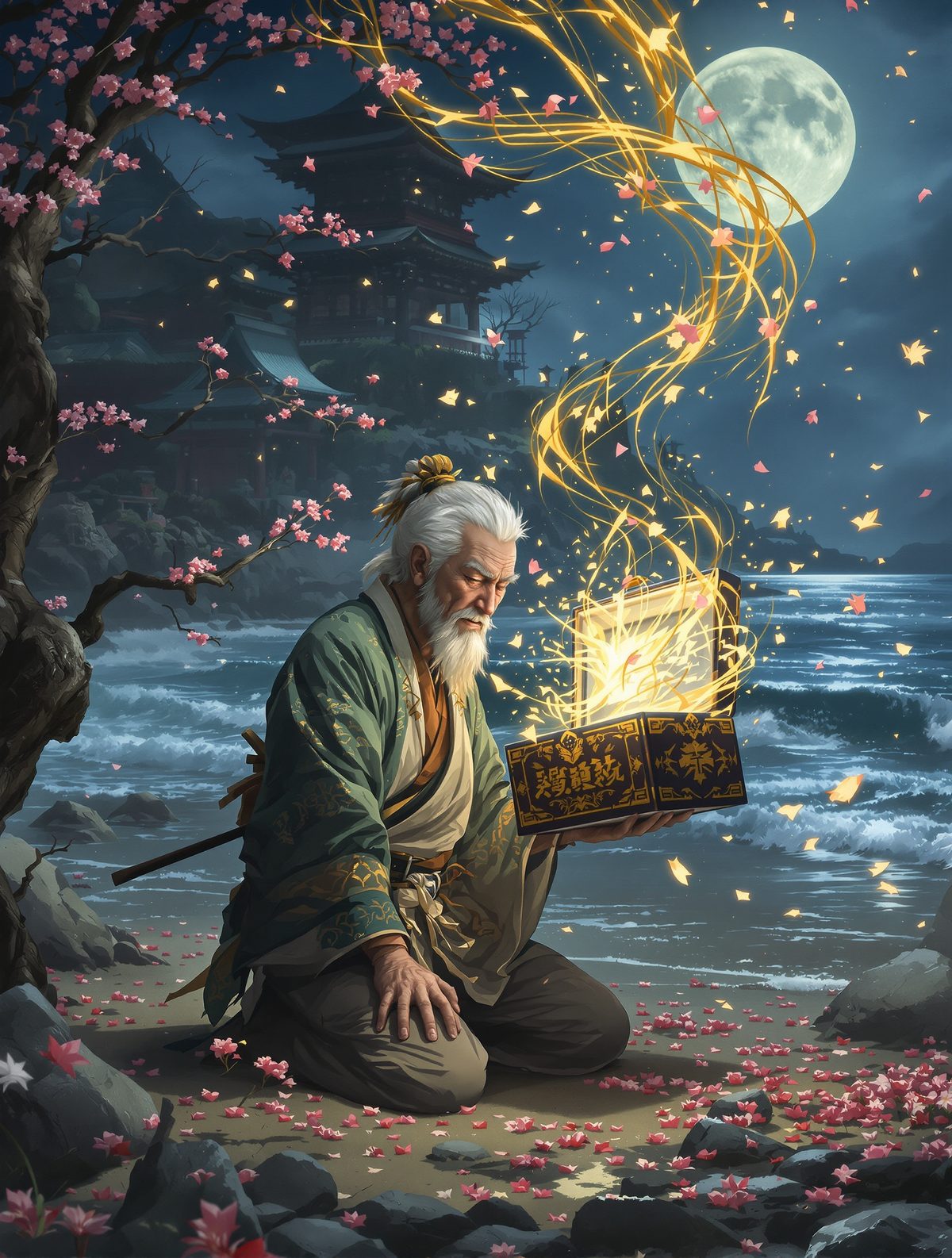
The wooden box felt heavier than it should have. Urashima Tarō's weathered hands trembled as he clutched the lacquered gift from Princess Otohime, the sea dragon's daughter who had loved him in an underwater palace that existed outside of time itself. Around him, the coastal village of Mizunoe—his home—had vanished. Strange houses with unfamiliar architecture dotted the landscape. The people wore clothes he'd never seen, spoke with accents that had drifted over centuries. Everyone he'd ever known was three hundred years dead.
This wasn't supposed to happen. He'd only been gone three days.
But in the depths of the Dragon Palace beneath the waves, time moved differently. What felt like a long weekend of feasting, dancing, and romance had consumed three centuries of mortal years. And now, standing on a beach that was simultaneously familiar and alien, Urashima faced the most human of temptations: the one thing he'd been explicitly told never to do.
The Turtle That Changed Everything
The legend of Urashima Tarō first appeared in written form during the Nara period (710-794 CE), though oral traditions suggest the story is far older. The earliest recorded version can be found in the Nihon Shoki (Chronicles of Japan) completed in 720 CE, where it's called the tale of Urashimako—a name that evolved into the more familiar Urashima Tarō over centuries of retelling.
But every version begins the same way: with an act of compassion that spiral into cosmic consequences.
Urashima was a fisherman from what is now the Tango Peninsula in Kyoto Prefecture, a rugged coastline where the Sea of Japan crashes against pine-covered cliffs. One morning, while checking his nets near the village of Mizunoe, he discovered a group of children tormenting a large sea turtle, pelting it with stones and prodding it with sticks. The turtle—ancient and dignified despite its predicament—looked at Urashima with eyes that seemed to hold centuries of wisdom.
In most cultures, this would be a simple moral tale about kindness to animals. But in Japanese mythology, turtles are tsuru—creatures that live for ten thousand years and serve as messengers between the mortal world and the realm of the kami (spirits). Urashima didn't just save an animal; he rescued an emissary of the divine.
The Dragon Palace Beneath the Waves
The next day, as Urashima cast his nets in the same spot, the turtle returned. But this was no ordinary creature. It spoke with a human voice, introducing itself as a servant of Princess Otohime, daughter of Ryūjin, the Dragon King who ruled the seas. The turtle had come to repay Urashima's kindness with an invitation to the Ryūgū-jō—the Dragon Palace beneath the waves.
What happened next defies the physics of the mortal world. Urashima climbed onto the turtle's shell, and together they descended beneath the waves—not drowning, but breathing as easily as if they were walking through air. The journey took them past coral gardens that sparkled like jeweled cities, through underwater forests where fish swam in perfect formations like living constellations.
The Dragon Palace itself was a marvel that combined the architectural grandeur of Tang Dynasty China with the organic flowing forms of the sea. Constructed from coral, pearl, and precious metals that don't exist in the surface world, the palace stretched for miles across the ocean floor. Each wing represented a different season—spring gardens where cherry blossoms bloomed eternal, summer halls where warm breezes carried the scent of jasmine, autumn courtyards where maple leaves fell upward like reverse rain, winter chambers where snow fell but never accumulated.
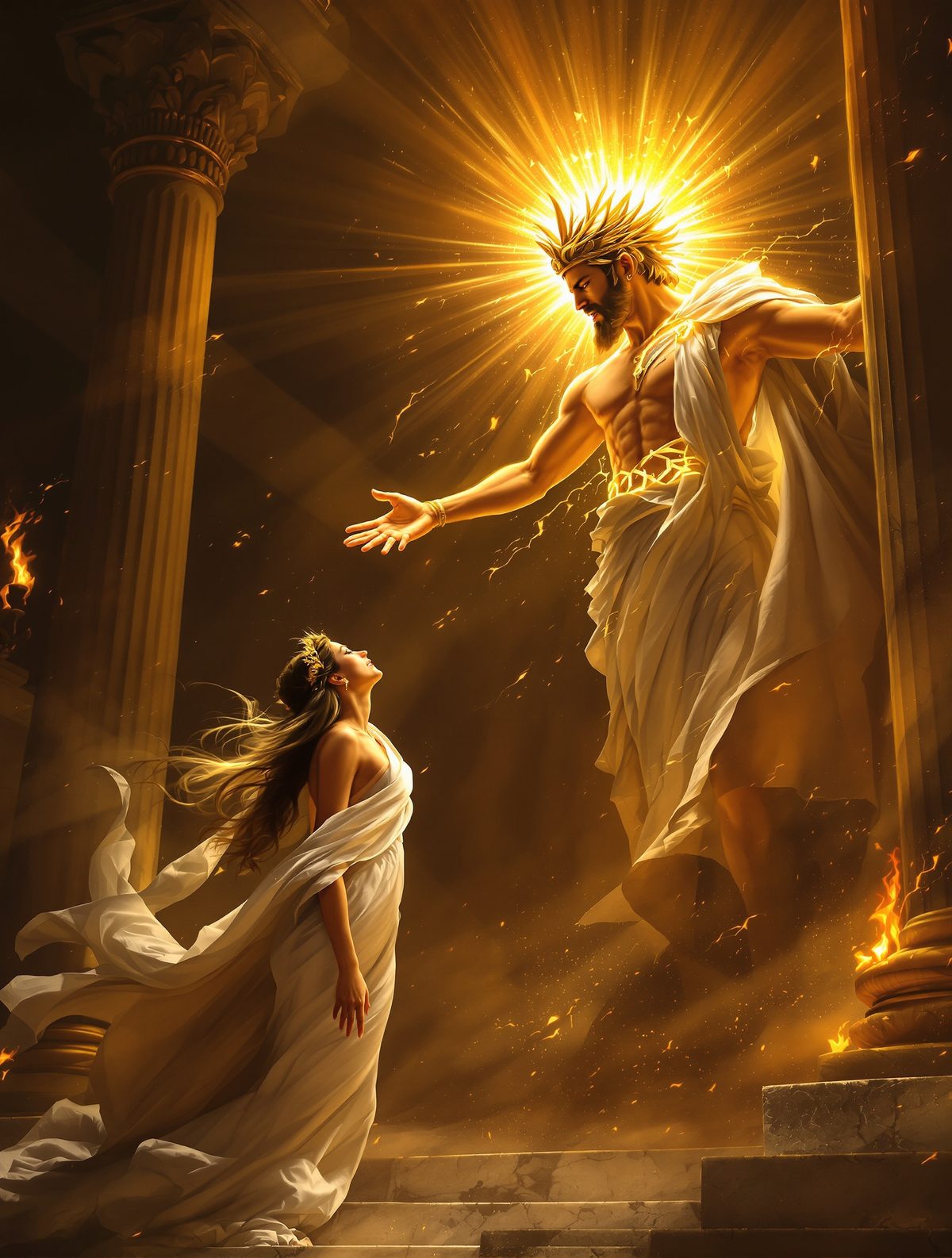
Princess Otohime herself was described as possessing a beauty that human language couldn't capture—not just physical perfection, but an otherworldly grace that came from being a creature of pure spirit temporarily taking mortal form. She welcomed Urashima as a honored guest, and what began as gratitude slowly transformed into something deeper.
Three Days That Lasted Three Centuries
Time in the Dragon Palace followed different rules. Urashima feasted on foods that tasted like memories—some dishes evoked the warmth of his mother's embrace, others the excitement of his first successful fishing expedition. He danced to music played by orchestras of sea creatures, each note seeming to resonate directly with his soul rather than his ears.
Princess Otohime showed him wonders that existed nowhere in the mortal realm: libraries where books wrote themselves, recording every story that had ever been told; gardens where plants grew backward into seeds; workshops where craftsmen forged tools from crystallized moonlight.
But the most intoxicating element wasn't the magic—it was the complete absence of suffering. In the Dragon Palace, there was no hunger, no illness, no aging, no death. No bitter winters where fishing was impossible. No storms that claimed boats and lives. No watching parents grow frail and fade away. Urashima lived in a state of perpetual contentment that humans are never meant to experience.
The danger wasn't that time moved differently in the Dragon Palace—it was that it moved so perfectly that you forgot mortal time existed at all. Days blended into each other without the natural rhythms of fatigue, seasons, or change to mark their passage. When Urashima finally felt the tug of homesickness, he had no idea whether he'd been gone for days, weeks, or months.
The Weight of Centuries
Princess Otohime didn't try to stop him from leaving. Perhaps she knew, with the wisdom of an immortal being, that love built on preventing choice isn't love at all. But she gave him a farewell gift: a small tamatebako—a jeweled box sealed with silk cords. Her instructions were simple and absolute: "This box contains something precious, but you must never open it. As long as it remains sealed, you will be protected."
The turtle carried him back to the surface, back to what should have been the familiar waters off Mizunoe. But the Japan that greeted Urashima was a different country entirely. The Asuka period he'd known, with its grand Buddhist temples and Chinese-influenced court culture, had given way to something unrecognizable. The clothes, the architecture, even the language had evolved beyond his understanding.
Wandering through the transformed landscape, Urashima desperately sought anyone who might remember him, his family, his friends. Finally, he found an elderly man who listened to his questions with growing amazement. "Urashima?" the old man said. "That's a name from the old stories. My great-great-grandfather used to tell tales about a fisherman named Urashima who disappeared into the sea. But that was three hundred years ago."
Three hundred years. Everyone he had ever loved was centuries dead. Their children were dead. Their children's children were dead. He was a living ghost, a man displaced not just in space but in time itself.
The Box That Contained Time Itself
Standing alone on the beach where his village once stood, Urashima stared at the tamatebako. Princess Otohime's warning echoed in his mind, but what did it matter now? What could be worse than this isolation, this complete severance from everything that had given his life meaning?
The box opened with a soft sigh, releasing not objects but pure temporal energy—the three centuries he'd somehow avoided while living in the Dragon Palace. White smoke poured out, and as it touched Urashima, his body began to change. His black hair turned white, then fell out entirely. His smooth skin wrinkled and creased. His strong fisherman's muscles withered.
In seconds, Urashima aged three hundred years. His body crumbled to dust that was scattered by the ocean breeze, finally claiming the death that should have found him centuries ago.
But some versions of the legend suggest a different interpretation of the box's contents. Rather than containing the years he'd lost, the box held his memories of the Dragon Palace—the only thing that had allowed him to maintain his human form in the mortal world. By opening it, he released those memories back to the sea, choosing to forget the paradise he could never return to rather than live forever haunted by its perfect beauty.
The Price of Paradise
The legend of Urashima Tarō has endured for over thirteen centuries because it captures something essentially human about the relationship between time, memory, and loss. In a culture that values both respect for elders and awareness of mortality, Urashima's story serves as a cautionary tale about the dangers of trying to escape the natural rhythms of life.
But perhaps the most profound element of the story isn't the magical palace or the time displacement—it's the box itself. Princess Otohime gave Urashima a choice. She could have simply sent him back to his own time, or kept him forever in the Dragon Palace. Instead, she gave him agency over his own fate, even if that agency came with terrible consequences.
In our modern world of infinite digital distractions and the constant promise of technological solutions to human problems, Urashima's story feels remarkably contemporary. We're all carrying our own versions of the tamatebako—choices that promise to solve our problems but might cost us something essential about what makes us human. The question isn't whether we'll face these temptations, but whether we'll have the wisdom to understand what we're really choosing when we untie those silk cords.
Sometimes the most merciful thing about time is that it passes. And sometimes the cruelest thing about paradise is discovering that we're not built to survive it.