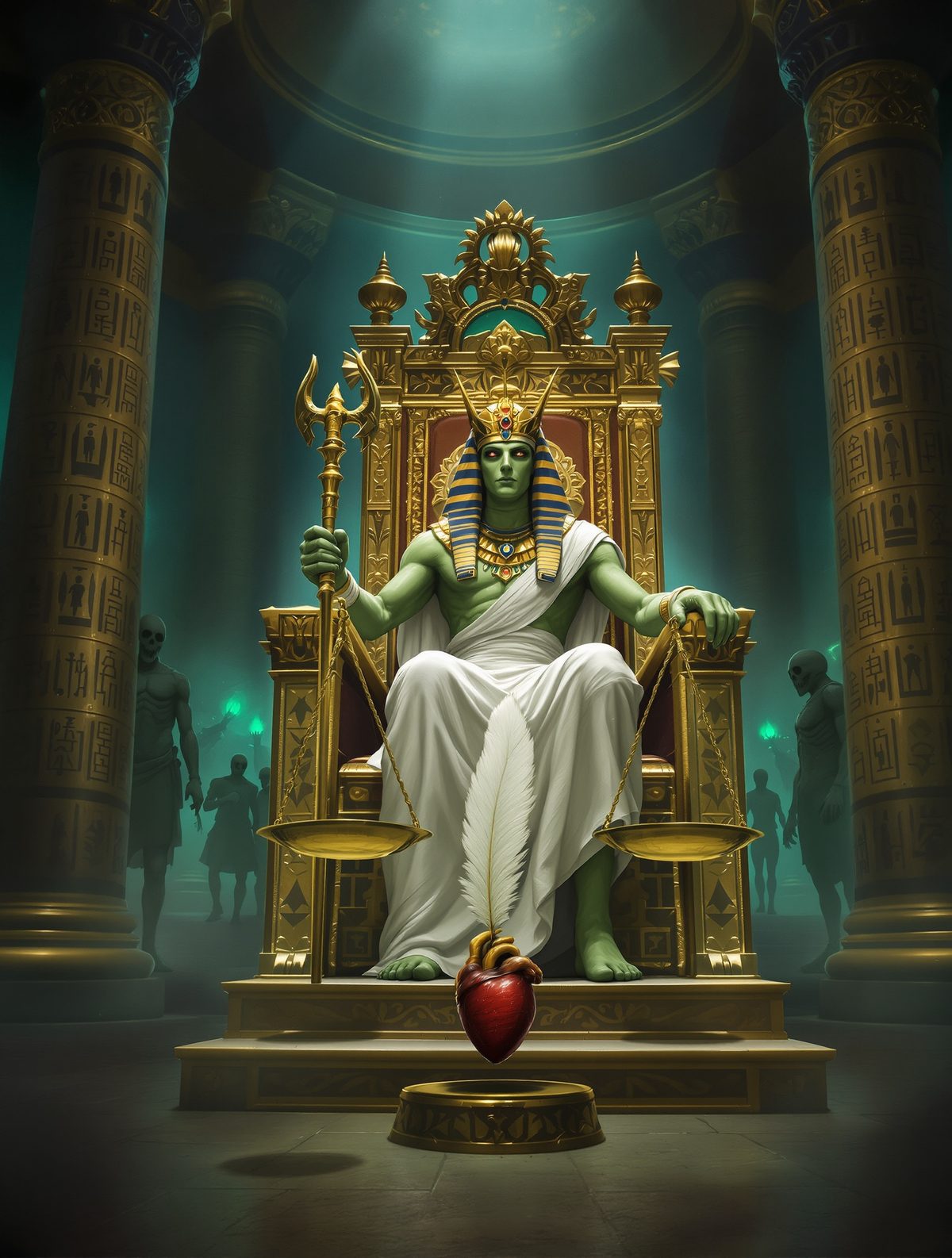
Your heart pounds in your chest as you step through the gates of eternity. Before you stretches the Hall of Two Truths, a vast chamber where golden light dances off walls covered in hieroglyphs that seem to writhe and whisper ancient secrets. At the far end, seated on a throne of black granite, sits a figure wrapped in pristine white linen. His skin is the green of the Nile's life-giving waters, his eyes hold the weight of millennia, and in his crossed hands rest the crook and flail of absolute authority. This is Osiris, Lord of the Dead, and he is about to decide whether your soul spends eternity in paradise—or gets devoured by a creature so terrifying that even the gods fear her.
Welcome to the most consequential moment in any ancient Egyptian's existence: the Weighing of the Heart. This wasn't just religious theater—for over 3,000 years, from around 2686 BCE to 395 CE, millions of Egyptians lived their entire lives preparing for this singular moment when their moral worth would be measured against a single ostrich feather.
The Green God's Bloody Rise to Power
Osiris didn't start as lord of the underworld. According to the Pyramid Texts—some of humanity's oldest religious writings, dating to around 2400 BCE—he was once a living king of Egypt, beloved for bringing civilization, agriculture, and law to the land. But his brother Set, consumed by jealousy, hatched a plan that would make Shakespeare's villains look like amateurs.
Set crafted a beautiful sarcophagus, perfectly fitted to Osiris's measurements, and presented it at a feast as a gift for whoever could fit inside. When Osiris climbed in, Set slammed the lid shut and hurled the coffin into the Nile. But death was only the beginning of Osiris's torment. Set later discovered the body, tore it into fourteen pieces, and scattered them across Egypt—from the Delta to the cataracts of Aswan.
Here's where the story takes a supernatural turn that ancient texts describe in vivid detail: Isis, Osiris's wife and sister (royal Egyptian marriages were complicated), embarked on a desperate quest to recover every piece of her husband's dismembered corpse. Using her mastery of magic, she reassembled Osiris and temporarily restored him to life—long enough to conceive their son Horus, who would eventually avenge his father.
But Osiris could no longer rule among the living. Instead, he descended to the Duat—the Egyptian underworld—where his experience of death and resurrection made him uniquely qualified to judge the dead. His green skin, depicted in countless tomb paintings from Thebes to Saqqara, symbolized rebirth and the eternal cycle of the Nile's floods.
The Hall Where Truth Cannot Hide
The Hall of Two Truths wasn't just Osiris's courtroom—it was a cosmic tribunal where the fundamental order of the universe hung in the balance. Ancient Egyptian artists, working in tombs like that of Ani (a scribe who died around 1250 BCE), left us incredibly detailed depictions of this otherworldly courtroom that reveal surprising insights into Egyptian concepts of justice.
Picture a vast hall with a ceiling that stretches into darkness, its walls lined with 42 divine judges—one for each of Egypt's administrative districts, or nomes. These weren't mere observers but active participants in the judgment, each responsible for examining specific aspects of the deceased's moral life. The god of the 13th nome, for instance, specifically judged whether the dead person had ever stolen food, while the deity of the 23rd nome examined sexual misconduct.
At the hall's center stood the scales of Ma'at—not the simple balance we might imagine, but an elaborate golden instrument tended by Anubis, the jackal-headed god whose black fur symbolized the fertile soil of the Nile and the color of mummified flesh. Anubis had literally invented mummification when he prepared Osiris's body for the afterlife, making him the perfect technician for this cosmic procedure.
But here's a detail that often gets overlooked: the deceased wasn't passive during this judgment. They had to actively participate by reciting the "Negative Confession"—42 declarations of innocence that had to be delivered flawlessly. "I have not killed," they would declare. "I have not stolen grain. I have not polluted the water. I have not driven cattle from their pastures." A single stumble could doom them forever.
The Feather That Outweighs Mountains
The feather of Ma'at appears deceptively simple in ancient depictions—just a single white ostrich plume, often no larger than a human hand. But this seemingly insignificant object represented something profound: the cosmic principle of truth, justice, and moral order that kept the universe from sliding into chaos.
Ma'at herself was both a goddess and a concept so fundamental that even the gods had to obey her laws. She was present at the creation of the world, and her feather had witnessed every act of justice and injustice since time began. When placed on the scales opposite a human heart, it became the ultimate moral measuring device.
The heart, in Egyptian belief, was far more than just an organ that pumped blood. It was the seat of intelligence, emotion, memory, and moral character—everything that made a person who they were. Unlike other organs, which were removed and preserved separately during mummification, the heart was deliberately left in the body because the deceased would need it for judgment.
Ancient medical papyri from around 1600 BCE reveal that Egyptians understood the heart's central role in the body better than many later civilizations. They knew it was connected to every part of the body through vessels, and they believed these same vessels carried not just blood, but thoughts, emotions, and the accumulated weight of every moral choice a person had ever made.
When Anubis placed the heart on the scales, it carried the complete moral history of the deceased. Every lie told, every kindness shown, every act of cruelty or compassion—all of it was weighed against Ma'at's feather. The scales had to balance perfectly. Even the tiniest tip toward the heart side meant moral failure and eternal destruction.
Ammit: The Soul Destroyer
Crouching beside the scales, her massive jaws slightly open and ready to spring into action, waited the most terrifying creature in the Egyptian pantheon: Ammit, the Devourer of Hearts. Part crocodile, part lion, part hippopotamus—three of the most dangerous animals in ancient Egypt—she represented the ultimate punishment for the morally unworthy.
But here's what makes Ammit truly horrifying to the Egyptian mind: she didn't just kill the condemned soul. She erased it from existence entirely. In a culture that believed the soul could live forever through memory and proper burial rites, Ammit offered something far worse than death—complete and utter annihilation. The soul she devoured would never be reborn, never be remembered, never exist in any form again.
Ancient texts describe her consumption in visceral detail: she would first devour the heart, eliminating the person's capacity for thought and emotion. Then she would consume the rest of the soul, piece by piece, until nothing remained—not even the possibility of nothingness, because nothingness implies something once existed to become nothing.
Archaeological evidence from worker villages near the pyramids suggests that even ordinary Egyptians lived in genuine fear of this fate. Protective amulets depicting hearts have been found in countless graves, and many mummies were buried with heart scarabs—stone beetles inscribed with spells designed to prevent the heart from "speaking against" its owner during judgment.
The Paradise of Perfect Balance
For those whose hearts achieved perfect balance with Ma'at's feather, the reward was beyond imagination: entry into the Field of Reeds, a paradise that made earthly life seem like a pale shadow. Ancient descriptions from texts like the Amduat, found in royal tombs in the Valley of the Kings, paint a picture of an eternal realm where the blessed dead lived in perfection.
This wasn't a static heaven of endless harp-playing, but a dynamic paradise where the righteous continued to live, work, and grow. They would have estates greater than any they'd known in life, with fields that yielded grain nine cubits tall (about 13 feet). The Nile flowed with perfect regularity, the sun god Ra sailed overhead in eternal glory, and loved ones were reunited forever.
But perhaps most remarkably, the justified dead could also return to the land of the living as blessed spirits. They could watch over their descendants, answer prayers, and even influence events in the mortal world. This is why elaborate tomb complexes like those at Giza included temples where the living could communicate with the dead—because death, for the morally worthy, was just a promotion to a higher level of existence.
Osiris himself would welcome each new arrival personally, according to texts found in tombs from Memphis to Elephantine. The god who had conquered death would embrace those who had proven themselves worthy, making them part of his eternal court where they would help judge future souls arriving in the Hall of Two Truths.
The Weight of Ancient Wisdom
The Weighing of the Heart reveals something profound about how ancient Egyptians understood morality, justice, and the meaning of life itself. This wasn't just about following religious rules—it was about living with the constant awareness that every choice mattered on a cosmic scale.
In our modern world, where moral relativism often reigns and the consequences of our actions can seem abstract or distant, the Egyptian vision offers something both terrifying and inspiring: the idea that truth is absolute, that justice is real, and that the weight of our choices echoes through eternity. Whether we believe in Osiris's judgment or not, the fundamental question remains as relevant today as it was 4,000 years ago: if your heart were weighed against a feather of perfect truth, would it balance?
The ancient Egyptians spent lifetimes preparing for a moment that would last only seconds. Perhaps there's wisdom in that urgency—in living as if every heartbeat adds weight to the scales, and every choice determines whether we'll be remembered as those who made the world heavier or lighter with our presence.