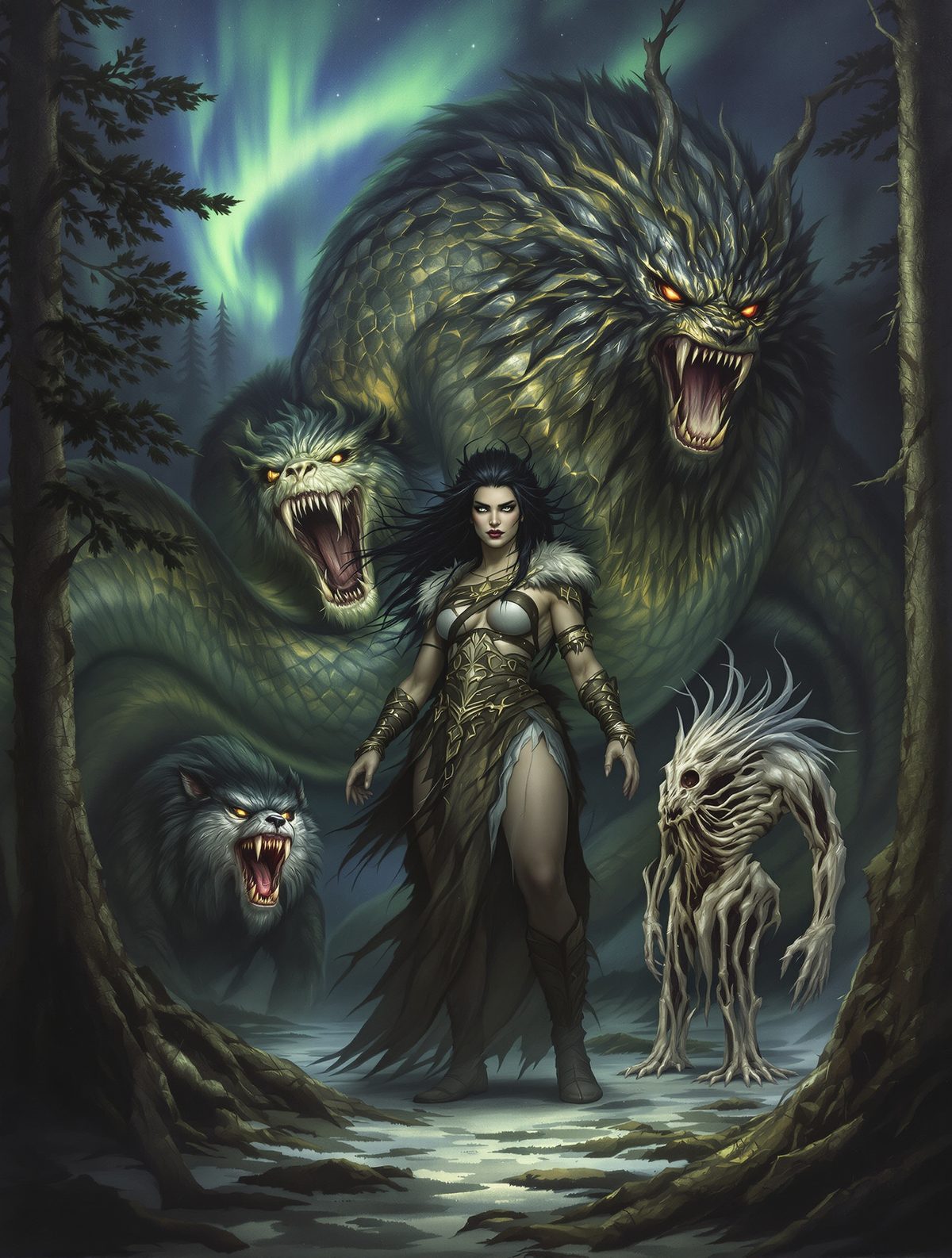
In the shadow-haunted realm of Jotunheim, where frost giants carved their halls from living ice and ancient magic, a prophecy was being born in flesh and blood. The giantess Angrboda, whose name means "bringer of grief," lay in labor not once, not twice, but three times—each birth unleashing a force that would shake the very foundations of the nine worlds. Her lover was none other than Loki, the shape-shifting trickster god, and together they had conceived the instruments of the gods' own destruction.
What emerged from Angrboda's womb would make even the battle-hardened gods of Asgard tremble. A serpent large enough to encircle the world. A wolf whose jaws could swallow the sun. And a daughter whose very appearance—half beautiful maiden, half rotting corpse—would rule over the realm of the dead. These were not merely monsters, but the living embodiment of Ragnarok itself.
The Forbidden Love That Shook Nine Worlds
Long before the gods discovered the terrible offspring, Loki had wandered into the wilderness of Jotunheim, drawn by whispers of a giantess whose beauty was matched only by her mastery of the dark arts. Angrboda was no ordinary giant—she was a powerful sorceress, a keeper of ancient wisdom that predated even the gods themselves. Some scholars believe her name derives from the Old Norse "angr" (grief) and "boða" (to announce), marking her as a herald of sorrow from the very beginning.
Their union was passionate and forbidden, conducted far from the golden halls of Asgard where such alliances were viewed with suspicion. In the depths of the Ironwood—Járnviðr in Old Norse—a primeval forest where magic ran as thick as morning mist, they built their hidden sanctuary. Here, surrounded by the howling of wolves and the whisper of ancient spells, Angrboda bore her three children.
What makes this tale particularly fascinating is that unlike many mythological births, these pregnancies were sequential, not simultaneous. Each child represented a different aspect of cosmic destruction: the serpent embodying the chaos of the seas, the wolf representing untamed wildness turned destructive, and their daughter symbolizing the inevitability of death itself.
Jormungandr: The Serpent That Embraces the World
The first child to emerge was perhaps the most immediately terrifying—a serpent of impossible size that would come to be known as Jormungandr, the World Serpent. Born as a seemingly normal snake, the creature began growing at an alarming rate, its coils expanding daily until even the vast halls of the Ironwood could no longer contain it.
When Odin's ravens, Huginn and Muninn, brought word of this monstrous offspring to Asgard, the All-Father made a decision that would prove both pragmatic and catastrophic. Rather than attempt to kill the serpent—which the prophecies warned was impossible—Odin cast Jormungandr into the seas surrounding Midgard, believing the vast oceans would contain the beast.
Instead, the serpent continued to grow until it could grasp its own tail, completely encircling the world of humans. The Vikings believed that when Jormungandr stirred in the ocean depths, it caused tidal waves and storms. But more ominously, the prophecies declared that when the serpent finally released its tail, Ragnarok would begin. In this way, Angrboda's first child became both the guardian and destroyer of the human world—a living ouroboros marking the boundary between order and chaos.
Fenrir: The Wolf Who Devours Gods
If Jormungandr represented chaos contained, the second child embodied chaos unchained. Fenrir—whose name means "fen-dweller" or "marsh-wolf"—was born as a seemingly normal wolf pup, small enough to be cradled in human arms. The gods, learning from their experience with the serpent, decided to take a different approach with this offspring.
Rather than banishing Fenrir, they brought the wolf pup to Asgard itself, hoping to raise it among the gods where it could be watched and controlled. For a time, this strategy seemed to work. Only Tyr, the one-handed god of war and justice, was brave enough to feed the growing wolf, and Fenrir appeared to be nothing more than an unusually large pet.
But Angrboda's blood ran true. As Fenrir matured, he grew not just in size but in cunning and strength until he towered above the gods themselves. His jaw could crush mountains, and his howl could shatter the walls of Valhalla. The gods realized too late that they had nurtured their own executioner. Their solution—binding Fenrir with an unbreakable chain called Gleipnir—only ensured that when the wolf finally broke free at Ragnarok, his rage would be absolute. The prophecies were clear: Fenrir would devour Odin himself when the final battle came.
Hel: The Goddess Born of Two Worlds
Perhaps the most complex of Angrboda's children was her daughter Hel, whose very appearance reflected the dual nature of existence itself. Born with the body split down the middle—one half that of a beautiful, living woman, the other half a decaying corpse—Hel embodied the Norse understanding that life and death were not opposites but partners in an eternal dance.
Unlike her brothers, Hel posed no immediate physical threat to the gods. She was quiet, contemplative, and showed no signs of the destructive growth that marked her siblings. Yet in many ways, she was the most dangerous of the three, for she represented something the gods could neither fight nor control: the inevitability of death itself.
Recognizing both her power and her nature, Odin made Hel ruler of the realm of the dead—the dark domain that came to bear her name. From her throne in the hall called Éljúdnir ("sprayed with snowstorms"), she would receive all who died of sickness or old age, while warriors who fell in battle went to Valhalla. But the prophecies warned that during Ragnarok, Hel would march alongside her brothers, leading an army of the dishonored dead against the gods.
What many don't realize is that Hel's domain wasn't considered a place of torment in Norse mythology—it was simply the natural destination for most souls. Her rule was just, if cold, making her perhaps the most sympathetic of Angrboda's monstrous children.
The Mother Who Vanished from History
While her children would go on to shape the destiny of gods and men, Angrboda herself fades from most surviving Norse sources after giving birth to her prophetic offspring. Some scholars believe this absence is deliberate—that later Christian scribes deliberately minimized her role because a powerful female figure birthing the enemies of the gods conflicted with their theological worldview.
What fragments remain suggest that Angrboda continued to live in the Ironwood, becoming the mother and teacher of all wolves. Some sources indicate that she possessed the gift of prophecy herself, having foreseen the role her children would play in the cosmic drama. If so, her union with Loki takes on an even darker significance—the conscious choice to birth Ragnarok itself.
In certain versions of the myth, Angrboda appears again at Ragnarok, leading her wolf-children from the Ironwood to join the final battle. This would make her not just the mother of the gods' destruction, but an active participant in their downfall—the grief-bringer living up to her ominous name.
The Prophecy Made Flesh
The tale of Angrboda and her three children reveals something profound about the Norse understanding of fate and free will. The gods, upon learning of the prophecies surrounding these offspring, took action to prevent their own destruction—casting out Jormungandr, imprisoning Fenrir, and exiling Hel. Yet each of these preventive measures actually ensured that the prophecies would come to pass exactly as foretold.
By throwing the World Serpent into the ocean, they created the boundary marker for Ragnarok. By betraying and binding Fenrir, they guaranteed his hatred. By making Hel ruler of the dead, they gave her the army she would need for the final battle. In trying to escape their fate, the gods sealed it.
This paradox speaks to something eternal in the human experience—our tendency to create the very outcomes we fear most through our attempts to avoid them. Angrboda's story reminds us that sometimes the greatest threats come not from our enemies, but from our own reactions to fear and prophecy. In our modern world, where we face global challenges that seem too vast to comprehend, perhaps there's wisdom in the Norse recognition that some forces cannot be fought or controlled—only understood and accepted.
The giantess who gave birth to the end of the world ultimately birthed something else as well: the understanding that destruction and creation are forever intertwined, and that even the gods must face the consequences of their choices. Her legacy lives on not just in the monsters she mothered, but in the eternal questions her story poses about fate, family, and the price of trying to change what cannot be changed.