
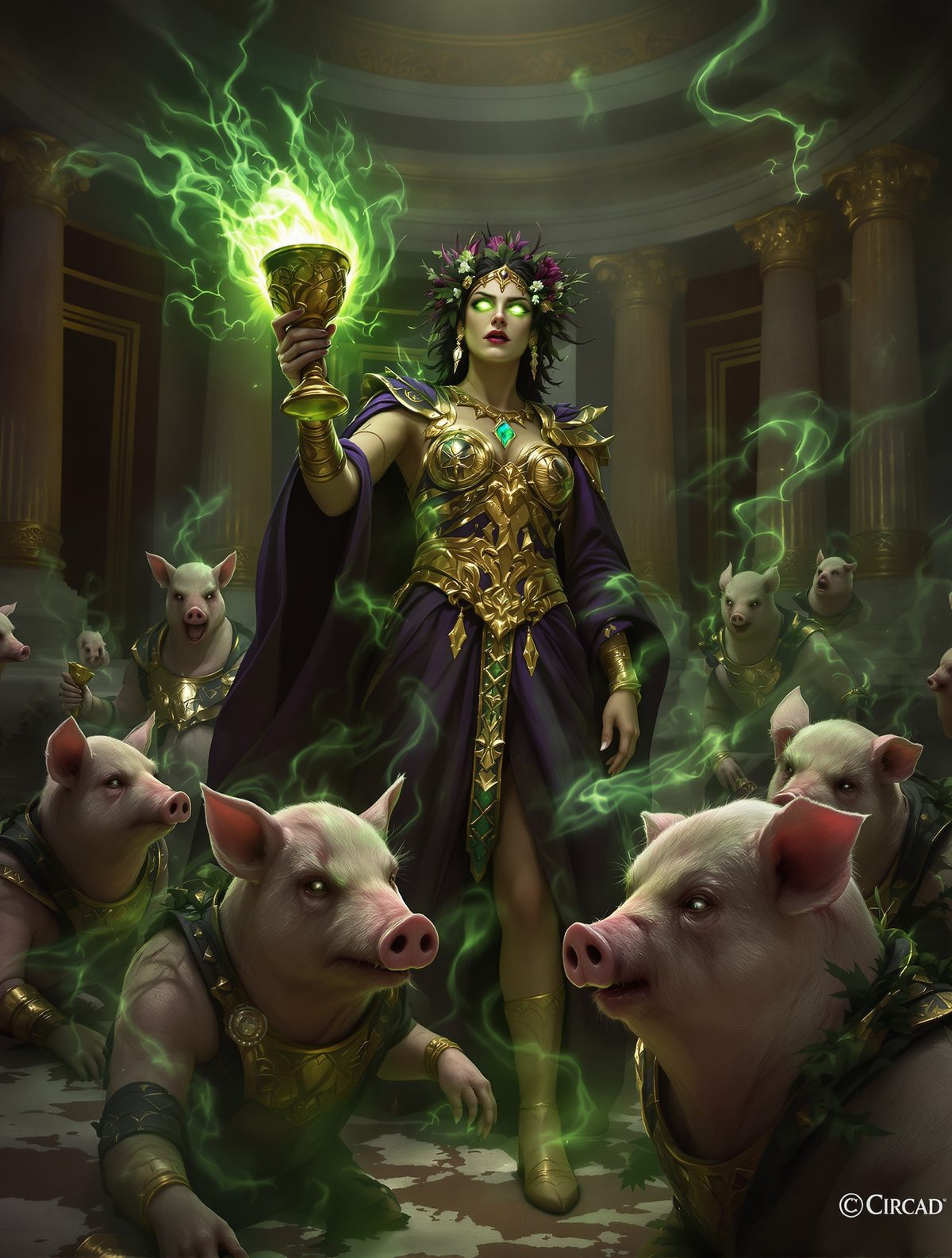
The bronze bowls gleamed in the torchlight as twenty-two Greek sailors lifted them to their lips, unaware they were about to drink their own doom. The wine was sweet with honey, perfumed with exotic herbs, and served by the most beautiful woman they had ever seen. Within moments of swallowing, their screams turned to squeals, their hands became hooves, and their proud warrior bodies twisted into the pink, snorting forms of pigs. Yet behind their beady eyes, their human minds remained perfectly intact—trapped forever in bodies that could only grunt and wallow.
This is the tale of Circe's terrible feast, one of the most visceral and psychologically horrifying episodes in all of Greek mythology. But scratch beneath the surface of this ancient story, and you'll discover layers of meaning that ancient audiences understood far better than we do today.
The Sorceress of Aeaea: More Than Just a Witch
Circe wasn't some hedge witch brewing potions in a hovel. She was a goddess—daughter of Helios, the sun god himself, and sister to Aeëtes, king of Colchis (the same ruler who would later possess the Golden Fleece). Her island of Aeaea, possibly located near modern-day Monte Circeo on Italy's coast, was described by Homer as a place where the very geography seemed alive with magic.
Ancient sources describe her palace as being built from polished stone that gleamed like mirrors, surrounded by enchanted wolves and lions that had once been men. These beasts didn't attack visitors—instead, they wagged their tails and nuzzled newcomers like loyal pets, their human intelligence still flickering behind animal eyes. Imagine the psychological horror: these creatures knew what they had become, yet were powerless to communicate their plight.
What many don't realize is that Circe's transformative powers weren't random cruelty. In the ancient world, she represented something far more complex—the dangerous allure of civilization's opposite, the wild feminine power that could strip away the thin veneer of human culture and reveal the beast beneath.
The Fateful Feast: When Heroes Became Swine
When Odysseus and his men arrived at Aeaea around 1178 BCE (according to traditional chronologies), they had already been wandering for nearly two years after the fall of Troy. These weren't fresh-faced boys—they were battle-hardened veterans who had survived ten years of brutal siege warfare and countless maritime disasters.
Yet Circe's trap was elegant in its simplicity. She invited twenty-two of Odysseus's men (Eurylochus wisely remained outside as a lookout) into her gleaming halls for what appeared to be a standard xenia—the sacred Greek custom of hospitality. The feast she provided was magnificent: barley mixed with cheese and pale honey, accompanied by her special wine.
But here's a detail most retellings miss: the transformation wasn't instantaneous magic. Ancient commentators like Eustathius noted that the men first became drunk and began behaving like animals—fighting, grunting, wallowing in their food. Only then did Circe strike them with her golden wand, completing the physical transformation that matched their degraded behavior.
The psychological torment was the cruelest part. Homer specifically tells us that "their minds remained unchanged"—trapped in pig bodies, they retained full awareness of their humanity. They could see their hands had become hooves, feel their faces stretch into snouts, yet could only communicate through squeals and grunts.
The Plant That Saved a Hero: Moly's Ancient Mystery
When Odysseus learned of his men's fate, he set out alone to face Circe—and here the story takes a fascinating botanical turn. The god Hermes intercepted him on the path and gave him a mysterious plant called moly, described as having a black root and milk-white flower, "difficult for mortal men to dig up."
For over two millennia, scholars have debated what plant Homer actually meant. The most compelling theory identifies it as Allium nigrum, a species of wild garlic native to the Mediterranean. This plant matches Homer's description perfectly: black roots, white flowers, and it's notoriously difficult to harvest because the bulbs grow deep underground.
Here's where it gets interesting: modern research has shown that certain compounds in wild garlic can indeed counteract the effects of various plant toxins and alkaloids. Ancient Greek physicians may have actually used plants in the Allium family as antidotes to poisoning. Homer might have been preserving genuine medical knowledge disguised as mythology.
Protected by the moly, Odysseus drank Circe's potion and felt nothing. When she struck him with her wand and commanded him to "go to the pigsty with your companions," he instead drew his sword and rushed at her as if to kill her—the one response she had never encountered before.
Transformation and Reversal: The Deeper Magic
What happened next reveals the story's true psychological depth. Circe didn't beg for mercy or fight back—she immediately recognized Odysseus as the man of many wiles whom prophecy had foretold would visit her island. But her offer to reverse the spell came with a condition that many modern readers overlook: Odysseus had to become her lover.
This wasn't mere seduction. In ancient Greek thought, the union between the civilized hero and the wild sorceress represented a necessary balance. Circe's magic could only be truly conquered through acceptance, not force. Odysseus had to literally embrace the wild feminine power that had destroyed his men.
The reversal scene itself was remarkably detailed. Homer describes how Circe anointed the pigs with a different drug, causing their bristles to fall away as their human forms gradually returned. But the men who emerged weren't the same warriors who had entered her halls—they were described as younger, taller, and more beautiful than before. The transformation had somehow purified them.
This detail hints at Circe's true nature: she wasn't evil, but rather a force of testing and potential renewal. Those who failed her test became beasts; those who passed through her trials emerged transformed and improved.
The Year of Forgetting: Lotus-Eaters in Disguise
Here's perhaps the most overlooked aspect of the entire episode: Odysseus and his men stayed on Aeaea for a full year. This wasn't captivity—it was willing residence in a kind of paradise. Circe provided them with unlimited food, wine, and pleasure while they "restored their strength."
Only when his men finally reminded him of their ultimate goal did Odysseus ask Circe for directions home. She agreed to help, but warned him that his path lay through the underworld itself—she was sending them to consult the dead prophet Tiresias.
This year of magical suspension mirrors other episodes in the Odyssey where Odysseus's men are seduced by supernatural forces that offer escape from the harsh realities of their quest. The men who had been pigs became, in effect, lotus-eaters—willing prisoners of a beautiful illusion.
The Beast Within: Why Ancient Audiences Shuddered
To understand why Circe's curse resonated so powerfully with ancient audiences, we must remember that the line between civilization and savagery felt far thinner to them than it does to us. Greek culture defined itself in opposition to the "barbaric" practices of their neighbors, yet they were constantly aware of how easily those boundaries could collapse.
The transformation into pigs wasn't arbitrary—swine were considered the most shameful animals in Greek culture, associated with gluttony, lust, and moral degradation. By turning warriors into pigs while leaving their minds intact, Circe forced them to experience their own bestial nature from the inside.
Modern readers might see this as fantastical, but consider how the story reads as psychological metaphor: men arrive at a place of temptation, indulge their appetites without restraint, and discover they've lost their humanity in the process. Their leader saves them only by finding the wisdom to resist temptation and engage with dangerous forces on equal terms rather than as a victim.
Perhaps that's why this ancient story still haunts us today—because we recognize the eternal truth it contains. In every age, we face our own versions of Circe's cup, whether it's the seductive pull of technology that isolates us from human connection, consumer culture that reduces us to our appetites, or political rhetoric that appeals to our basest instincts rather than our highest aspirations.
The question Homer poses remains as relevant now as it was three thousand years ago: when offered the cup that promises pleasure but delivers transformation into something less than human, do we have the wisdom to refuse? And if we drink, do we possess the courage and insight necessary to find our way back to ourselves?