The mist rolled down from Mount Sengen like the breath of some primordial beast, carrying with it the acrid stench of sulfur and decay. In the valley below, an old man named Ashinazuchi clutched his remaining daughter to his chest, knowing that tomorrow the monster would come for her too. For seven long years, the eight-headed serpent Yamata-no-Orochi had demanded its tribute—one virgin daughter per season—and now only beautiful Kushinada-hime remained alive.
But as the old farmer wept into the gathering darkness, he could not have known that a banished god walked the mountain paths above, his divine sword thirsting for a battle that would echo through Japanese legend for millennia to come.
The Beast That Devoured Mountains
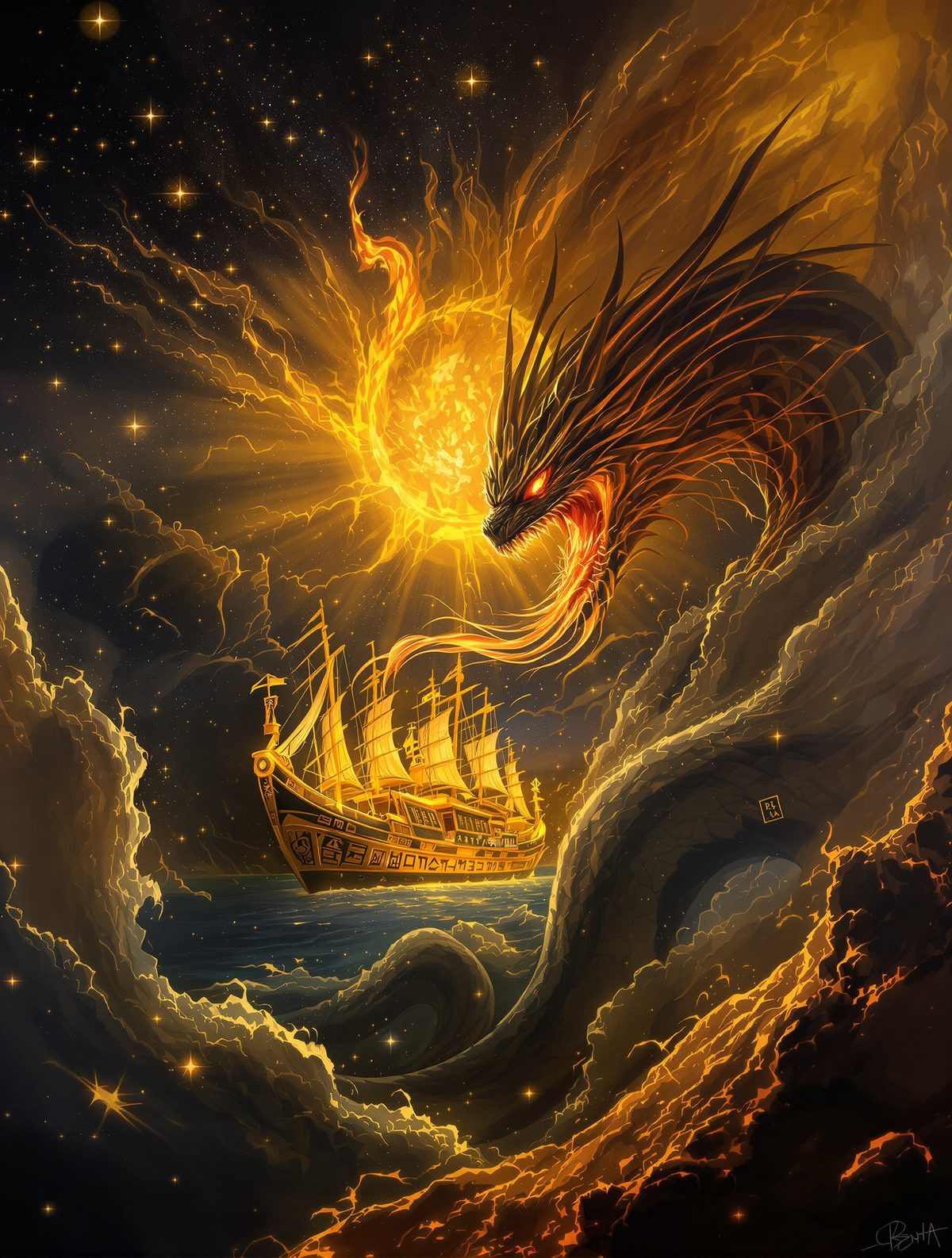
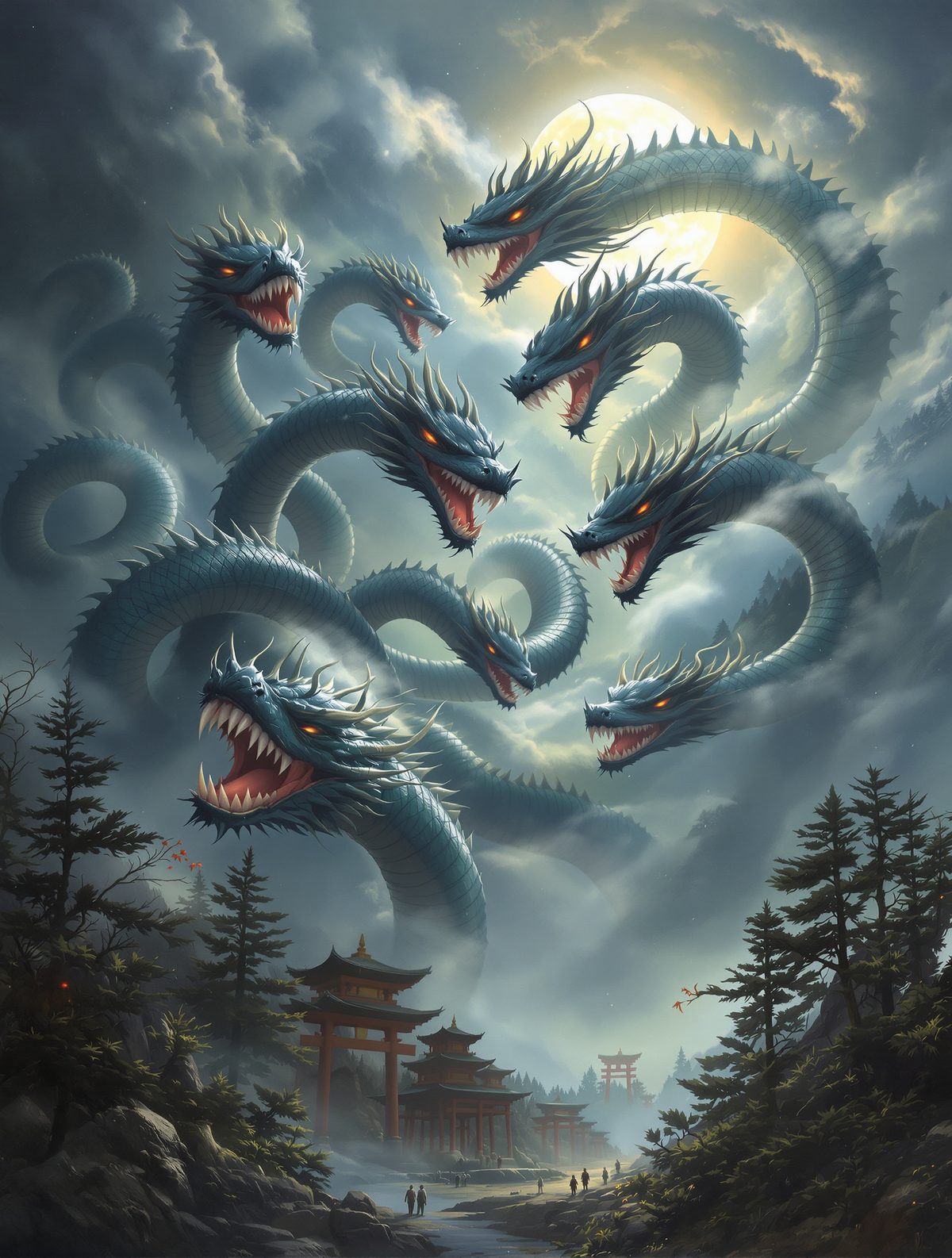
To understand the true horror of Yamata-no-Orochi, one must first grasp the sheer impossibility of its size. According to the Kojiki (Record of Ancient Matters), compiled in 712 CE, this was no ordinary serpent. The beast stretched across eight valleys and eight hills, its length so vast that moss and cypress trees grew along its back like a living mountain range. Each of its eight heads bore eyes red as winter cherries, and from its belly flowed rivers of blood that stained the earth crimson.
The name itself reveals the creature's terrifying nature: Yamata means "eight-forked" while no-Orochi translates to "great serpent." But these clinical translations fail to capture what ancient Japanese truly feared—a force of nature so vast and alien that it defied human comprehension. Imagine standing in a valley and realizing that the mountain ridges surrounding you are actually the coils of a single, breathing creature.
What makes this legend particularly chilling is its specificity. Unlike many mythological monsters that simply terrorize at random, Yamata-no-Orochi followed a deliberate, ritualistic pattern. Every year, when the autumn mists began to gather, the great serpent would descend from its mountain lair to claim its prize from the same unfortunate family.
A Father's Impossible Choice
Ashinazuchi and his wife Tenazuchi had once been blessed with eight daughters, each more beautiful than cherry blossoms in spring. Their names have been lost to time—the chroniclers focused on the survivor, not the victims—but we know they were taken in order, eldest to youngest, with the methodical precision of a cosmic harvesting.
This detail reveals something profound about ancient Japanese concepts of fate and cosmic order. The serpent didn't simply devour at random; it followed a pattern as inexorable as the seasons themselves. Each autumn, when the rice harvest should have brought celebration, brought instead the sound of Ashinazuchi's weeping echoing across the valleys.
By the eighth year, the old farmer had been hollowed out by grief. When the storm god Susanoo-no-Mikoto encountered him by the Hi River (in modern-day Shimane Prefecture), Ashinazuchi was described as crying "tears that could fill a lake." His final daughter, Kushinada-hime—whose name means "Wondrous Princess of the Rice Fields"—sat beside him, already resigned to her fate.
What's remarkable is how this story captures the helplessness of ordinary people caught in the gears of supernatural forces. Ashinazuchi wasn't a warrior or a king; he was simply a farmer who had committed no crime except having beautiful daughters. His situation reflects a universal human fear: the terror of being utterly powerless against forces beyond our control or understanding.
The Banished God's Bargain
Susanoo's arrival was no accident of timing. The storm god had recently been exiled from the heavenly realm of Takamagahara for his violent outbursts against his sister, the sun goddess Amaterasu. Cast down to earth, he wandered the mortal realm seeking purpose—or perhaps redemption through heroic deed.
When Susanoo offered to slay the great serpent in exchange for Kushinada-hime's hand in marriage, he wasn't simply playing the heroic rescuer. Ancient Japanese marriage customs involved complex negotiations and exchanges of value. By proposing this bargain, Susanoo was essentially offering to pay the ultimate bride-price: risking divine life itself.
But the storm god was also famously cunning. Rather than facing the monster in direct combat—even gods could be devoured by something the size of eight mountain ranges—he devised a plan that reveals sophisticated understanding of both chemistry and psychology. Susanoo ordered the construction of eight enormous vats, each filled with sake refined eight times over.
Here's a detail most retellings miss: the specific choice of eight-times-refined sake wasn't arbitrary. This represented the absolute pinnacle of brewing technology in ancient Japan. Such liquor would have been impossibly expensive and potent—reserved only for the most sacred ceremonies or offerings to the gods. Susanoo was essentially using the equivalent of weapons-grade alcohol as bait.
The Night of Eight Thunders
As autumn mist thickened into evening fog, Yamata-no-Orochi began its descent from the mountains. Witnesses described hearing the creature before seeing it—the sound of eight massive bodies sliding across stone, crushing forests with each movement. The ground trembled as if earthquake spirits danced beneath the earth.
When the serpent finally emerged from the mist, even Susanoo must have felt a moment of divine doubt. Each head was large enough to swallow a temple; the eyes blazed like eight red suns setting simultaneously. The creature's breath alone withered trees and turned streams to steam.
But Yamata-no-Orochi had one weakness that would prove fatal: an insatiable appetite that extended beyond virgin flesh to any pleasure offered. When the eight heads discovered the vats of refined sake, each massive mouth began drinking with the enthusiasm of a creature that had never tasted anything so perfect.
The scene that followed must have been simultaneously magnificent and terrifying. Eight heads, each the size of a house, drinking deeply from vats that could have supplied an entire village's festival. The sound alone—like eight waterfalls flowing upward—would have echoed across the valley.
As the monster drank, its movements grew sluggish, then unsteady. Finally, all eight heads collapsed simultaneously, and Yamata-no-Orochi fell into a stupor so deep that its snoring shook mountains. This was Susanoo's moment.
The Sword in the Serpent's Tail
Drawing his divine blade, Susanoo began the grim work of execution. He methodically severed each massive head, divine steel cutting through scales harder than stone. With each strike, geysers of blood erupted skyward, staining the autumn mist permanently red—a phenomenon that locals claimed could still be seen centuries later when fog rolled through the valleys.
But as the storm god worked his way along the creature's massive body, his sword struck something unexpected in the serpent's tail. The divine blade—forged in heaven itself—chipped against some impossibly hard object buried within the monster's flesh.
What Susanoo discovered would become one of Japan's three Imperial Regalia: the sword Kusanagi-no-Tsurugi, also known as Ama-no-Murakumo-no-Tsurugi (Sword of the Gathering Clouds of Heaven). This blade had apparently been lodged in the serpent's tail for unknowable eons, perhaps from some previous battle between gods and monsters.
The discovery raises tantalizing questions that ancient chroniclers never answered: Had some earlier hero wounded Yamata-no-Orochi but failed to complete the kill? Was the sword somehow the source of the creature's power, or had the monster's flesh grown around it over centuries of regeneration? The Kojiki offers no explanations, leaving us with one of mythology's great mysteries.
Echoes in the Modern World
The legend of Yamata-no-Orochi resonates today precisely because it captures something timeless about the human experience: our ongoing struggle against forces that seem too vast to comprehend, let alone defeat. In our age of climate change, global pandemics, and technological disruption, the image of an eight-headed monster demanding yearly sacrifice feels uncomfortably familiar.
Perhaps more importantly, Susanoo's victory reminds us that even the most overwhelming challenges can sometimes be overcome through intelligence rather than brute force. The storm god didn't win through superior strength—he won by understanding his enemy's weakness and exploiting it with patience and cunning.
The sword Kusanagi, pulled from the serpent's tail, still theoretically resides in Atsuta Shrine in Nagoya, though no living person has seen it in centuries. Whether it physically exists or not, it remains a powerful symbol: that even our darkest battles may contain the seeds of unexpected treasures, if we have the courage to see them through to the end.
In the valley where Yamata-no-Orochi once demanded its terrible tribute, farmers still grow rice in fields blessed by Kushinada-hime's name. Sometimes the most profound victory isn't the slaying of the monster—it's the simple act of ensuring that somewhere, beauty and life continue to flourish where terror once reigned.