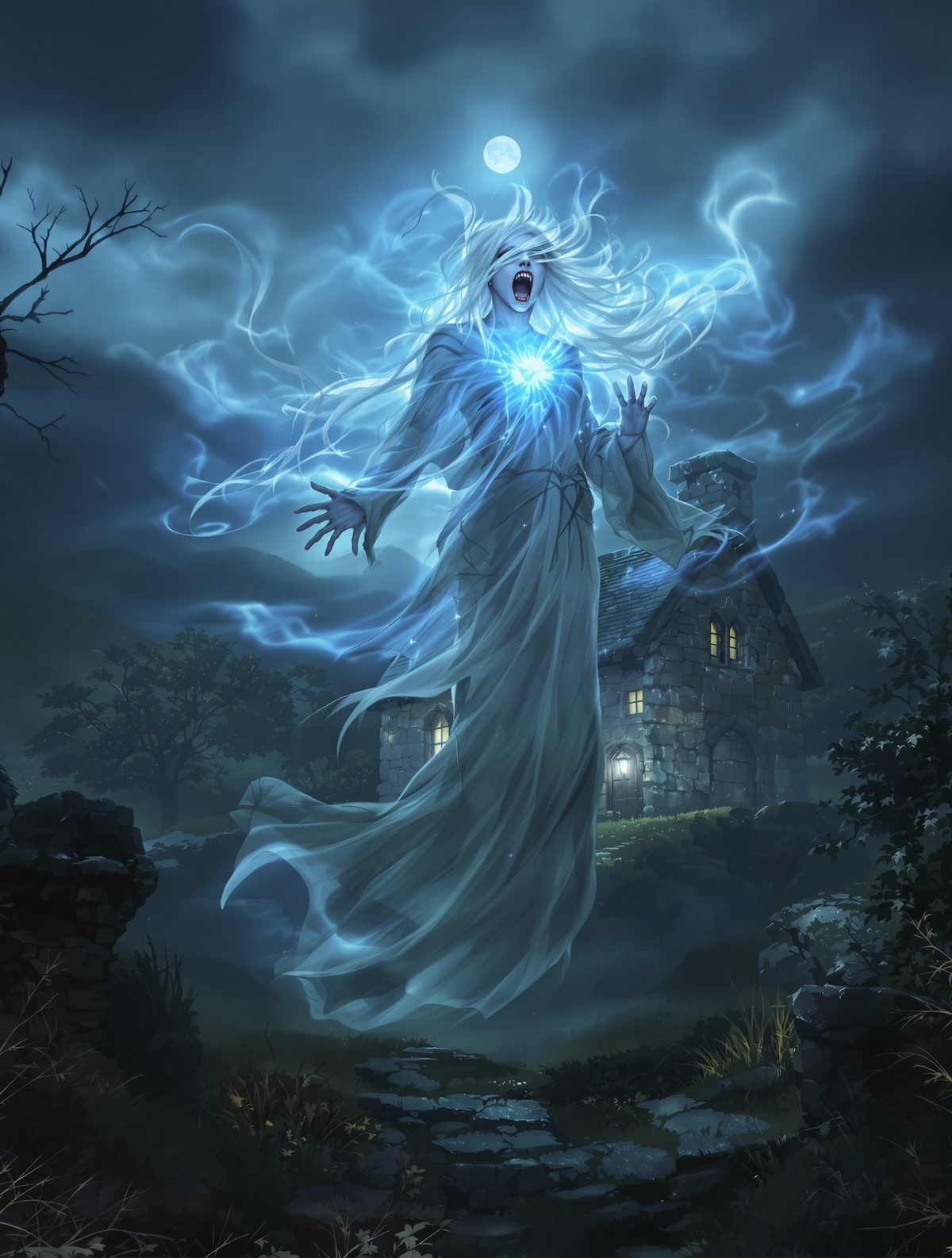
The mist clings to the ancient stones of Castle Roche in County Louth as midnight approaches. Inside, the O'Carroll family sleeps peacefully, unaware that death is already writing their names in her ledger. But outside, beneath the gnarled hawthorn tree, a figure appears—gaunt, ethereal, her gray hair streaming in a wind that touches nothing else. She raises her head to the moon and releases a wail so piercing, so filled with otherworldly grief, that it seems to tear holes in the fabric of reality itself. The banshee has come calling, and when she weeps, someone dies.
For over a thousand years, the bean sidhe—literally "woman of the fairy mounds" in Old Irish—has haunted the noble bloodlines of Ireland with her prophetic mourning. Unlike other harbingers of doom who merely predict tragedy, the banshee experiences it. Her keening carries the genuine anguish of loss for deaths that exist only in the threads of fate, making her perhaps the most tragic figure in all of Celtic mythology.
The Ancient Bloodlines She Follows
The banshee doesn't appear for just anyone. Historical accounts from the 12th century onward consistently describe her attachment to five principal Irish families: the O'Neills, the O'Briens, the O'Connors, the O'Gradys, and the Kavanaghs. These weren't chosen randomly—each claimed direct descent from the legendary kings of Ireland, their bloodlines stretching back to mythical figures like Niall of the Nine Hostages and Brian Boru.
What makes this particularly fascinating is the banshee's apparent understanding of genealogy that would impress modern DNA researchers. 17th-century accounts describe her appearing to Anglo-Norman families who had intermarried with Irish nobility, suggesting she could somehow sense royal Irish blood even when diluted by centuries of political marriages. The Fitzgeralds of Desmond, despite their Norman origins, reportedly had their own banshee after marrying into the O'Brien line in 1314.
But here's where it gets truly extraordinary: the banshee supposedly followed these bloodlines even when they emigrated. During the Great Famine of 1845-1852, Irish-American newspapers in Boston and New York published dozens of accounts from Irish immigrants who claimed to have heard the banshee's wail in their New World homes, mourning relatives who had died back in Ireland—sometimes before news of the death could possibly have reached America by ship.
Three Faces of Prophetic Sorrow
Medieval Irish manuscripts describe the banshee in three distinct forms, each tied to different types of prophetic mourning. The most commonly reported is the bean charrán—a wizened crone in gray rags who appears as a washerwoman at streams and rivers. Witnesses from County Cork in 1598 described seeing her washing bloodstained armor and clothing in the River Lee the night before the Battle of the Yellow Ford, where English forces would suffer catastrophic losses.
The second manifestation is the bean chocaire, appearing as a beautiful young woman in white or silver. This form typically appears to young men destined to die in their prime. The most famous account comes from the 1689 Siege of Derry, where multiple soldiers reported seeing a luminous woman in white walking the battlements, weeping silently. Those who saw her allegedly died within three days, always from a single, precise wound despite being in the thick of chaotic battle.
Perhaps most unsettling is the third form—the bean tighe or household banshee, who appears as a gray-clad woman of indeterminate age, often mistaken for a servant or distant relative. 16th-century chronicler Geoffrey Keating wrote of banshees who would appear inside great houses, sitting by the fire and keening softly while seemingly invisible to all but one family member—always the person destined to discover the body.
The Keen That Echoes Through Time
The banshee's cry itself deserves special attention, as it represents something far more complex than simple supernatural shrieking. The Irish tradition of caoineadh—ritual keening for the dead—was an ancient art form performed by women who served as professional mourners. These women would wail, sing, and sometimes even compose spontaneous poetry about the deceased, their voices carrying specific melodic patterns that could convey everything from the person's age to their social status.
What makes the banshee's keen supernatural isn't just its prophetic nature, but its perfect execution of this ancient art for someone not yet dead. Witnesses consistently describe hearing not just wailing, but actual songs—complete with verses about the doomed person's life, accomplishments, and the manner of their coming death. In 1641, members of the O'Neill household in Ulster reported hearing a banshee singing in perfect Gaelic about young Conn O'Neill's bravery in battle and his destined fall "beneath the yellow banner of the stranger"—three days before English forces bearing yellow standards would kill him at the Battle of Julianstown.
Even more remarkable are accounts of banshees keening in harmony. The death of Hugh O'Brien, Earl of Thomond, in 1624 was reportedly preceded by an entire night of multiple banshees singing together from different locations around his castle—a supernatural choir mourning in complex harmonies that servants described as "more beautiful and terrible than any music made by human voices."
When Prophecy Meets History
The most documented banshee encounter in Irish history occurred on the night of April 23, 1014, before the Battle of Clontarf. The Annals of Ulster and the War of the Gaedhil with the Gaill both record that banshees were heard keening throughout Dublin and the surrounding countryside. What makes this account historically significant is that multiple independent sources—Irish, Norse, and even some Anglo-Saxon chronicles—mention the otherworldly wailing.
The battle would claim the life of Brian Boru, High King of Ireland, along with his son Murchad and grandson Toirdelbach. According to the Cogadh Gaedhel re Gallaibh, the banshee's keen was so loud and persistent that it prevented anyone in the Irish camp from sleeping, leaving them exhausted before the crucial battle that would determine Ireland's fate for centuries to come.
But perhaps the most chilling historical account comes from 1649, when Oliver Cromwell's forces were besieging Drogheda. English Parliamentary records, normally dismissive of Irish "superstitions," contain multiple testimonies from English soldiers who heard unexplained wailing from the Irish quarter of the town for three consecutive nights. The wailing stopped abruptly on September 11th—the morning Cromwell breached the walls and began the massacre that would kill nearly 3,500 Irish defenders and civilians.
The Science of Supernatural Grief
Modern researchers have proposed fascinating theories about the banshee phenomenon that don't necessarily debunk it but rather suggest natural explanations for supernatural experiences. Dr. Michael Persinger's research into electromagnetic fields and temporal lobe stimulation suggests that certain geological areas—particularly those with high quartz content like much of Ireland's landscape—might generate electromagnetic anomalies that could trigger hallucinations, particularly in people under stress.
More intriguingly, some ethnomusicologists have noted that the banshee's keen shares specific tonal qualities with mourning songs found across multiple cultures worldwide—from Aboriginal Australian death chants to certain Tibetan throat singing techniques. These particular frequencies, typically between 40-60 Hz, have been shown to induce feelings of unease and grief in listeners, suggesting the banshee legend might preserve ancient knowledge about sound's psychological effects.
There's also the compelling theory that the banshee tradition represents an early form of what we now call "anticipatory grief"—the psychological phenomenon where people begin mourning someone before they actually die. In a warrior culture where death in battle was common and life expectancy short, families might have developed heightened sensitivity to signs that a loved one was in mortal danger, with the banshee serving as a cultural framework for processing these intuitions.
In our modern world, where death often comes sterile and hidden in hospitals rather than dramatically on battlefields, the banshee reminds us of a time when death was intimate, communal, and worthy of artistic expression. Her legend preserves not just a supernatural tradition, but an entire philosophy about how communities should respond to loss—with beauty, with ceremony, and with the understanding that grief shared is grief lessened. Perhaps that's why, even in our scientific age, the banshee's wail continues to echo through our collective imagination, calling us back to a more honest relationship with mortality itself.