Picture this: The world lies in absolute darkness. No sunrise promises a new day. No warmth touches the frozen earth. The gods themselves huddle in cosmic twilight, knowing that someone must die—horribly, completely—to bring light back to creation. Two volunteers step forward. One is wealthy, beautiful, adorned in jade and gold. The other is covered in festering boils, his skin a map of disease and suffering. Guess which one saves the world?
This isn't just another creation myth lost in dusty codices. This is the story of Nanahuatzin, the diseased god whose ultimate sacrifice became the blazing sun that still rises each morning—a tale that reveals profound truths about courage, humility, and the Aztec understanding of what makes a hero.
When the Fifth Sun Died
To understand Nanahuatzin's sacrifice, we must first grasp the cosmic catastrophe that preceded it. According to the Histoyre du Mechique and other colonial-era sources recording Aztec beliefs, the world had already been destroyed four times. Each previous "sun" or cosmic age had ended in cataclysm—jaguars devouring humanity, hurricanes sweeping away civilizations, fire raining from the heavens, and finally, a devastating flood that transformed people into fish.
Now the Fifth Sun lay dying, and with it, all light vanished from existence. The gods gathered at Teotihuacán—yes, that massive pyramid complex you can still visit today, which the Aztecs believed was where the gods themselves once walked. In their cosmology, this wasn't just an ancient city built by humans; it was the sacred forge where the universe was reborn.
The divine assembly faced an uncomfortable truth: creating a new sun required the ultimate sacrifice. Someone had to leap into the cosmic fire and burn completely, transforming their divine essence into solar energy. It was a one-way trip to becoming the engine that would drive all life on Earth.
The Unlikely Volunteers
Two gods stepped forward to offer themselves as cosmic fuel. The first was Tecuciztecatl, whose name means "He of the Sea Snail Shell"—a reference to the precious shells used in Mesoamerican currency. Everything about Tecuciztecatl screamed wealth and status. His feathers gleamed with gold, his skin shone unblemished, and his confidence radiated like the sun he intended to become.
The second volunteer couldn't have been more different. Nanahuatzin (sometimes called Nanahuatl) translates roughly to "He Who Is Covered with Sores." Ancient sources describe him as diseased, his body a constellation of boils and open wounds. While Tecuciztecatl prepared for his sacrifice with offerings of precious jade, colorful feathers, and balls of copal incense worth a fortune, Nanahuatzin could only manage humble bundles of green reeds, thorns from the maguey plant, and his own scabs soaked in blood.
Here's a detail that might surprise you: this wasn't portrayed as tragic or pitiable. In Aztec thought, disease often marked someone as touched by the divine. Xochiquetzal, goddess of love and beauty, was also associated with sexually transmitted diseases—not as punishment, but as a sign of her overwhelming power over human passion. Nanahuatzin's afflictions marked him as someone who had already suffered, who understood sacrifice in his very bones.
Four Days of Preparation
The ritual preparation lasted exactly four days—a sacred number in Aztec cosmology representing completeness and the four cardinal directions. During this time, both gods performed autosacrifice, piercing themselves with thorns and offering their blood to sanctify the upcoming ceremony.
But their offerings revealed everything about their characters. Tecuciztecatl's thorns were made of precious coral and jade—beautiful, valuable, but hardly painful. His "blood" was actually expensive red copal resin. Even his grass bundles were tied with genuine quetzal feathers, each worth more than most people earned in a lifetime.
Nanahuatzin, meanwhile, used actual thorns—the kind that draw real blood and leave genuine wounds. His offerings were maguey spines that had pierced his flesh, bundled with simple zacate grass and soaked in his actual blood. Where Tecuciztecatl performed sacrifice as theater, Nanahuatzin lived it as reality.
The cosmic fire blazed at the heart of Teotihuacán, so intense that later accounts say its heat could be felt from leagues away. This wasn't metaphorical—Aztec sources describe a literal bonfire large enough to consume a god, built from sacred woods and fed with offerings from across the empire.
The Moment of Truth
When the four days ended, both gods stood at the fire's edge. The heat was so overwhelming that approaching meant immediate death—which was, of course, the point. The other gods formed a sacred circle, chanting encouragement: "Take courage, Tecuciztecatl, fall into the fire!"
This is where the story takes its most revealing turn. Tecuciztecatl, for all his preparation and confidence, couldn't do it. Four times he approached the flames, and four times his nerve failed. The heat was too intense, the reality of dissolution too terrifying. His beautiful feathers and jade ornaments suddenly seemed like armor he was reluctant to shed.
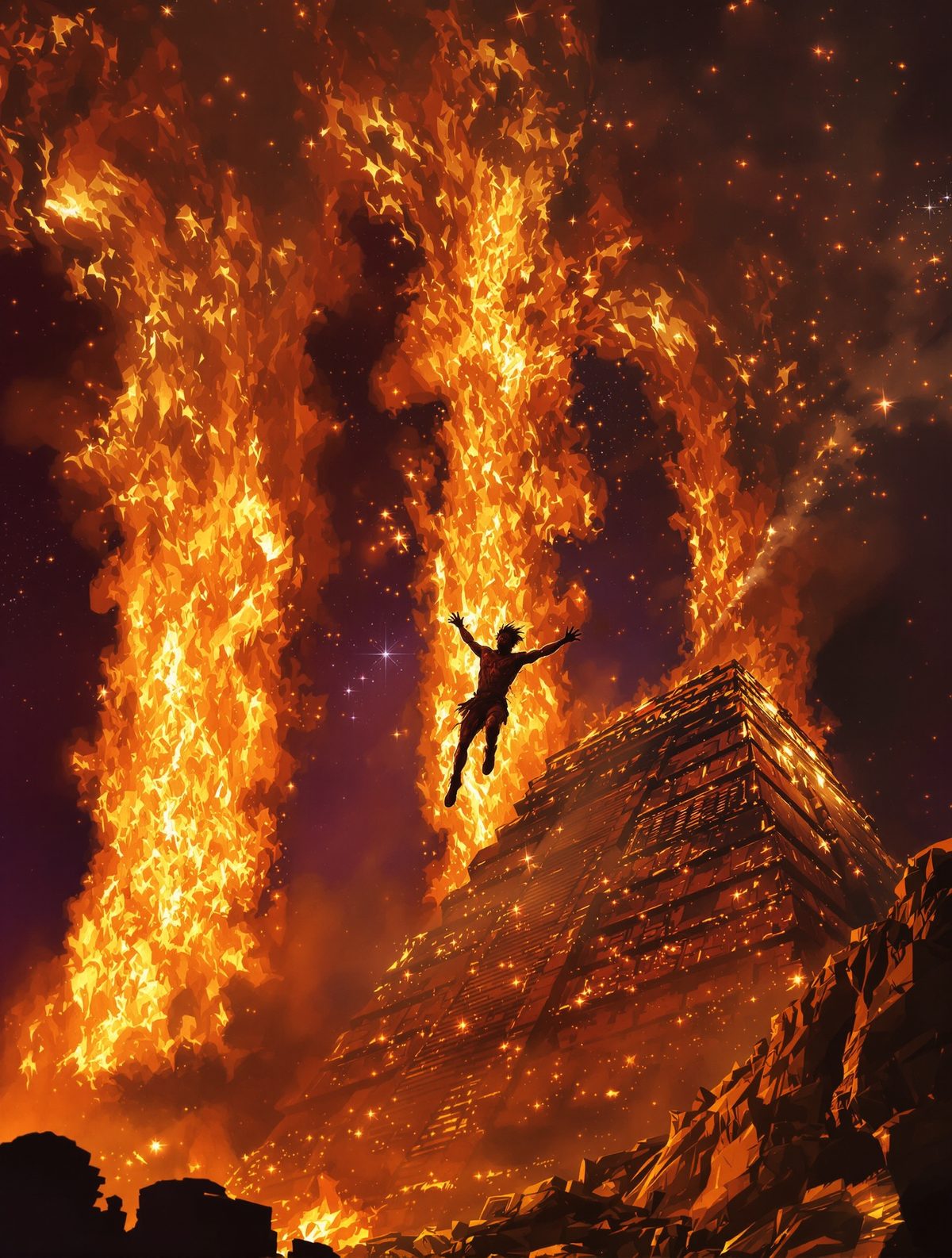
The gods turned to Nanahuatzin. "Now you try, Nanahuatzin!" And here's the kicker—he didn't hesitate. Not even for a moment. This god who had spent his existence in pain, whose body was already a testament to suffering, closed his eyes and leaped directly into the cosmic fire.
The transformation was immediate and spectacular. The flames consumed his diseased flesh, his humble offerings, his very divine essence—and from that sacrifice, the sun blazed to life. Ancient sources describe the moment as a cosmic thunderclap, light exploding across the heavens after eons of darkness.
The Birth of Sun and Moon
Seeing Nanahuatzin's success, Tecuciztecatl finally found his courage—or perhaps his shame overcame his fear. He leaped into the dying embers of the fire, but his hesitation cost him dearly. While Nanahuatzin became the brilliant sun, Tecuciztecatl emerged as merely the moon, forever dimmer, forever second.
But the story doesn't end there. In some versions of the myth, the newly born sun initially refused to move across the sky. The light existed, but it remained stationary, creating eternal day on one side of the world and endless night on the other. Only when all the other gods sacrificed themselves to provide cosmic wind did Nanahuatzin begin his daily journey across the heavens.
This detail reveals something profound about Aztec cosmology: the sun wasn't just created by sacrifice—it was sustained by it. Every dawn represented Nanahuatzin's ongoing choice to rise, to bring light and warmth to a world that could only exist through divine suffering. This is why the Aztecs practiced daily blood offerings to the sun, why their morning prayers thanked Nanahuatzin for his continued sacrifice.
The Humility of Heroes
What makes this myth extraordinary isn't just its cosmic scope, but its subversive message about heroism. In a society often stereotyped as obsessed with warfare and conquest, the greatest hero is a diseased god who succeeds through humility rather than strength, genuine sacrifice rather than mere display.
Consider how this story functioned in Aztec society. Every sunrise became a reminder that true courage comes from those who have already suffered, who understand that real sacrifice can't be performed with jade substitutes and theatrical gestures. Every dawn honored a god who was literally scarred, who found strength in what others might see as weakness.
This wasn't just mythology—it was social commentary. In a hierarchical society where noble birth and wealth determined status, the story of Nanahuatzin suggested that the universe itself was powered by humility and authentic sacrifice rather than privilege and posturing.
Today, as we face our own cosmic challenges—climate change, global inequality, the need for genuine leadership in times of crisis—perhaps Nanahuatzin's example still burns bright. The diseased god who became the sun reminds us that sometimes the most broken among us carry the fire the world needs. Sometimes the ones covered in scars are the ones brave enough to leap into the flames when everyone else hesitates at the edge.
Every sunrise is Nanahuatzin's gift to the world, born from a moment when courage mattered more than appearance, when authentic sacrifice trumped expensive performance, when a god covered in boils proved that heroes don't always look the way we expect them to.