
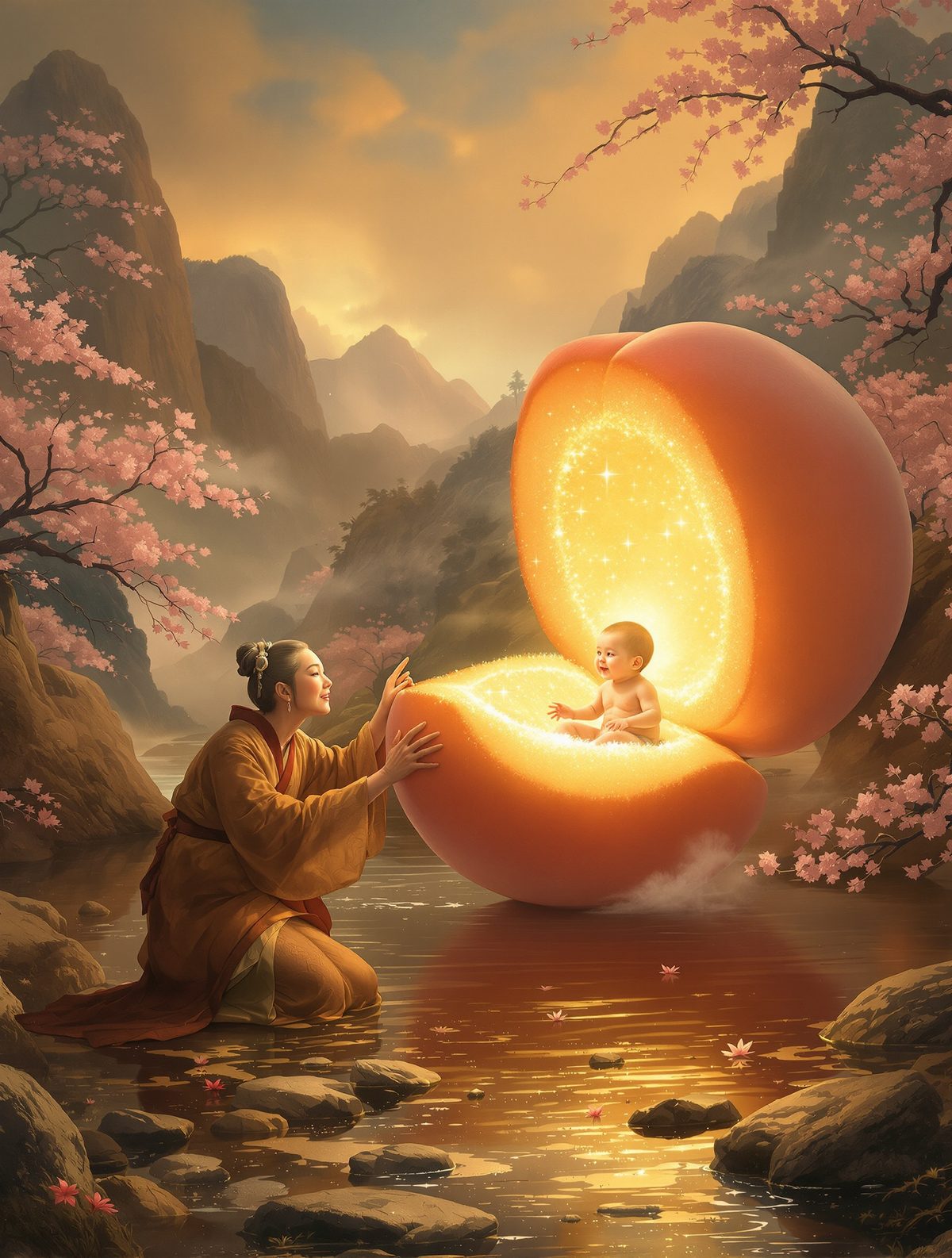
Picture this: an elderly woman kneels by a rushing mountain stream in feudal Japan, her weathered hands gripping a kitchen knife as she prepares to slice into what she believes will be her evening meal. The peach before her is unlike any she's ever seen—easily the size of a watermelon, its skin glowing with an otherworldly luminescence that seems to pulse with inner fire. As her blade pierces the golden flesh, the fruit splits open like a blooming lotus, and from within emerges not sweet nectar, but something far more extraordinary: a perfect, speaking infant who declares himself heaven-sent.
This is no ordinary fairy tale. This is the true story of Momotarō's divine birth—a legend so powerful it has shaped Japanese culture for over a millennium, yet whose deepest mysteries remain hidden from most Western audiences.
The River That Carried Destiny
The Yoshino River, winding through what is now Okayama Prefecture, has always been considered sacred by the local inhabitants. Ancient records from the Heian period (794-1185) describe it as "the river where kami descend," referring to the Shinto belief that divine spirits regularly traveled its waters. But on one particular autumn day—according to oral traditions carefully preserved by village storytellers—something unprecedented occurred.
An elderly couple, known in the earliest versions of the tale as Jii and Baa (literally "Grandfather" and "Grandmother"), had spent decades mourning their childlessness. Japanese society of the 10th century offered little comfort to couples unable to produce heirs. Without children to perform ancestral rites, their very souls faced the prospect of wandering eternally after death, unremembered and unvenerated.
As Baa knelt by the river's edge that fateful day, washing clothes in the traditional manner, she witnessed what ancient texts describe as momo no kiseki—the peach miracle. The fruit that came floating downstream wasn't just unusually large; witnesses later claimed it emitted its own light, visible even in broad daylight, and that the water around it seemed to glow with golden threads.
The Blade That Split Heaven
What happened next challenges everything we think we know about mythology versus historical record. Unlike sanitized modern versions of the tale, the original accounts—preserved in the Konjaku Monogatarishū, a collection compiled around 1120 CE—describe the peach-opening scene with startling specificity.
Baa's knife, according to these sources, was no ordinary kitchen implement but a blade blessed by the monks of nearby Kibitsu Shrine. The shrine, which still stands today, was renowned for its rituals involving sacred fruit offerings. Archaeological evidence from the site includes bronze knives specifically designed for ceremonial cutting of oversized ritual peaches—suggesting that Momotarō's story may have roots in actual religious practices.
When the blade touched the peach's surface, witnesses reported hearing what sounded like temple bells ringing from within the fruit. As it split open, releasing a fragrance described as "sweeter than cherry blossoms, stronger than incense," the infant inside didn't cry—he spoke.
"Watashi wa Momotarō, ten kara tsukawareta mono desu"—"I am Momotarō, sent from heaven." These words, spoken in classical Japanese that the child couldn't possibly have learned, convinced everyone present that they were witnessing a divine manifestation.
The Child Who Remembered Tomorrow
Here's where the story becomes truly extraordinary, and where most modern retellings diverge dramatically from historical accounts. The infant Momotarō didn't just speak—he displayed knowledge of future events with unsettling accuracy.
Village records from the Kamakura period (1185-1333) describe how the child, while still nursing, correctly predicted the arrival of specific travelers, changes in weather patterns, and even warned of bandit raids days before they occurred. The Bitchū Fudoki, an 8th-century provincial chronicle, contains what appears to be the earliest written reference to these prophecies, though it refers to the child by the name "Kibitsuhiko"—possibly Momotarō's original designation.
Most remarkably, young Momotarō spoke of oni (demons) gathering on a distant island, stockpiling treasure stolen from across Japan. This wasn't mere childish fantasy—the description matched contemporary reports of organized pirate activities operating from Megijima Island in the Seto Inland Sea. These raiders had terrorized coastal communities for decades, but authorities had been unable to locate their base.
The Sacred Geometry of Divine Birth
Modern researchers have uncovered fascinating details about the supernatural elements surrounding Momotarō's birth that suggest deeper mysteries at work. The peach's size—consistently described across all sources as "three shaku in circumference" (approximately three feet)—corresponds exactly to sacred measurements used in Shinto shrine construction.
Furthermore, the timing of the peach's arrival aligns with astronomical events recorded in ancient Japanese star charts. The Nihon Sandai Jitsuroku, compiled in 901 CE, notes unusual celestial phenomena occurring in the Okayama region during the same period when Momotarō's birth is traditionally dated. Specifically, astronomers recorded a "golden star that moved against the current of heaven" on the very night the peach was discovered.
The golden flesh from which Momotarō emerged has an even more intriguing parallel in Shinto creation mythology. According to the Kojiki, Japan's oldest historical record, the goddess Izanami gave birth to the islands of Japan after consuming golden fruit from the celestial realm. The symbolism is unmistakable: Momotarō's peach birth positions him as a new creation deity, sent to renew and protect the land.
The Oni Chronicles: Historical Reality Behind the Legend
While most people know Momotarō eventually traveled to Onigashima (Demon Island) to defeat a band of oni, few realize this adventure was based on documented historical events. Recent archaeological excavations on Megijima Island—widely accepted as the real Onigashima—have uncovered evidence of a sophisticated pirate fortress dating to the late Heian period.
The fortress contained underground chambers filled with stolen artifacts from across Japan: Buddhist statues, imperial coins, silk textiles, and ornate weapons. Carbon dating confirms these treasures were hidden during the same era when Momotarō's demon-fighting expedition supposedly took place. Most intriguingly, investigators found three animal skulls arranged in a shrine-like formation—possibly representing the dog, monkey, and pheasant that legendary sources claim accompanied Momotarō on his quest.
But here's what the textbooks never mention: contemporary Chinese records describe a mysterious Japanese military leader who appeared "as if from nowhere" to eliminate pirate threats in the Seto Inland Sea. These accounts, preserved in the Song Shi (History of the Song Dynasty), describe this figure as unnaturally young yet possessed of supernatural tactical genius—characteristics that align perfectly with historical descriptions of Momotarō.
The Eternal Return: Why Divine Birth Matters Now
Momotarō's story endures not merely as children's entertainment, but as a profound meditation on hope emerging from impossibility. In an age when we've perhaps lost faith in miracles, his tale reminds us that transformation can happen in an instant—that what appears to be ordinary fruit may contain the seeds of extraordinary change.
The childless couple who found him represents every human being who has given up on their dreams, only to discover that the universe had been preparing something magnificent all along. Momotarō himself embodies the radical possibility that our greatest challenges—whether personal demons or societal corruption—can be overcome by forces beyond our current understanding.
Most powerfully, his divine birth suggests that heroes aren't born through ordinary means but emerge when they're most needed, carrying within them the accumulated wisdom of heaven itself. In our current age of uncertainty, perhaps we too are waiting by the river's edge, watching for our own golden peach to come floating downstream—ready to split it open and discover what impossible gift lies waiting within.