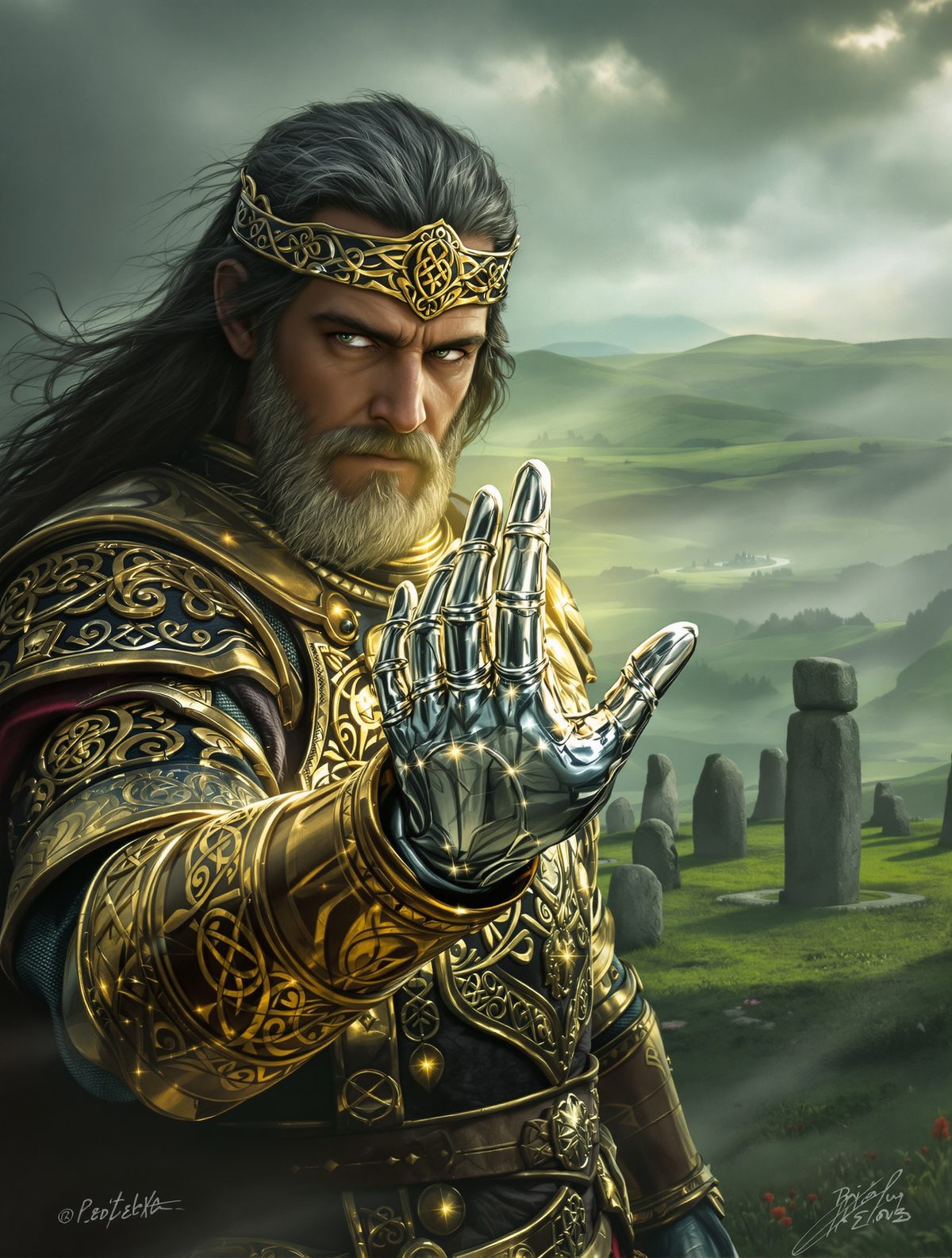
The screams of dying warriors echoed across the blood-soaked plains of Magh Tuireadh as the High King of the Tuatha Dé Danann raised his sword one final time. In a single, devastating blow from a Fomorian war-club, everything changed. Nuada Airgetlámh—whose very name would one day mean "Silver Hand"—watched in shock as his sword arm flew through the air, severed at the wrist. In that moment, he lost more than flesh and bone. He lost his kingdom.
But this is no ordinary tale of royal downfall. This is the story of how ancient magic, divine craftsmanship, and sheer determination transformed a maimed ex-king into something unprecedented: a ruler whose metal fingers would grip power tighter than any flesh ever could.
The Perfect King Falls
To understand the magnitude of Nuada's loss, we must first grasp the iron-clad laws that governed Celtic kingship in mythological Ireland. The Tuatha Dé Danann—the godlike tribe of Dana—demanded absolute perfection from their rulers. Not mere political competence or military prowess, but physical flawlessness. A king with any blemish, scar, or missing limb was fláithiúil—unfit to rule.
This wasn't mere vanity. The ancient Celts believed their king's body was mystically connected to the land itself. A wounded king meant a wounded kingdom. Crops would fail, cattle would sicken, and enemies would prosper. The concept, known as the fír flathemon or "truth of the ruler," held that only a physically perfect king could maintain the cosmic balance between the mortal and divine realms.
Nuada had been the epitome of this ideal. Tall, golden-haired, and wielding one of the four great treasures of the Tuatha Dé Danann—the unstoppable sword of Findias—he had led his people to countless victories. But the Fomorians, those ancient gods of chaos and the sea, proved different adversaries entirely.
The First Battle of Magh Tuireadh raged for four days. Archaeological evidence suggests this mythical battlefield may correspond to the plain of Moytura in County Mayo, where Bronze Age burial mounds still dot the landscape. Here, according to the 11th-century text Cath Maige Tuired, Nuada faced Sreng of the Fir Bolg in single combat—a duel that would cost him everything.
The Bitter Taste of Exile
The aftermath was swift and merciless. Despite his protests, despite his years of faithful service, Nuada was stripped of his crown within hours of his wounding. The Tuatha Dé Danann couldn't risk the mystical contamination of a blemished king. In his place, they installed Bres the Beautiful, whose Fomorian heritage they overlooked in favor of his unmarked flesh.
What followed were seven years that the Irish myths remember as the darkest in their people's history. Bres, despite his physical perfection, proved to be everything Nuada was not: cruel, miserly, and incompetent. He imposed crushing tributes on his subjects, forced noble warriors to perform menial labor, and—perhaps worst of all in a culture that prized artistic expression—refused to reward poets and musicians for their craft.
The satirist Coirpre composed what may be the first recorded poem of political protest in Irish literature: "Without food quickly served, without a cow's milk whereon a calf can grow, without a dwelling fit for a man under the gloomy night, without means to entertain a bardic company—let such be the condition of Bres."
Meanwhile, the exiled Nuada watched his kingdom crumble from afar. But the former king was not idle. He had sought out Dian Cécht, the divine physician of the Tuatha Dé Danann, whose skills in healing were legendary even among gods.
The God of Healing's Masterwork
Dian Cécht's reputation preceded him. This was the deity who had created the Well of Slane, whose waters could heal any wound short of death itself. His medical knowledge was so advanced that he jealously guarded it—legend claims he murdered his own son Miach for surpassing his skills. But for Nuada, the god was willing to attempt something unprecedented.
The crafting of the silver hand took place in secret, deep within the otherworldly halls of the Tuatha Dé Danann. Working alongside Credne the Brazier, master of metalwork, Dian Cécht began with silver of the purest quality—not mere earthly metal, but silver touched by starlight and blessed by the moon goddess Brigid herself.
The process was unlike anything attempted before or since. Each finger joint was individually forged and blessed with incantations passed down from the earliest days of creation. Sinews of silver wire, finer than spider's silk, ran through hollow bones of gleaming metal. The palm bore engravings in Ogham script—ancient Irish writing—invoking strength, wisdom, and the binding of flesh to spirit.
But the true miracle came in the joining. Using arts that the medieval scribes could only describe as "magic beyond the understanding of mortals," Dian Cécht fused the silver hand to Nuada's living flesh. The metal didn't merely attach—it integrated, becoming part of the king's very essence. Nerves of starlight connected to veins of quicksilver, allowing the artificial fingers to move with all the grace and strength of their flesh predecessors.
The King Reborn
When Nuada emerged from Dian Cécht's halls, the silver hand gleaming like captured moonlight, even his own people initially recoiled in wonder and fear. Here was something new in their world—neither fully divine nor mortal, but a fusion of both. The hand moved with fluid precision, could grip with crushing strength, and bore no trace of the weakness that flesh was heir to.
More importantly, it was perfect. The Celtic laws demanded flawless kingship, and what could be more flawless than divine craftsmanship? The silver hand bore no scars, felt no pain, and would never age or weaken. In replacing his mortal flesh with immortal metal, Nuada had paradoxically become more suitable for kingship than he had ever been before.
The deposition of Bres happened with remarkable swiftness. Faced with a people on the brink of revolt and a former king whose silver hand seemed to glow with otherworldly authority, the Fomorian pretender fled back to his own people. But rather than accepting defeat gracefully, Bres would return with the full might of his chaotic kin—setting the stage for the Second Battle of Magh Tuireadh, where Nuada would lead his people to their greatest victory.
The Hand That Gripped Destiny
Nuada's silver hand became more than just a replacement limb—it transformed into a symbol of divine favor and unconquerable will. Ancient Irish texts describe how the metal fingers never trembled, even in the face of the most terrible enemies. When gripping his sword of Findias, the hand provided such perfect control that Nuada's blade work became legendary throughout the Celtic world.
During the climactic Second Battle of Magh Tuireadh, it was Nuada's silver hand that rallied the wavering Tuatha Dé Danann forces. Witnesses described how the metal gleamed like a beacon in the chaos of battle, visible even through the supernatural mists that the Fomorians had summoned. The sight of their silver-handed king, unbreakable and eternal, gave his warriors courage that mere mortality could never have inspired.
Tragically, this same battle would claim Nuada's life. The Fomorian king Balor, whose poison eye could kill with a glance, struck down the silver-handed ruler even as victory was within grasp. But by then, Nuada had achieved something unprecedented: he had proven that perfection could be crafted as well as born, and that the will to rule could overcome any physical limitation.
The Legacy of Living Metal
Why does the story of Nuada's silver hand continue to captivate us more than a millennium after it was first recorded? Perhaps because it speaks to something fundamentally human: our refusal to accept limitations, our drive to rebuild ourselves when we are broken.
In an age where we create increasingly sophisticated prosthetics, where technology merges ever more seamlessly with biology, and where the boundaries between human and artificial intelligence blur daily, Nuada's silver hand seems less like fantasy and more like prophecy. The Celtic king who ruled with metal fingers wasn't just reclaiming his throne—he was pointing toward a future where our limitations need not define us.
The silver hand reminds us that sometimes our greatest strength comes not from what we were born with, but from what we choose to become. In losing his flesh, Nuada gained something more valuable: the proof that human will, combined with divine craftsmanship, can transcend any boundary. His metal fingers didn't just grip a sword—they grasped the very concept of unlimited human potential.