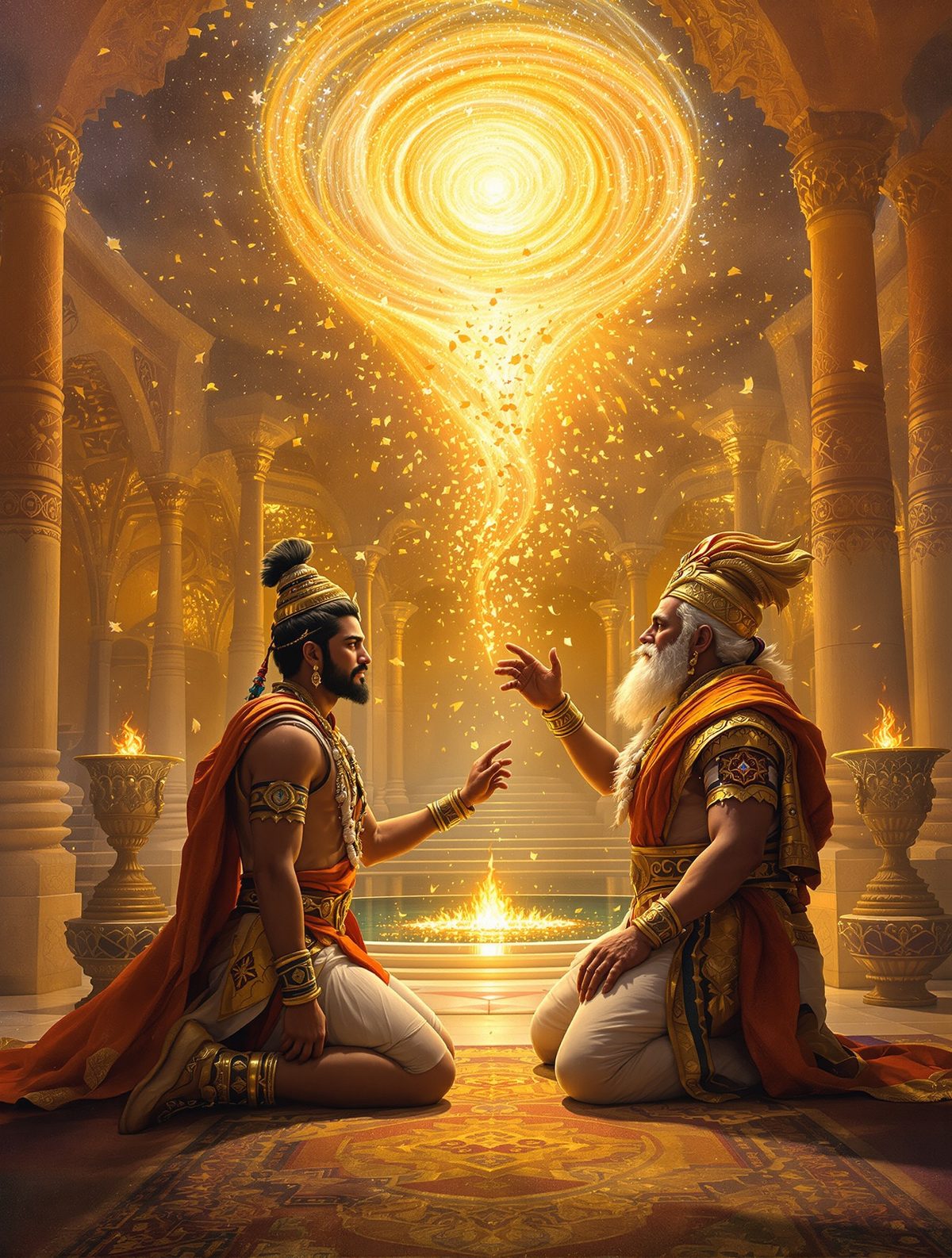
Picture this: a young prince stands by the sacred Yamuna River, his voice carrying across the waters as he speaks words that will echo through eternity. "I will never marry. I will never have children. I will never claim the throne that is rightfully mine." Above him, the heavens themselves seem to tremble. Flowers begin to rain from the sky as celestial beings witness an oath so profound, so terrible in its implications, that it defies the very purpose of human existence. This is the moment Prince Devavrata became Bhishma—the man bound by the most devastating promise in all of Hindu mythology.
What could drive a prince to destroy his own future with a handful of words? The answer lies in a love story that would reshape the fate of an entire dynasty, setting in motion events that would culminate in the greatest war the ancient world had ever seen.
The Prince Who Had Everything—Except a Mother's Love
Devavrata was no ordinary prince. Born to King Shantanu of Hastinapura and the river goddess Ganga herself, he possessed divine blood and mortal ambition in equal measure. His birth came with a price—Ganga had agreed to bear Shantanu's children only if he never questioned her actions, no matter how strange or cruel they might seem. True to her divine nature, she drowned seven of their sons in the sacred river immediately after birth, claiming she was freeing them from a terrible curse.
Only Devavrata survived, spirited away by his divine mother to be raised by the greatest teachers of the age. He learned statecraft from Brihaspati, the guru of the gods themselves. The warrior-sage Parashurama taught him the arts of war until the young prince could match his master blow for blow. When he returned to his father's court, he was the perfect heir—strong, wise, handsome, and utterly devoted to dharma.
But perfection, as Devavrata would learn, can be its own curse.
The Fisherman's Daughter Who Stole a King's Heart
Years passed in Hastinapura like pages in a well-ordered book. King Shantanu ruled wisely with his magnificent son by his side, and the kingdom prospered. Then, on a hunting expedition along the Yamuna River, fate intervened in the form of a fragrance so intoxicating it could bewitch the gods themselves.
Following the scent through the river mists, Shantanu discovered its source: Satyavati, daughter of a humble fisherman, whose beauty was matched only by the divine perfume that emanated from her very skin. What the king didn't know was that this wasn't her first encounter with divinity—years earlier, the sage Parasara had blessed her with this supernatural fragrance and granted her the gift of eternal virginity, even after bearing him a son who would grow up to become the great sage Vyasa.
For Shantanu, already familiar with divine love through his marriage to Ganga, this was more than attraction—it was obsession. The aging king, who had ruled for decades with wisdom and restraint, found himself powerless before a fisherman's daughter.
The Price of Love: A Father's Impossible Choice
When Shantanu approached Satyavati's father for her hand in marriage, he encountered an obstacle that would have made lesser men retreat. The fisherman, Dashraj, was no fool. He knew his daughter's worth and understood the politics of royal succession all too well.
"Your Majesty," Dashraj said with the careful respect of a man making an impossible demand, "I would be honored to give my daughter to you. But what security can you offer her children? Prince Devavrata is your heir. My daughter's sons would be nothing but footnotes in the great book of your dynasty."
The demand was clear: make Satyavati's future children the heirs to Hastinapura's throne. For Shantanu, this meant disinheriting Devavrata—the perfect son who had never given him a moment's trouble, who embodied every virtue a king could want in an heir.
Torn between love and duty, Shantanu made perhaps the most human choice of his life. He walked away. But love, as poets know, is rarely so easily conquered. The king returned to his palace a changed man—distracted, melancholic, aging visibly by the day as he pined for what he could not have.
The Son's Ultimate Sacrifice: A Vow That Shook Heaven and Earth
Devavrata watched his father waste away with the keen eye of a son who loved too deeply to remain silent. When he finally discovered the cause of Shantanu's suffering, the prince didn't hesitate. He went straight to Dashraj's humble dwelling by the river, ready to negotiate what his father could not.
"I renounce my claim to the throne," Devavrata declared, his words falling like stones into still water. "Any son born to Satyavati shall be the rightful heir to Hastinapura."
But the fisherman was craftier than the prince had anticipated. "What of your sons, noble prince? What of their claims? A grandson's ambition might prove stronger than a father's promise."
It was then that Devavrata spoke the words that would define him for eternity, his voice carrying the weight of absolute conviction: "I, Devavrata, son of Shantanu and Ganga, do hereby swear before gods and men that I shall never marry. I shall never father children. I shall remain celibate for all the days of my life, however long they may be."
The effect was immediate and supernatural. The very air seemed to crystallize around his words. From the heavens above, flowers began to fall like rain—roses, jasmine, lotus petals—a divine acknowledgment of a vow so profound it transcended mortal understanding. A voice boomed from the sky, whether from Indra, king of gods, or the cosmic forces themselves: "From this day forth, you shall be known as Bhishma—he of the terrible vow. And as reward for this sacrifice, death shall come to you only when you will it."
The Terrible Gift: When Immortality Becomes a Curse
Shantanu's joy at his son's sacrifice was matched only by his horror at its implications. In a moment of overwhelmed gratitude, he granted Bhishma the boon of ichcha-mrityu—the power to choose the moment of his own death. It seemed like a gift, but would prove to be another chain binding the prince to a life of service and suffering.
Satyavati bore Shantanu two sons: Chitrangada and Vichitravirya. Both would die young—Chitrangada in battle with a gandharva, Vichitravirya of illness before producing an heir. The throne that Bhishma had sacrificed everything to secure for Satyavati's lineage seemed destined to remain empty.
But Bhishma's vow held firm. Even as he watched lesser men inherit what should have been his, even as he served as regent and protector to increasingly unworthy successors, even as the kingdom he loved slipped toward civil war, he never wavered. His celibacy became legendary, his loyalty absolute, his isolation complete.
The Legacy of a Terrible Promise
Bhishma's story didn't end with his vow—it was just beginning. He would live to see Satyavati's lineage continued through her first son, the sage Vyasa, who would father the next generation through niyoga. He would watch those children—Dhritarashtra, Pandu, and Vidura—grow to adulthood and begin the cycle of rivalries that would tear the kingdom apart.
Most tragically of all, he would live to see his terrible vow's ultimate consequence: a civil war between his great-grandnephews, the Pandavas and Kauravas, fought on the blood-soaked field of Kurukshetra. Bound by his oath of loyalty to the throne of Hastinapura, Bhishma would be forced to fight against the righteous Pandavas, even knowing they were in the right.
When the warrior Arjuna finally brought him down—shooting him full of arrows until he became a human pincushion—Bhishma lay on that bed of arrows for 58 days, waiting for the auspicious moment to die, contemplating a lifetime spent serving a vow that had brought more suffering than joy to everyone it was meant to protect.
In our modern world, where commitment is increasingly rare and sacrifice often seen as foolishness, Bhishma's story resonates with uncomfortable power. His vow asks the ultimate question: when does devotion become destruction? When does love become the very thing that destroys what it seeks to protect? Perhaps the gods rained flowers not in celebration, but in mourning for a young man who chose duty so absolute it severed him from the very humanity he sought to serve.
Bhishma's terrible vow reminds us that some promises, once made, echo through lifetimes—and that the greatest tragedies often spring not from evil intentions, but from good people making impossible choices in the name of love.