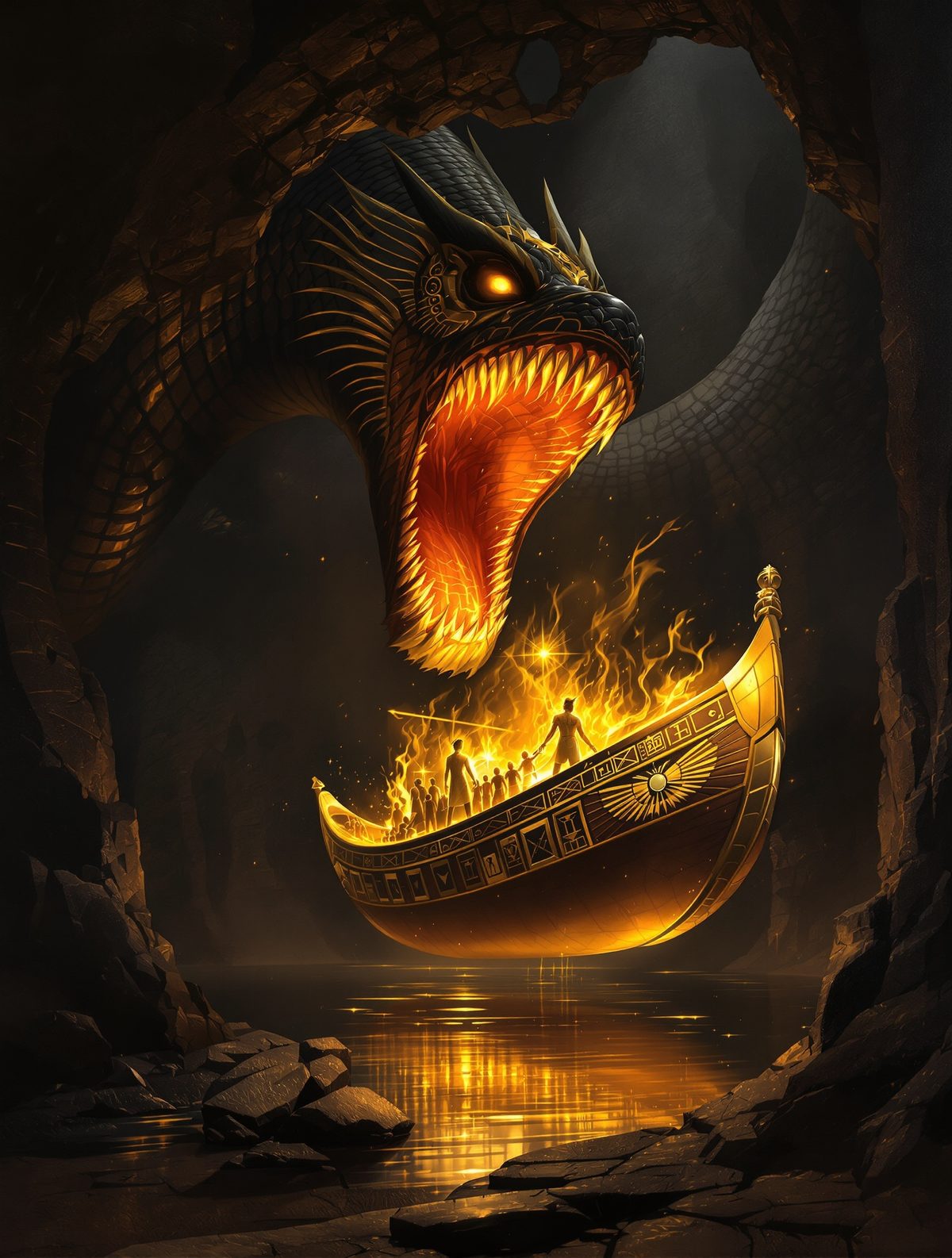
Picture this: it's 3000 BCE along the Nile, and the sun has just vanished below the western horizon. In villages from Memphis to Thebes, Egyptian families huddle together, whispering prayers into the gathering darkness. They know what's happening in the realm beyond sight—their beloved sun god Ra is sailing his golden barge through the treacherous waters of the Duat, the Egyptian underworld. And somewhere in that primordial darkness, a serpent the size of a mountain range is opening jaws that could swallow eternity itself.
This wasn't just mythology to the ancient Egyptians. This was their daily reality—a cosmic battle between order and chaos that determined whether tomorrow would ever come. Every eclipse, every cloudy day, every moment when shadows seemed too long was evidence that Apep, the serpent of destruction, was winning his eternal war against the light.
The Serpent Born from Cosmic Spit
Apep wasn't your garden-variety mythological monster. According to the Pyramid Texts—some of the oldest religious writings in human history, dating back to 2400 BCE—this serpent emerged from the primordial waters of Nun, born from the spit of the goddess Neith. But here's where it gets truly bizarre: Apep was considered so fundamentally evil that he was never actually created. Instead, Egyptian theology insisted he had always existed, a primordial force of chaos that predated even the gods themselves.
The ancient Egyptians described Apep as stretching for miles, his scales darker than the deepest cave, his eyes like dying stars. Some texts claim he was 50 cubits long—roughly 75 feet—but other sources suggest this was merely the length of his head. The Book of Overthrowing Apep, a collection of spells dating to around 350 BCE, describes him as dwelling in the deepest part of the underworld, in a place called "the Lake of Fire," where he regenerated each day, ready to devour the sun anew.
But here's what most people don't realize: Apep represented something far more sophisticated than simple evil. To the Egyptians, he embodied isfet—the concept of chaos, disorder, and everything that threatened the delicate balance of ma'at (cosmic order). He wasn't just trying to eat Ra out of hunger or malice; he was the universe's tendency toward entropy made manifest.
Ra's Perilous Journey Through the Hours of Night
Every sunset triggered what the Egyptians considered the most important event in the cosmos: Ra's journey through the Duat. This wasn't a peaceful cruise down the celestial Nile. The sun god traveled in his mesektet boat—his "night bark"—accompanied by a crew of protective deities including Sia (divine knowledge), Hu (divine utterance), and the fierce lioness goddess Bastet.
The journey was divided into twelve hours, each presenting its own deadly challenges. Ancient papyri like the Amduat (literally "That Which Is in the Duat") provide detailed maps of this underworld voyage, complete with the names of gates, the passwords required to pass through them, and the specific demons Ra would encounter. These weren't just religious texts—they were essentially ancient GPS systems for navigating the afterlife.
But the seventh hour was when terror reached its peak. This was when Ra's boat entered the domain of Apep, and the cosmic serpent would launch his attack. According to the Book of Gates, another funerary text from around 1550 BCE, Apep would rear up from the primordial waters, his mouth agape, creating a whirlpool of darkness that threatened to drag the entire solar barge into oblivion.
What happened next was perhaps the most dramatic scene in all of Egyptian mythology: Apep would successfully swallow Ra's boat whole. For hours—sometimes the entire length of an eclipse—the sun god would be trapped inside the serpent's belly, fighting desperately to cut his way out while the world above remained locked in darkness.
The Divine Rescue Squad
Fortunately for Ra (and for every living thing that depended on sunlight), he wasn't fighting alone. The Egyptian pantheon deployed what amounted to a divine special forces unit to ensure the sun god's daily resurrection. Leading this celestial SWAT team was Set—yes, the same Set famous for murdering his brother Osiris—who, in this context, served as Ra's primary bodyguard and Apep-slayer.
The irony is delicious: Set, god of chaos and violence, was the one designated to fight the ultimate embodiment of chaos. Ancient Egyptian religion was nothing if not comfortable with paradox. Standing at the prow of Ra's boat with a massive spear, Set would battle Apep throughout the night, stabbing the serpent repeatedly while Ra worked to restore cosmic order from within the beast's belly.
But Set wasn't the only member of this supernatural rescue squad. The god Atum would speak Apep's "secret name"—a concept central to Egyptian magic, where knowing something's true name gave you power over it. Meanwhile, the goddess Isis would weave protective spells, and the ibis-headed Thoth would record the battle's progress, ensuring that cosmic law was properly maintained.
Perhaps most fascinating of all was the role of deceased pharaohs in this nightly drama. According to tomb inscriptions from the Valley of the Kings, dead kings were expected to join Ra's crew and help fight Apep. This wasn't symbolic—the Egyptians literally believed that their mummified rulers spent eternity as cosmic warriors, battling chaos every single night to ensure the sun would rise.
The Rituals That Kept the World Spinning
The ancient Egyptians weren't content to leave this battle entirely to the gods. They developed an elaborate series of daily rituals designed to help Ra defeat Apep, performed in temples across Egypt with the precision of a military operation. The most important of these ceremonies took place at the Temple of Karnak, where priests would perform the "Overthrowing of Apep" ritual every dawn and dusk.
These rituals were surprisingly violent. Priests would create wax figures of Apep—sometimes several feet long—and subject them to elaborate torture. They would stab the serpent effigies with knives, burn them with fire, and spit on them while reciting spells from the Book of Overthrowing Apep. The ritual culminated with the complete destruction of the wax serpent, its remains scattered to the winds.
But here's the truly remarkable part: these ceremonies were considered so crucial to maintaining cosmic order that they continued for over 3,000 years, from the Old Kingdom through the Roman period. Even when foreign rulers controlled Egypt—Greeks, Romans, Persians—they maintained the anti-Apep rituals, recognizing that the local population considered them essential to the functioning of the universe.
During solar eclipses, these rituals reached fever pitch. The partial or total darkening of the sun was seen as evidence that Apep was gaining the upper hand in his cosmic struggle with Ra. Entire communities would participate in noise-making ceremonies—banging pots, shouting, playing instruments—designed to help Ra fight his way out of the serpent's belly. Similar practices existed across the ancient world, but the Egyptian version was uniquely systematic, with detailed instructions preserved on papyrus for how to conduct emergency anti-Apep operations.
When the Serpent Actually Won
Of course, there were times when all the rituals and divine intervention seemed to fail—when Apep appeared to achieve temporary victory. Solar eclipses were the most obvious example, but the Egyptians also interpreted other natural phenomena through the lens of this cosmic battle. Unusually long nights during winter months, severe storms that blocked the sun, and even the annual flooding of the Nile (which temporarily darkened the river) were all seen as evidence of Apep's power.
The most terrifying scenario of all was the possibility that Apep might achieve permanent victory—that one day, the sun simply wouldn't rise. This apocalyptic vision was described in several Egyptian texts, including the Instructions for Merikare, which warned of a time when "the sun disc is covered" and "the earth is in darkness." Such fears weren't entirely irrational; the ancient world experienced genuine astronomical events that must have seemed like the end of the world, including major volcanic eruptions that darkened skies for months.
Interestingly, some texts suggest that Apep's victory was not only possible but inevitable—that the cosmic cycle itself required periodic returns to primordial chaos before order could be restored. This sophisticated understanding of cycles of destruction and renewal places Egyptian mythology alongside the most complex theological systems ever developed.
The Eternal Battle That Never Ends
What makes the Ra-Apep struggle so compelling isn't just its dramatic imagery, but what it reveals about ancient Egyptian psychology. These people understood, perhaps better than any civilization before or since, that existence itself is fragile—that the difference between order and chaos, between life and death, between meaning and meaninglessness, is as thin as the moment between night and dawn.
Every morning for over three millennia, Egyptians woke up and saw the sunrise as evidence that their gods, their rituals, and their cosmic understanding were working. The sun didn't rise because of gravity and planetary rotation—it rose because they had helped Ra escape from Apep's jaws once again. In an age without scientific explanation for natural phenomena, this mythology provided something precious: a sense of agency in an uncertain universe.
Today, when we face our own forms of chaos—climate change, social upheaval, global pandemics—the Egyptian vision of eternal vigilance against entropy feels strikingly relevant. Perhaps the real lesson of Apep and Ra isn't about ancient superstition, but about the eternal human need to believe that consciousness, order, and light can triumph over the forces that would swallow them whole. The battle never ends, but every dawn is proof that it can be won, one day at a time.