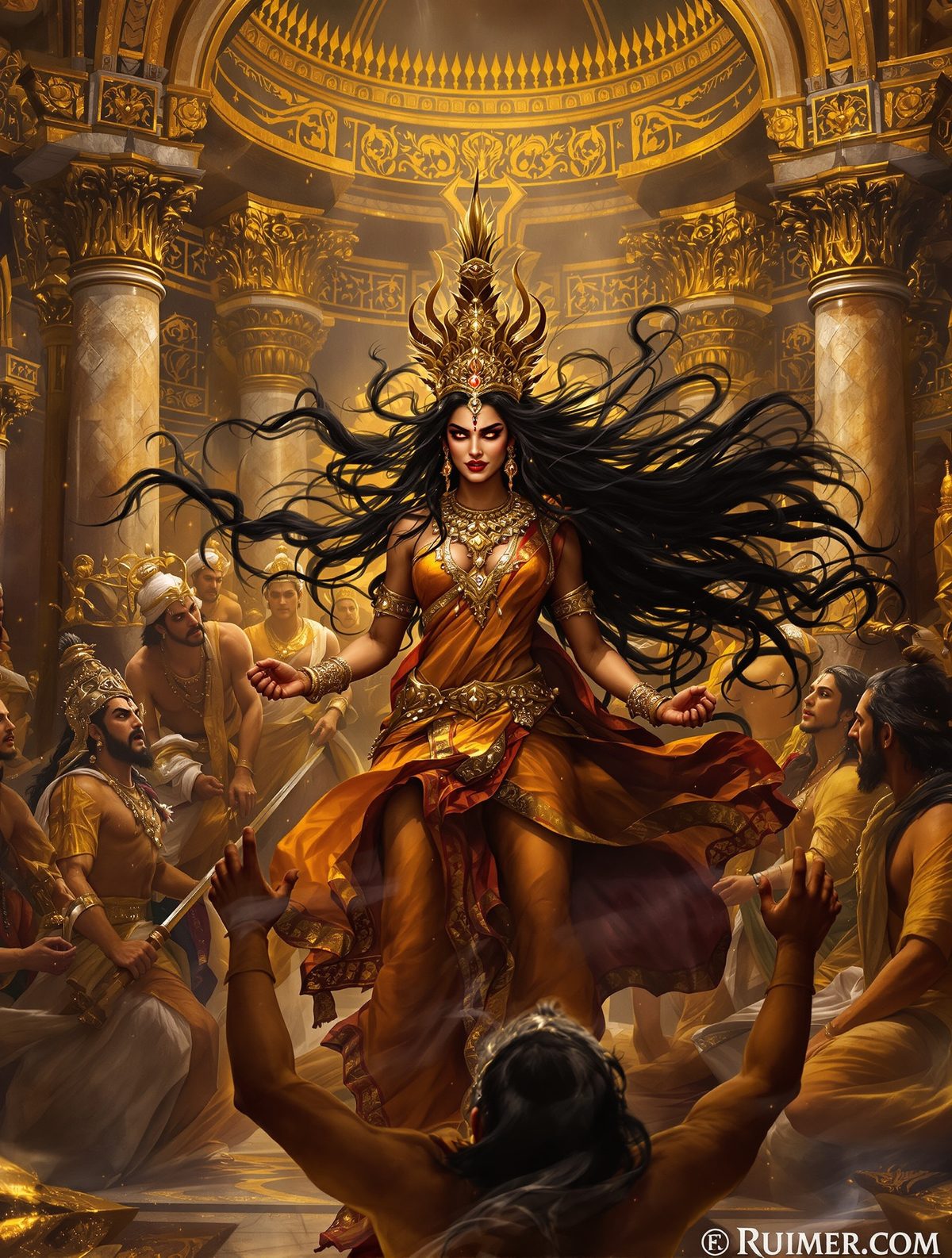
In the vast halls of Hastinapura's royal court, where marble columns stretched toward gilded ceilings and the scent of sandalwood hung heavy in the air, a woman's scream pierced the afternoon silence. It was 3102 BCE, and Princess Draupadi—wife to five princes, daughter of fire itself—was being dragged across cold stone by her lustrous black hair. But as the cruel prince Dushasana's fingers twisted through her tresses, he had no idea he was lighting the fuse that would detonate an empire and leave millions dead on the battlefield of Kurukshetra.
The oath Draupadi made that day, her hair streaming wild behind her as tears of rage burned her cheeks, would echo through thirteen years of exile and planning. Her unbound locks became more than a symbol of dishonor—they became a battle standard that would unite armies and topple dynasties. This is the story of how one woman's hair became the most feared weapon in ancient India.
The Humiliation That Shook Heaven and Earth
The dice had been rolling for hours in the palace of Hastinapura, their ivory faces determining the fate of kingdoms. Prince Yudhishthira, eldest of the Pandava brothers, had already lost his wealth, his kingdom, and his brothers to his cousin Duryodhana's rigged game. In a moment of desperate madness, he made one final, catastrophic wager: his wife, Draupadi.
When the dice settled and Yudhishthira's loss became absolute, the court fell silent. Even the torches seemed to flicker with uncertainty. Duryodhana's eyes gleamed as he ordered his brother Dushasana to fetch their new "slave" from the women's quarters.
What happened next violated every sacred law of dharma. Draupadi, in her monthly cycle and wearing only a single garment, was dragged by her hair into the assembly of kings and nobles. Her long, dark tresses—considered the crowning glory of Indian womanhood—became instruments of her degradation as Dushasana wound them around his fist and pulled.
But here's what most versions leave out: Draupadi wasn't just any princess. Born from sacred fire during her father King Drupada's revenge ceremony, she possessed divine knowledge and an unbreakable will. As Dushasana began to disrobe her before the assembly of men, she closed her eyes and called upon Krishna himself. Legend says her sari became infinite, unwinding endlessly as the prince pulled, until he collapsed in exhaustion surrounded by mountains of cloth.
Words That Carved Fate in Stone
Rising to her feet in that hall of stunned silence, her hair disheveled and eyes blazing with divine fury, Draupadi spoke words that would haunt the Kaurava dynasty: "I will not bind my hair until I wash it in Dushasana's blood. Let it remain open as witness to this humiliation until the day I drag him by his hair as he has dragged me by mine."
The assembled kings shifted uncomfortably. In ancient Indian tradition, a woman's unbound hair in public was a sign of either extreme grief or terrible curse. For a married woman of royal blood to leave her hair loose was to signal that the cosmic order itself had been shattered.
But Draupadi wasn't finished. Her voice carrying the authority of the sacred fire from which she was born, she continued: "And when that blood flows, it will water the seeds of a war that will leave not one Kaurava alive to remember this day."
Elder Bhishma, the grandfather of both royal houses and witness to centuries of history, later said that in that moment, he felt the earth itself shudder. The ancient texts describe how birds fell silent across the kingdom and temple flames flickered without wind—nature itself recoiling from the magnitude of the oath.
Thirteen Years of Unbound Fury
For the next thirteen years of exile—twelve in the wilderness and one in hiding—Draupadi's hair remained loose. Her five husbands, the mighty Pandava brothers, were forced to watch their wife move through the world with her shame visible for all to see. Each day, her unbraided locks served as a reminder of their failure to protect her and their obligation to seek vengeance.
The psychological warfare was devastating. Across the subcontinent, stories spread of the princess with unbound hair whose curse hung over the Kaurava throne. Potential allies began to reconsider their loyalties. Who wanted to stand with a dynasty marked for divine destruction?
During their exile, the Pandavas encountered numerous kings and warriors. Each meeting began the same way—with shocked stares at Draupadi's loose hair and whispered questions about the curse she carried. The brilliant military strategist Arjuna later wrote that his wife's hair became their most effective recruiting tool: men joined their cause not just for politics or profit, but because they believed they were fighting alongside destiny itself.
Perhaps most remarkably, Draupadi never once wavered in her resolve. Despite numerous opportunities to bind her hair—during religious ceremonies where tradition demanded it, in moments of celebration, or simply for comfort during the harsh forest years—she refused. The texts describe how she would sometimes weep while combing the tangles from her locks, but never once reach for a hair tie or braid.
The Hair That Launched a Thousand Ships of War
When the Pandavas finally returned from exile to claim their kingdom, negotiations for peace began. Krishna himself, serving as diplomat, attempted to prevent the coming war. But every proposal foundered on one unshakeable obstacle: Draupadi's oath.
At the peace conference in Hastinapura, she appeared before both armies with her hair flowing loose, just as it had been for thirteen years. The sight reportedly reduced several Kaurava warriors to tears—not of pity, but of terror at the supernatural persistence of her curse. Dushasana himself is said to have fainted when he saw her approach.
The war that followed was unlike anything in recorded history. The Mahabharata describes eighteen days of battle at Kurukshetra that left 1.66 billion warriors dead—a number that represented virtually every fighting man on the Indian subcontinent at the time. Archaeological evidence from the region still reveals layers of ash and iron consistent with an enormous ancient conflict.
Throughout the carnage, Draupadi waited. She had seen her hair in dreams, flowing free in the wind above fields of corpses, until finally it would touch the blood of the one who had dishonored it.
The Promise Fulfilled in Blood and Victory
On the seventeenth day of battle, the moment finally came. Bhima, strongest of the Pandava brothers and Draupadi's husband, faced Dushasana in single combat. The fight was mercifully brief—thirteen years of rage had given Bhima strength beyond mortal limits.
What followed was gruesome even by ancient warfare standards. Bhima tore open Dushasana's chest with his bare hands, pulled out his enemy's blood-soaked heart, and brought it to Draupadi. There, on the battlefield of Kurukshetra, surrounded by the corpses of two armies, she finally washed her hair.
The ancient texts describe how she dipped her long tresses into the warm blood, working it through from root to tip as she had worked oil through her hair as a young bride. Only when every strand was cleansed in her enemy's life did she finally, for the first time in thirteen years, braid her hair and bind it properly.
Warriors from both sides reportedly stopped fighting to watch this grisly ceremony. When it was finished and Draupadi stood with her hair properly dressed, a great silence fell over the battlefield. The curse was lifted, but at a cost that left the subcontinent nearly empty of kings and kingdoms.
The Strands That Still Bind Us
Today, in temples across India, women still whisper prayers to Draupadi before binding their hair each morning. Her story reminds us that sometimes the most powerful acts of resistance are the quietest ones—the daily choice to leave visible the wounds others would prefer to forget.
In our modern world of social media outrage cycles and hashtag movements, Draupadi's thirteen-year commitment to her cause feels almost impossible to imagine. She carried her trauma publicly, transforming personal humiliation into political power through sheer persistence. Her unbound hair became proof that some injustices cannot be swept away with apologies or buried under time.
Perhaps most remarkably, she understood that in a world where women's bodies are controlled and policed, the simple act of refusing to conform to expectations of feminine presentation becomes revolution itself. Every day for thirteen years, she chose to make her society uncomfortable with visual evidence of its failures.
The war that followed may have destroyed an empire, but it also proved that no dynasty, no matter how powerful, can survive when half the population refuses to forgive or forget. Draupadi's hair wasn't just a symbol of personal honor—it was a thread that, when pulled, unraveled an entire civilization that had forgotten how to treat women as human beings rather than property to be won, lost, and humiliated at will.