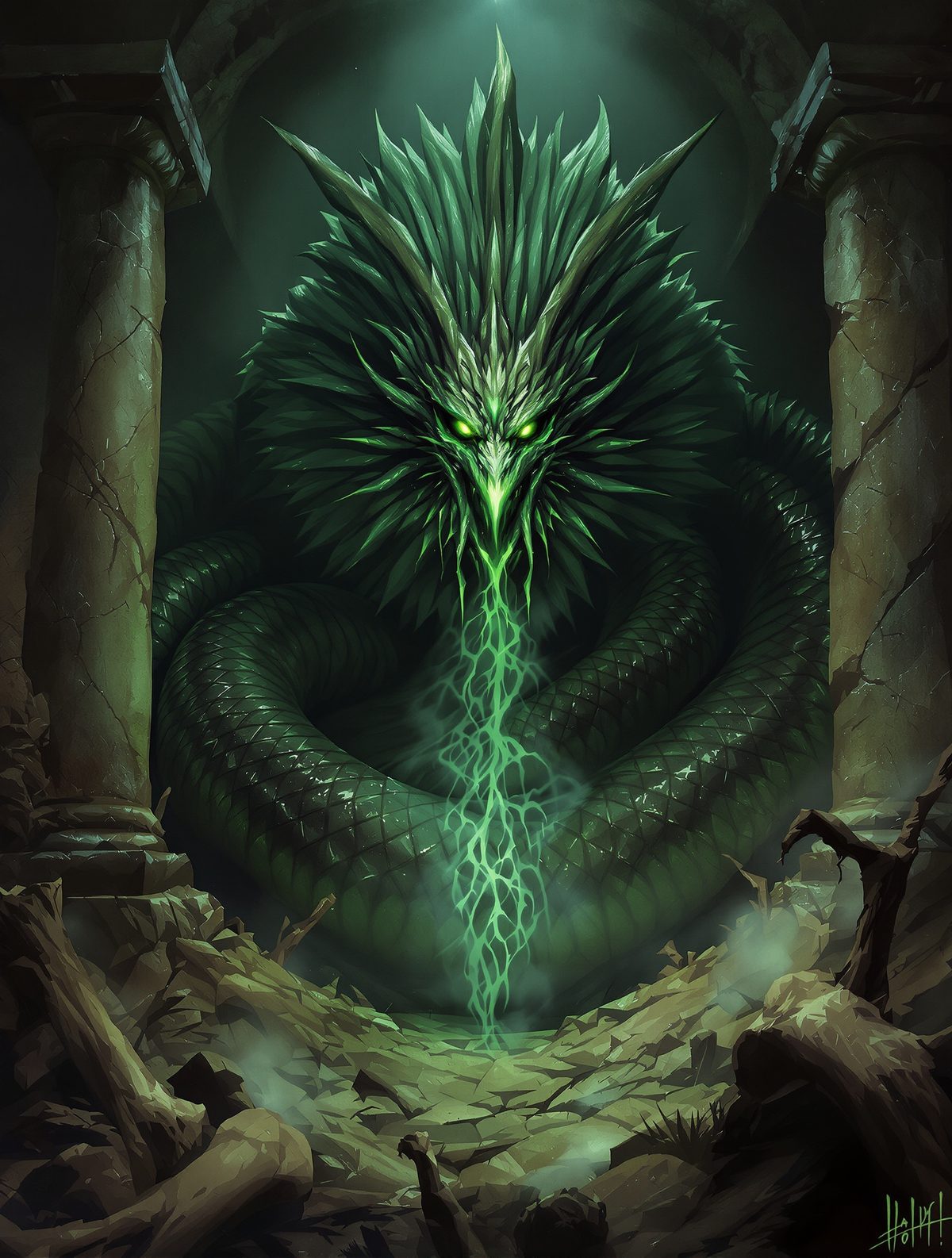
In the year 1587, the Italian naturalist Ulisse Aldrovandi penned a chilling account that would make even the bravest medieval knight's blood run cold. He described a creature so deadly that merely catching its reflection in a mirror could kill a man instantly, whose breath could split solid rock, and whose very presence turned fertile land into barren wasteland. This was no ordinary serpent—this was the Basilisk, the undisputed King of Serpents, whose reign of terror stretched across centuries of European folklore and whose legend was so pervasive that it influenced everything from medieval bestiaries to the architecture of cathedral grotesques.
But what made this creature so terrifying wasn't just its supernatural powers—it was the very real fear it instilled in medieval minds, fear so profound that entire villages would be abandoned at the mere rumor of its presence. The Basilisk represented something far more sinister than a simple monster story. It embodied humanity's deepest anxieties about corruption, death, and the thin line between the natural and supernatural worlds.
Born of Darkness and Unholy Union
The origins of the Basilisk read like a recipe from hell's own cookbook, and medieval scholars took these instructions with deadly seriousness. According to the Etymologiae of Isidore of Seville, written in the 7th century, the creature's birth required a precise and unnatural sequence of events that could only occur through dark sorcery or cosmic misalignment.
The process began with a serpent's egg—not just any serpent, but specifically one laid during the dog days of summer when Sirius blazed brightest in the sky. This egg had to be perfectly spherical, lacking the typical oblong shape of normal reptilian eggs. But here's where the legend takes its most bizarre turn: this serpent's egg had to be incubated not by its mother, but by a cockerel—a male rooster that had somehow been compelled to sit upon the egg as if brooding.
Medieval chroniclers like Alexander Neckam, writing in the 12th century, insisted that this unholy incubation period lasted exactly sixty-six days. During this time, the egg would emit a foul odor that could wither plants within a hundred paces. When the creature finally hatched, it emerged not as a typical snake, but as something far more sinister—a serpent bearing a distinctive crown-like crest, yellow eyes that glowed with inner fire, and a body that seemed to absorb light itself.
What makes this origin story particularly fascinating is how seriously it was taken by medieval authorities. In 1474, a rooster in Basel, Switzerland, was actually put on trial and executed for the "crime" of laying an egg—such was the terror that the mere possibility of Basilisk creation could inspire in medieval communities.
The Anatomy of Annihilation
Medieval bestiaries described the Basilisk with the meticulous detail typically reserved for actual animals, suggesting just how real this creature was to the medieval mind. According to the Aberdeen Bestiary, completed around 1200, the Basilisk measured exactly twelve fingers in length—roughly nine inches—making it deceptively small for such a powerful creature.
But size meant nothing when the creature possessed the most lethal gaze in all of creation. The Basilisk's eyes were said to contain concentrated death itself. Unlike the Medusa's gaze that turned victims to stone, the Basilisk's stare worked far more insidiously—it transformed the victim's blood into venom, causing them to die from their own corrupted life force. Medieval physicians like Albertus Magnus, writing in the 13th century, theorized that the creature's eyes emitted invisible "death rays" that could penetrate any material except polished metal.
The creature's breath presented an equally terrifying threat. According to the Physiologus, an influential 2nd-century text that shaped medieval understanding of natural history, the Basilisk's exhalation could split boulders, wither entire forests, and create permanent zones of desolation. The 13th-century scholar Bartholomeus Anglicus claimed that the creature's breath was so toxic that it could kill birds flying overhead at heights of up to 200 feet.
Perhaps most unnervingly, even the Basilisk's reflection retained its deadly properties. Medieval mirrors, polished metal surfaces that provided imperfect reflections, were considered especially dangerous because they might show a distorted image of the creature that could still prove fatal. This belief was so widespread that many medieval homes kept mirrors covered or turned toward walls as a precautionary measure.
Encounters from the Crypt of History
While the Basilisk may have been mythical, the documented encounters with the creature reveal fascinating insights into medieval psychology and social dynamics. The most famous recorded encounter occurred in Vienna in 1212, during the reign of Frederick II. According to the Chronica Majora of Matthew Paris, a Basilisk took up residence in the cellars beneath the city's market square, and its presence was blamed for a mysterious plague that killed dozens of residents.
The city's response reveals the medieval approach to supernatural threats: they didn't call for knights or warriors, but for Brother Johannes, a Benedictine monk known for his learning in natural philosophy. Armed with a polished shield and accompanied by a rooster—the Basilisk's natural enemy—Brother Johannes descended into the cellars. According to the chronicle, he used his shield as a mirror to reflect the creature's deadly gaze back upon itself, causing the Basilisk to die from its own power.
What's particularly striking about this account is its practical details. The chronicler notes that Brother Johannes wore leather gloves treated with holy water, carried a vial of unicorn horn powder (believed to neutralize poison), and most importantly, brought multiple roosters in cages. This last detail reflects one of the most curious aspects of Basilisk lore—the creature's inexplicable vulnerability to roosters.
Another documented encounter comes from the chronicles of Regensburg in 1405, where a Basilisk allegedly appeared in the wine cellars of the Benedictine monastery of St. Emmeram. The monks reported that entire barrels of wine turned to vinegar overnight, and the monastery's cats and dogs fled the building en masse. The creature was eventually "defeated" when the monastery's rooster crowed at dawn, though skeptical modern historians note that this particular incident coincided suspiciously with a corruption scandal involving the monastery's wine stores.
The Rooster's Paradox: Natural Enemy of the Unnatural
Of all the curious aspects of Basilisk lore, none is more intriguing than the creature's fatal weakness to roosters. This vulnerability seems almost comically anticlimactic—the most deadly creature in medieval imagination could be destroyed by common barnyard fowl. Yet this paradox reveals deeper medieval beliefs about the cosmic order and the power of dawn, renewal, and divine providence.
According to medieval natural philosophers like Vincent of Beauvais, writing in the 13th century, the rooster's power over the Basilisk stemmed from its role as herald of the dawn. Since the Basilisk was fundamentally a creature of darkness and corruption, the rooster's crow—which announced the return of God's light each day—represented a direct challenge to the creature's very existence.
This weakness was considered so reliable that medieval armies supposedly carried roosters specifically for protection against Basilisk attacks. The De Re Militari of Roberto Valturio, published in 1472, includes detailed instructions for transporting war-roosters and positioning them strategically around military camps. While no battle accounts specifically mention Basilisk encounters, the mere fact that military manuals included such preparations speaks to the pervasive nature of the belief.
Interestingly, the rooster's protective power was believed to work even after death. Medieval apothecaries sold rooster feathers, ground rooster bones, and preserved rooster blood as protective talismans against Basilisk encounters. The city of Florence's sumptuary laws from 1456 actually regulated the price of rooster-based anti-Basilisk remedies, suggesting a thriving market in supernatural protection.
The Basilisk's Shadow Across Medieval Culture
The influence of Basilisk legend extended far beyond simple monster stories, permeating medieval art, architecture, literature, and even legal proceedings. Cathedral sculptors across Europe incorporated Basilisk motifs into their grotesques and gargoyles—not merely as decoration, but as active protection against evil influences. The famous Basilisk carving on Cologne Cathedral, completed in 1322, was positioned specifically to "guard" the main entrance with its deadly gaze turned outward against malevolent forces.
Medieval illuminated manuscripts reveal the creature's cultural significance through their careful artistic choices. In the Queen Mary Psalter, created around 1310, the Basilisk appears alongside other creatures in the margins, but uniquely, it's the only animal depicted with its eyes closed—even the illustrator feared to draw its deadly gaze directly.
Perhaps most surprisingly, Basilisk beliefs influenced medieval jurisprudence. Court records from Toulouse in 1390 describe a murder trial where the defendant claimed he killed his victim in self-defense, believing the man to be a Basilisk in human form. While the court ultimately rejected this defense, the fact that it was seriously considered reveals how deeply these beliefs penetrated medieval consciousness.
The creature also appeared in medieval medical texts as both a source of deadly poison and, paradoxically, powerful medicine. The Practica Medicina of John of Gaddesden, physician to Edward II of England, describes treatments using powdered Basilisk bone for various ailments—though he cautions that obtaining such ingredients required "the utmost care and divine protection."
Legacy of the Lethal Stare
The Basilisk's enduring power lies not in its reality, but in what it represented to medieval minds grappling with invisible threats, corruption, and the fragility of life. In an age before germ theory, when disease could strike without warning and death often came suddenly and inexplicably, the Basilisk embodied the very real terror of forces beyond human control or understanding.
Today, as we face our own invisible threats—from viral pandemics to digital surveillance to environmental toxins—the medieval Basilisk seems less like ancient superstition and more like a prescient metaphor. The creature's power to kill through sight alone eerily parallels our modern anxieties about radiation, toxic exposure, and other invisible dangers that can destroy life through mere proximity.
Moreover, the Basilisk legend's emphasis on corruption and contamination—the way it turned fertile land barren and pure blood to poison—speaks to contemporary fears about environmental destruction and the corruption of natural systems. Perhaps most relevant of all is the creature's weakness to something as simple as a rooster's crow, suggesting that even the most terrifying threats might have unexpected, humble solutions.
The King of Serpents may never have existed, but the fears it embodied remain eternally human. In understanding why our ancestors believed in creatures like the Basilisk, we better understand ourselves—and perhaps find wisdom in their conviction that even the deadliest gaze could be defeated by the simple herald of dawn.