The realgar wine glowed amber in the flickering candlelight of the modest Hangzhou home, its bitter fragrance cutting through the humid air of the fifth day of the fifth lunar month. Across the wooden table, Xu Xian raised his cup with the practiced reverence of tradition, unaware that he was about to witness something that would shatter not only his perception of reality, but his very heart. His beloved wife Bai Suzhen hesitated, her porcelain fingers trembling around the cup's rim. In that moment of hesitation lay a secret that had taken her a thousand years to perfect—and would take only seconds to destroy.
The Perfect Deception: A Love Built on Lies
For three blissful years, Bai Suzhen had mastered the art of being human. Every morning, she would carefully arrange her long black hair in the elaborate style favored by women of the Southern Song Dynasty, her movements deliberately measured to mimic mortal grace. She had learned to breathe in the shallow, quick pants of human lungs rather than the deep, slow rhythm that came naturally to her serpentine nature. Most challenging of all, she had trained herself to feel genuinely warm to the touch, suppressing the cool-blooded temperature that would have immediately betrayed her true form.
The deception had begun years earlier on the rain-soaked causeway of West Lake, where she had first encountered the young scholar Xu Xian. Disguised as a beautiful woman caught in a sudden downpour, she had accepted his offered umbrella with practiced vulnerability. What started as calculated manipulation—a way to repay a kindness he had shown her in a previous lifetime—had evolved into something far more dangerous: genuine love.
Their courtship unfolded like a perfectly choreographed dance. Bai Suzhen displayed just the right amount of shyness, the appropriate level of education for a woman of good family, and an almost supernatural ability to anticipate her suitor's needs. Because it was supernatural, whispered the few who suspected something otherworldly about the beautiful stranger who had appeared from nowhere. But Xu Xian, besotted and blinded by affection, dismissed such gossip as the jealous murmurings of those who envied his good fortune.
The Alchemy of Transformation: How Spirits Became Human
What the people of 12th-century Hangzhou didn't understand—and what modern readers might find fascinating—is the incredible complexity involved in a spirit's transformation into human form. According to the detailed accounts preserved in classical Chinese texts like the Taiping Guangji and later elaborations in Ming Dynasty literature, the process required not just magical power, but an intimate understanding of human physiology that would impress modern medical students.
Bai Suzhen had spent decades studying human women, learning to replicate everything from the specific gravity of human tears to the precise rate of pulse that would feel normal under a lover's touch. She had to consciously control her body temperature, maintain the illusion of breathing, and most challenging of all, suppress her natural ability to sense heat signatures and vibrations—skills that would have seemed suspiciously acute to her human companions.
The white snake spirit had also mastered the subtleties of human emotion, learning to blush on command, to let her voice quaver with the right amount of nervousness, and to display the thousand small imperfections that make humans believable. Her performance was so convincing that she had begun to fool herself, sometimes forgetting for hours at a time that she was anything other than Xu Xian's devoted wife.
The Festival of Reckoning: When Tradition Becomes Trap
The Dragon Boat Festival of 1174 arrived with the usual fanfare. Throughout Hangzhou, families prepared the traditional zongzi—sticky rice wrapped in bamboo leaves—and hung bunches of mugwort above their doorways to ward off evil spirits. But the most crucial tradition was the consumption of realgar wine, a potent mixture of rice wine and arsenic sulfide that was believed to purify the body and drive away demons.
For centuries, Chinese families had observed this ritual without question. The orange-red powder dissolved into wine created a bitter, almost medicinal drink that was said to strengthen human constitution while proving toxic to supernatural beings. What most people didn't realize was that this wasn't mere superstition—realgar wine actually worked as advertised, functioning as a kind of mystical litmus test that could strip away spiritual disguises.
As the sun set on that fateful evening, Bai Suzhen found herself trapped between two impossible choices. Refusing to drink would arouse suspicion and potentially expose her secret. But consuming the realgar wine would trigger an involuntary transformation that would reveal her true nature with devastating clarity. For the first time in three years, her perfect control began to slip.
The Moment of Truth: When Love Meets Reality
Xu Xian, ever the devoted husband, had prepared the realgar wine himself, grinding the mineral with care and mixing it according to recipes passed down through generations of his family. He had no idea that he was essentially preparing a supernatural truth serum, one that would unravel the greatest deception of his life.
"To health and long life," he toasted, his eyes bright with affection as he looked across at his wife. Bai Suzhen forced a smile, knowing that her definition of "long life" operated on a completely different scale than his. She had already lived through several human lifetimes, and if her secret remained safe, she would outlive him by centuries.
The first sip burned her throat with an intensity that no human would have experienced. As the realgar entered her system, Bai Suzhen felt her carefully maintained human form beginning to destabilize. Her vision shifted, colors becoming more vivid as her serpentine sight reasserted itself. Her hearing sharpened until she could detect the frightened racing of her husband's heart, though he didn't yet understand why he should be afraid.
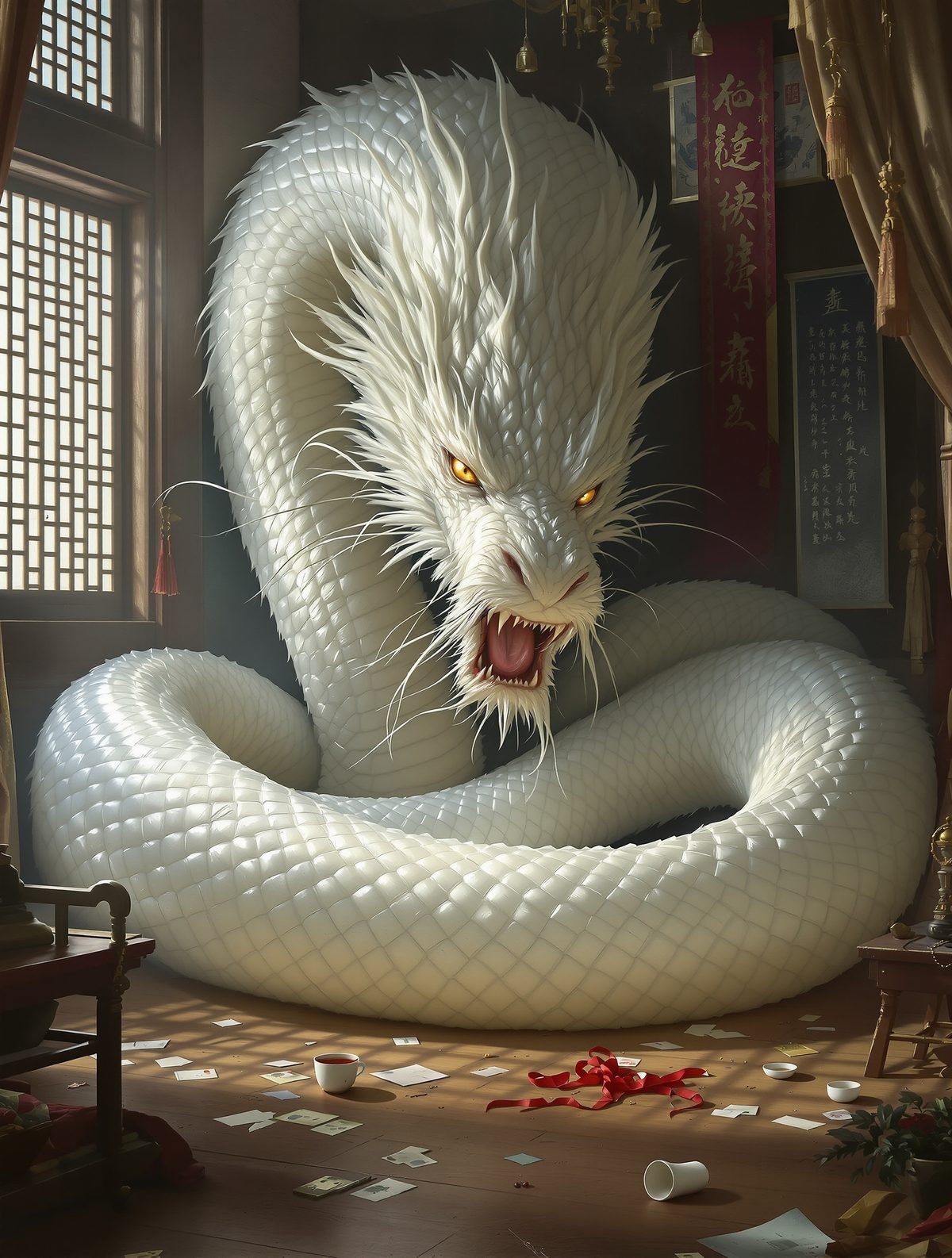
Within minutes, the transformation began in earnest. Her skin took on an otherworldly luminescence, scales shimmering beneath what had appeared to be smooth human flesh. Her spine began to elongate, and her legs merged into the powerful coils of her true form—a massive white serpent, beautiful and terrible in equal measure.
The Price of Truth: Death by Revelation
What happened next became the stuff of legend, whispered in teahouses and recorded by scholars who understood that some truths are too powerful for mortal minds to process. Xu Xian, confronted with the sight of his beloved wife transformed into a creature of myth and nightmare, suffered what modern medicine would recognize as acute cardiovascular shock.
The psychological trauma of realizing that his entire marriage had been built on deception, combined with the supernatural terror of witnessing an impossible transformation, proved too much for his human constitution. He collapsed where he sat, his heart simply stopping from the overwhelming impossibility of what he had witnessed.
Bai Suzhen, now fully revealed in her serpentine glory, coiled around her husband's lifeless form with a grief that transcended species. Her keening wail was said to have shattered every piece of porcelain in the house and sent ripples across the normally placid surface of West Lake. For all her supernatural power, she had proven helpless to prevent the one outcome she had most feared—that love and truth could not coexist in the same space.
The Eternal Question: Must Love Require Truth?
The tragedy of Bai Suzhen and Xu Xian continues to resonate more than eight centuries after it was first recorded, because it forces us to confront uncomfortable questions about the nature of authentic relationships. In our modern age of social media personas and carefully curated identities, we might ask: how different are we from Bai Suzhen, constructing elaborate performances designed to make us more loveable?
The story suggests that some truths are too dangerous for love to survive, yet also demonstrates that deception, no matter how well-intentioned, carries the seeds of its own destruction. Perhaps the real tragedy isn't that Bai Suzhen was a snake, but that love in its purest form demands a level of honesty that can be literally fatal to those unprepared to receive it.
In traditional Chinese culture, the tale served as both a warning about the dangers of supernatural deception and a meditation on the price of crossing boundaries between different worlds. But for contemporary readers, it might offer something even more valuable: a reminder that the masks we wear to make ourselves loveable often become the very things that make genuine connection impossible.