Picture this: you know exactly when the wooden horse will roll through Troy's gates. You see the flames that will consume your city, the blood that will soak its stones, the screams that will echo through its halls. You run through the streets, desperate to warn everyone you love. But when you open your mouth, they look at you with pity, shake their heads, and whisper about "poor mad Cassandra" behind your back. This was the exquisite torture designed by a spurned god—a curse so perfectly crafted that it would echo through millennia as the ultimate symbol of tragic irony.
Welcome to the story of Cassandra's kiss—perhaps the most devastating "gift" ever given in all of mythology, and certainly the most misunderstood curse in human literature.
The Golden God's Bargain
In the shadow of Troy's towering walls, around 1250 BCE according to traditional dating, lived Princess Cassandra, daughter of King Priam and Queen Hecuba. She was renowned not just for her beauty, but for her sharp intellect and devotion to the temple arts. It was this combination that caught the attention of Apollo, the golden god of prophecy, music, and poetry—among many other things.
Apollo was no stranger to mortal romance. His list of lovers reads like a who's who of ancient mythology: Daphne (who literally turned into a tree to escape him), Coronis, Hyacinthus, and dozens of others. But Cassandra was different. She possessed something that intrigued the god who knew everything before it happened—she was genuinely unpredictable.
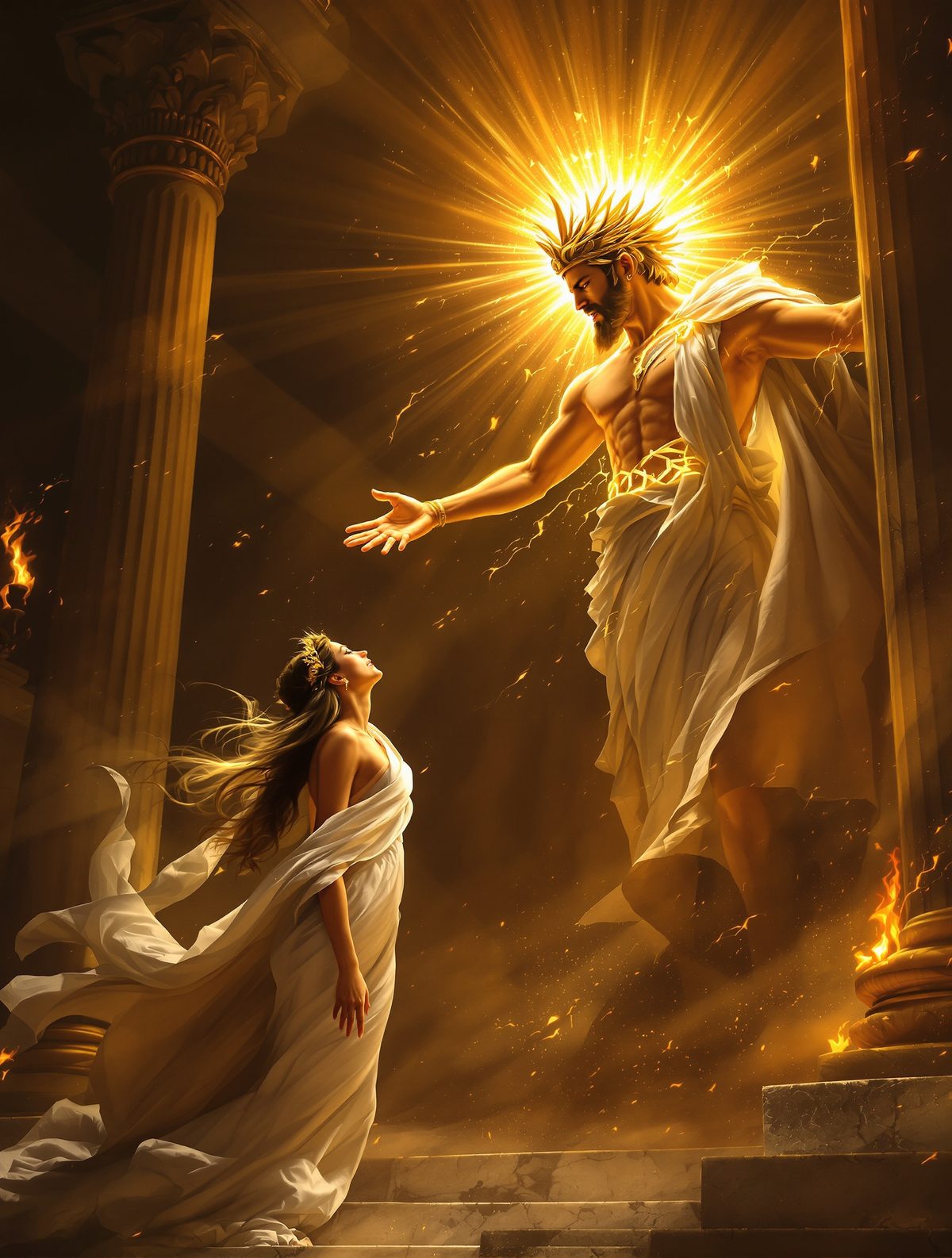
The exchange, as recorded in various ancient sources including Aeschylus's Agamemnon, was deceptively simple. Apollo appeared to Cassandra in his temple and offered her the gift of prophecy—the ability to see future events with perfect clarity—in exchange for a single kiss. To a princess of Troy, a city that prided itself on its connection to the divine, this seemed like the opportunity of a lifetime.
What the ancient sources don't often emphasize is how unprecedented this offer was. Prophetic abilities were typically earned through years of training, divine heritage, or as rewards for extraordinary service to the gods. Apollo was essentially offering Cassandra a cosmic shortcut, bypassing all traditional requirements. The catch? That kiss wasn't meant to be just ceremonial.
The Gift That Became a Curse
Cassandra accepted Apollo's offer and received his divine gift. Ancient texts describe the moment of transfer as overwhelming—suddenly she could see the threads of fate stretching out before her like a vast, intricate tapestry. Every choice led to consequences that rippled forward through time. She could see births, deaths, wars, peace treaties, and betrayals extending far beyond her own lifetime.
But when Apollo moved to claim what he believed was his due—not just a kiss, but Cassandra's love and body—she refused him. Some versions suggest she had seen, through her newly acquired powers, exactly what kind of lover the god would be. Apollo's track record with mortal women was, to put it mildly, problematic. Most of his relationships ended in tragedy, transformation, or abandonment.
Here's where the story takes its cruelest turn. Divine gifts, once given, could not be revoked—this was a fundamental law of the cosmos that even Zeus couldn't break. Apollo was stuck with his bargain, but he wasn't powerless to modify it. In a fit of divine rage that would make a toddler's tantrum look restrained, Apollo leaned forward and spat into Cassandra's mouth.
That single act of divine spite twisted his gift into the most exquisite torture imaginable. Cassandra would retain her prophetic abilities—she would see every disaster, every tragedy, every catastrophe coming with perfect clarity. But no one would ever believe her warnings. The very gift that could have saved countless lives became the source of unending torment.
The Weight of Unheeded Warnings
What followed was a decade of psychological torment that would drive anyone to the edge of sanity. Cassandra watched the Trojan War unfold exactly as she had foreseen it, helpless to prevent any of the bloodshed. She warned of Paris's fateful journey to Sparta that would bring Helen back to Troy and start the war. She predicted the deaths of her brothers, including the great hero Hector. She screamed warnings about Achilles' vulnerable heel and Patroclus's doomed mission wearing his friend's armor.
Each prophecy came true exactly as she had predicted, and each time her reputation for madness grew stronger. The Trojans developed what we might now recognize as a psychological defense mechanism—dismissing Cassandra's increasingly accurate predictions as the ravings of a madwoman was easier than confronting the terrible truths she revealed.
The most famous of her unheeded warnings, of course, concerned the Trojan Horse. Ancient sources, particularly Virgil's Aeneid, describe Cassandra frantically trying to convince the Trojans that the massive wooden horse left by the "retreating" Greeks was packed with enemy soldiers. She even grabbed an axe and tried to break it open herself, but was restrained by guards who thought she was having another episode.
Archaeological evidence from the real Troy (located in modern-day Turkey at the site called Hisarlik) shows that Troy VIIa was indeed destroyed by fire around 1180 BCE, lending some historical credence to the mythological timeline. Whether by horse, siege, or other means, something catastrophic did happen to match Cassandra's predicted timeline.
The Ultimate Irony of Perfect Knowledge
But perhaps the most overlooked aspect of Cassandra's curse wasn't just that people wouldn't believe her—it's that she was compelled to keep trying. Apollo's curse didn't just make her prophecies fall on deaf ears; it created an irresistible urge to share what she saw, knowing full well that each attempt would only reinforce her reputation for madness.
This aspect of the curse reveals its true sophistication. A simple silencing would have been cruel but clean. Instead, Apollo created a perpetual cycle of hope and despair. Every time Cassandra saw a future tragedy, she would experience a moment of hope that this time would be different, that this time people would listen. That hope made the inevitable rejection infinitely more painful.
Ancient Greek audiences would have recognized this as the perfect example of hubris meeting divine justice—except in this case, the punishment far exceeded the crime. Cassandra's only offense was exercising bodily autonomy, refusing a god's sexual advances after he had already given her his gift. The disproportion between her "crime" and her punishment would have been apparent even to ancient audiences, making her story one of the earliest examples of what we might now call victim-blaming in literature.
After Troy fell, Cassandra's torment continued. She was claimed as a war prize by Agamemnon, king of Mycenae, and taken back to his homeland. True to form, she predicted that they would both be murdered by Agamemnon's wife Clytemnestra upon their arrival. Also true to form, no one believed her. The prophecy came true with brutal efficiency—both she and Agamemnon were killed, ending her curse only in death.
The Modern Echo of Ancient Wisdom
Today, we use the term "Cassandra complex" to describe people who predict doom accurately but are ignored, often with catastrophic consequences. From climate scientists warning about global warming to economists predicting market crashes, our modern world is full of Cassandras whose expertise is dismissed until it's too late to act on their warnings.
But Cassandra's story offers an even deeper lesson about the nature of truth, power, and belief. In our age of information overload and "alternative facts," her curse feels remarkably contemporary. We live in a world where expertise is often dismissed, where people choose which truths to believe based on convenience rather than evidence, and where the messenger is often attacked rather than the message being evaluated.
The myth also serves as a powerful metaphor for anyone who has tried to warn others about abuse, corruption, or danger only to be disbelieved or silenced. Cassandra's story reminds us that throughout history, those who speak uncomfortable truths have often been labeled as mad, attention-seeking, or worse.
Perhaps most importantly, Cassandra's tale forces us to confront an uncomfortable question: In a world where we're constantly bombarded with predictions, warnings, and prophecies—from pandemic preparedness to economic forecasts to environmental collapse—how do we distinguish between the ravings of madmen and the warnings of modern-day Cassandras? The god Apollo may have been cruel, but his curse revealed a very human truth: sometimes the most important voices are the ones we're least willing to hear.