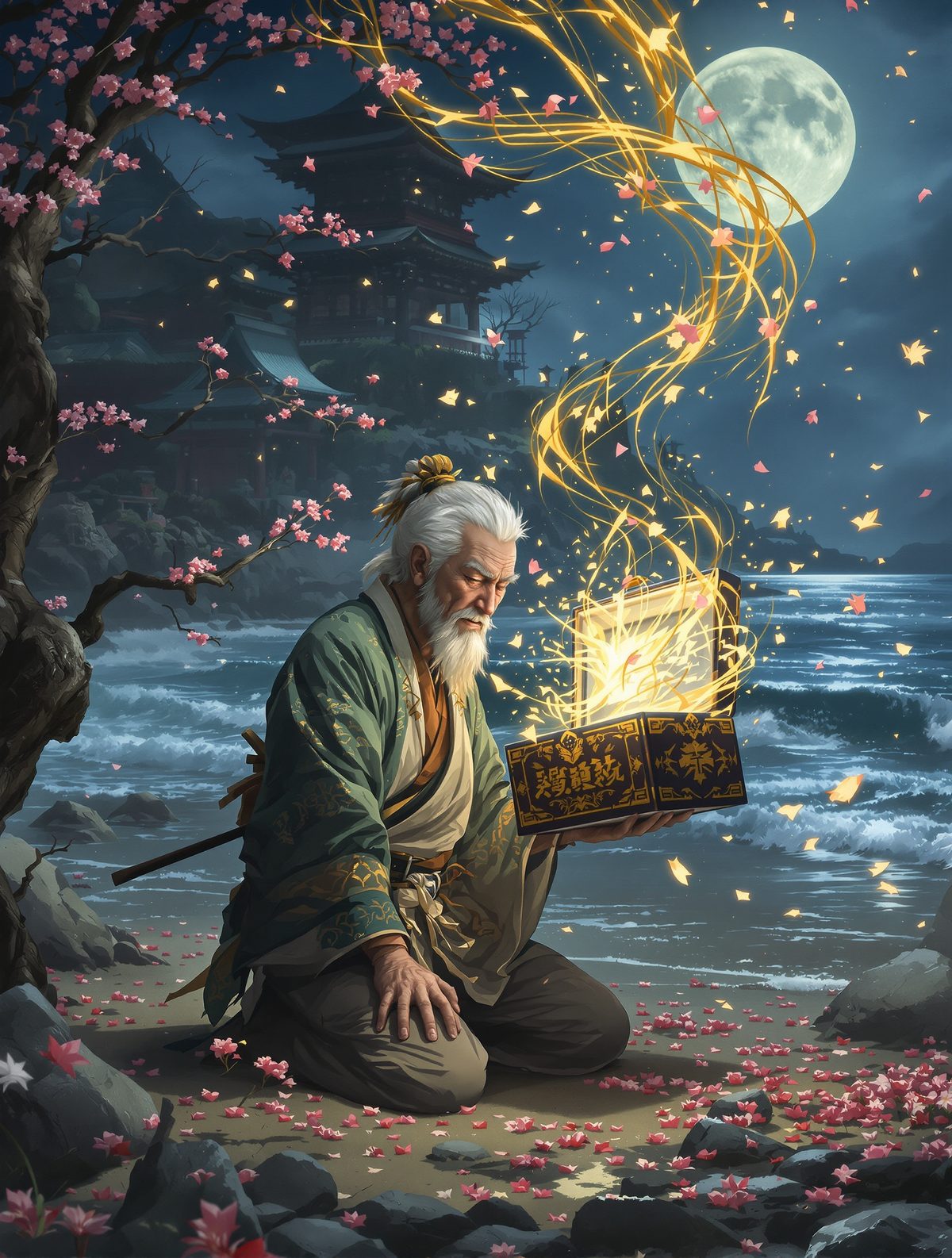
The fire had been dead for three days when Mikak made the choice that would damn his soul forever. Outside his makeshift shelter, the wind howled across Lake Superior's frozen shores like the voices of angry spirits. The winter of 1823 had been merciless—even by the brutal standards of the northern Ojibwe territory. Game had vanished. The fish beneath the ice lay beyond reach. And somewhere in the darkness beyond his dying shelter lay the body of his hunting companion, Naabinookwe, who had succumbed to starvation just hours before.
What happened next would transform a desperate man into something that was no longer human—the birth of a creature so terrifying that Algonquian peoples still whisper its name in hushed tones nearly two centuries later.
The Sacred Law That Could Never Be Broken
To understand the magnitude of Mikak's transgression, you must first understand the absolute sanctity of the taboo he was about to shatter. Among the Ojibwe, Cree, Innu, and other Algonquian peoples scattered across the vast boreal forests of northern Canada and the Great Lakes region, one law stood above all others: never consume human flesh.
This wasn't merely a cultural preference—it was a cosmic boundary. The Algonquian worldview held that humans occupied a delicate position between the spirit world and the natural realm. To consume human flesh was to violate the fundamental order of creation itself, unleashing forces that could tear apart the fabric between worlds.
Elder Joseph Pitikwahanapiwiyin of the Plains Cree, interviewed by ethnologist David Mandelbaum in 1934, explained it this way: "The spirits that guard the boundary between life and death, they watch always. When a person eats the flesh of their own kind, these guardians turn their backs. What fills that empty space... that is wihtikow."
The word varied across tribes—wihtikow, witiko, windigo—but the meaning remained constant: a cannibalistic creature of insatiable hunger that had once been human.
The Hunger That Devours Souls
Historical accounts from Hudson's Bay Company traders describe the winter of 1823 as one of unprecedented severity. Company records from Fort William show temperatures dropping to -47°F (-44°C) and staying below -20°F for over sixty consecutive days. Wildlife populations crashed. Even the region's Indigenous peoples, perfectly adapted to harsh winters, found themselves pushed to the brink of survival.
It was during this crisis that Mikak—a skilled hunter from the Gull Bay Ojibwe community—ventured onto the ice with his longtime companion Naabinookwe to check fish traps beneath Lake Superior's frozen surface. When a sudden blizzard trapped them miles from shore, their survival situation rapidly deteriorated.
For days, they huddled in a hastily constructed lean-to, burning their few possessions for warmth. Mikak later described to tribal elders how the hunger began as a gnawing ache, then evolved into something alive—a creature that seemed to claw at his stomach from the inside. When Naabinookwe died on the fourth day, that hungry thing inside Mikak began to speak.
"Just a little," it whispered. "Just enough to survive. Just enough to make it home."
The Transformation Begins
What makes the Wendigo legend particularly chilling is its clinical precision in describing the physical and psychological transformation that follows cannibalism. According to Mikak's own testimony—given to tribal elders before his eventual death—the change began immediately upon consuming human flesh.
First came the cold. Not the external cold of winter, but an internal freezing that seemed to crystallize his very blood. Mikak described feeling his heart literally turn to ice—a sensation modern hypothermia researchers might recognize, but which Algonquian peoples understood as something far more sinister.
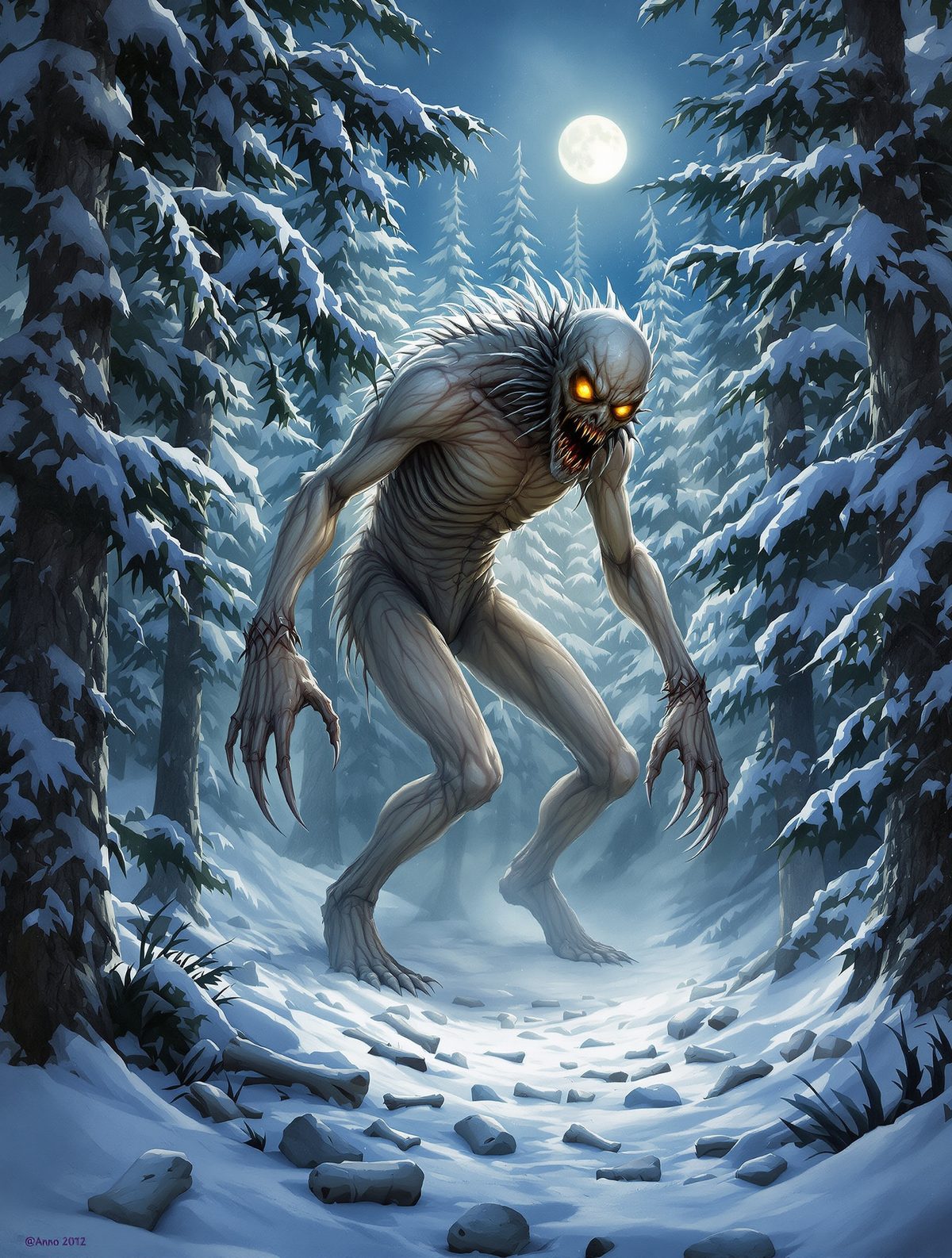
Within hours, his body began to change. His limbs stretched and elongated, joints popping and reforming. His skin took on a yellowed, waxy appearance, stretched tight over a rapidly expanding frame. Most horrifying of all, his appetite didn't diminish after eating—it intensified.
Contemporary anthropologist Jennifer Reid, who studied Wendigo accounts for over two decades, noted a crucial detail: "Unlike other cannibalistic practices found in world cultures, Wendigo transformation is specifically tied to survival cannibalism born of desperation, not ritual consumption. It's the shame and desperation that seem to trigger the metamorphosis, not the act itself."
When Monsters Walk Among Us
When Mikak finally returned to Gull Bay, his community immediately recognized what he had become. His physical transformation was obvious—he now stood nearly eight feet tall, his fingers had elongated into claw-like appendages, and his eyes had taken on an unsettling yellow hue. But it was his behavior that truly confirmed their worst fears.
The hunger that drove him was no longer for normal sustenance. Even after consuming massive quantities of fish, game, and prepared foods, Mikak continued to waste away, his body unable to derive nutrition from anything except human flesh. Worse, he began to view other humans not as people, but as potential meals.
Tribal elder Nokomis, whose great-grandmother witnessed these events, passed down an account that was recorded by Indian Agent Thomas McKenney in 1826: "His shadow fell wrong upon the ground. Children cried when he looked at them, though he tried to be gentle. The dogs would not come near him, and the horses stamped and rolled their eyes white when he passed."
The community faced an impossible choice: kill someone who had been their friend and protector, or risk him killing others to satisfy his supernatural hunger. The decision, when it came, was swift and final.
The Pattern Spreads
What makes Mikak's story particularly significant is that it wasn't isolated. Hudson's Bay Company records document at least seventeen similar cases between 1823 and 1827, all occurring during periods of extreme winter hardship across the Algonquian territories.
One of the most detailed accounts comes from Company trader Alexander Henry Jr., who documented the case of a Cree hunter named Nayaano near what is now Thompson, Manitoba. Henry's journal, preserved in the Manitoba Provincial Archives, describes how Nayaano survived a harsh winter by consuming the bodies of his dead family members, only to undergo a transformation similar to Mikak's.
"The man I had known—capable of tracking a moose for three days through dense forest—could no longer remember the names of his own children," Henry wrote. "Yet he could smell human flesh from extraordinary distances, and spoke constantly of his hunger for it, even while consuming vast quantities of other food."
These weren't random folk tales or campfire stories. They were documented transformations witnessed by multiple reliable sources, both Indigenous and European, occurring across thousands of square miles of territory during specific historical circumstances.
The Monster That Lives in All of Us
Modern psychology has attempted to explain Wendigo phenomena through various lenses—psychotic breaks triggered by extreme stress, cultural expressions of seasonal affective disorder, or manifestations of what psychiatrists now call "Wendigo psychosis." But such clinical explanations miss the deeper truth that Algonquian peoples understood intuitively.
The Wendigo isn't just a monster story—it's a mirror reflecting humanity's capacity for becoming something monstrous when pushed beyond moral boundaries. In our contemporary world, where extreme circumstances continue to test human ethical limits, the Wendigo legend remains disturbingly relevant.
Consider the 1972 Andes plane crash survivors, the Donner Party, or more recent cases of survival cannibalism. In each instance, the psychological aftermath often involved participants struggling with the sense that they had become fundamentally altered—no longer quite human—regardless of the justifiable nature of their choices.
The Wendigo legend serves as both warning and recognition: that within each of us lies the capacity for transformation into something we wouldn't recognize. The creature that Mikak became on those frozen shores of Lake Superior wasn't just born from hunger—it was born from the moment when survival became more important than remaining human.
Perhaps that's why, nearly two centuries later, the Wendigo continues to prowl through our collective nightmares, reminding us that the line between human and monster is far thinner than we'd like to believe.