Picture this: the most powerful goddess in ancient Mesopotamia, draped in divine regalia and radiating celestial authority, stands before seven massive gates leading into the realm of the dead. She has come to challenge death itself—and death happens to be her own sister. What unfolds next is perhaps the most brutal family feud in all of mythology, where blood means nothing and power means everything.
This is the story of Inanna's descent into the underworld, a tale carved into cuneiform tablets around 4,000 years ago that reveals the Mesopotamians understood something modern families know all too well: sometimes your worst enemy shares your DNA.
The Queen Who Thought She Could Conquer Death
Inanna was no ordinary deity. Known as Ishtar to the Babylonians and Astarte to other ancient peoples, she ruled over love, beauty, sex, and war—a combination that made her both irresistible and terrifying. Her temples in Uruk, one of the world's first cities, received countless offerings from worshippers who both desired her favor and feared her wrath. But Inanna had a problem that even divine power couldn't solve: there was one realm where her authority meant absolutely nothing.
The underworld, called the "Land of No Return" by the Sumerians, belonged entirely to her sister Ereshkigal. While Inanna basked in the worship of the living, Ereshkigal ruled over the countless dead in a realm where no light penetrated and no joy existed. Ancient texts describe it as a place where "dust is their food, clay their sustenance," and the dead "see no light, dwelling in darkness."
According to the epic poem preserved on tablets from the library of Ashurbanipal (668-627 BCE), Inanna decided she would extend her dominion into death's realm. The text suggests she claimed to be attending the funeral of Ereshkigal's husband, Gugalanna, but scholars believe this was merely a pretext. Inanna wanted it all—heaven, earth, and the underworld.
Seven Gates, Seven Humiliations
When Inanna arrived at the underworld's entrance, she found herself facing Neti, the chief gatekeeper, whose loyalty belonged entirely to Ereshkigal. The goddess demanded entry in a voice that "shook the gates of the underworld like fluttering bats," but Neti had his orders. He would admit her, but only under his mistress's terms.
What happened next was a masterpiece of psychological warfare. Ereshkigal ordered that Inanna be stripped of one divine attribute at each of the seven gates—a process that transformed the proud goddess from divine queen to helpless mortal with each step deeper into the realm of death.
At the first gate, guards removed her magnificent crown, the shugurra, which symbolized her authority over the heavens. At the second, they took her lapis lazuli necklace. The third gate cost her the double strand of beads around her neck. At the fourth, her breast ornaments disappeared. The fifth gate claimed her golden ring. Her lapis lazuli measuring rod and line—symbols of divine justice—vanished at the sixth gate. Finally, at the seventh gate, they stripped away her royal robe, leaving Inanna completely naked and powerless.
Here's what most people don't realize: this wasn't random cruelty. Each item represented a specific aspect of divine power, and their removal followed precise ritual protocols that would have been immediately recognizable to ancient audiences. The Mesopotamians believed that divine authority was literally embedded in these sacred objects—remove them, and you remove the god's power.
Sister Against Sister: The Ultimate Power Play
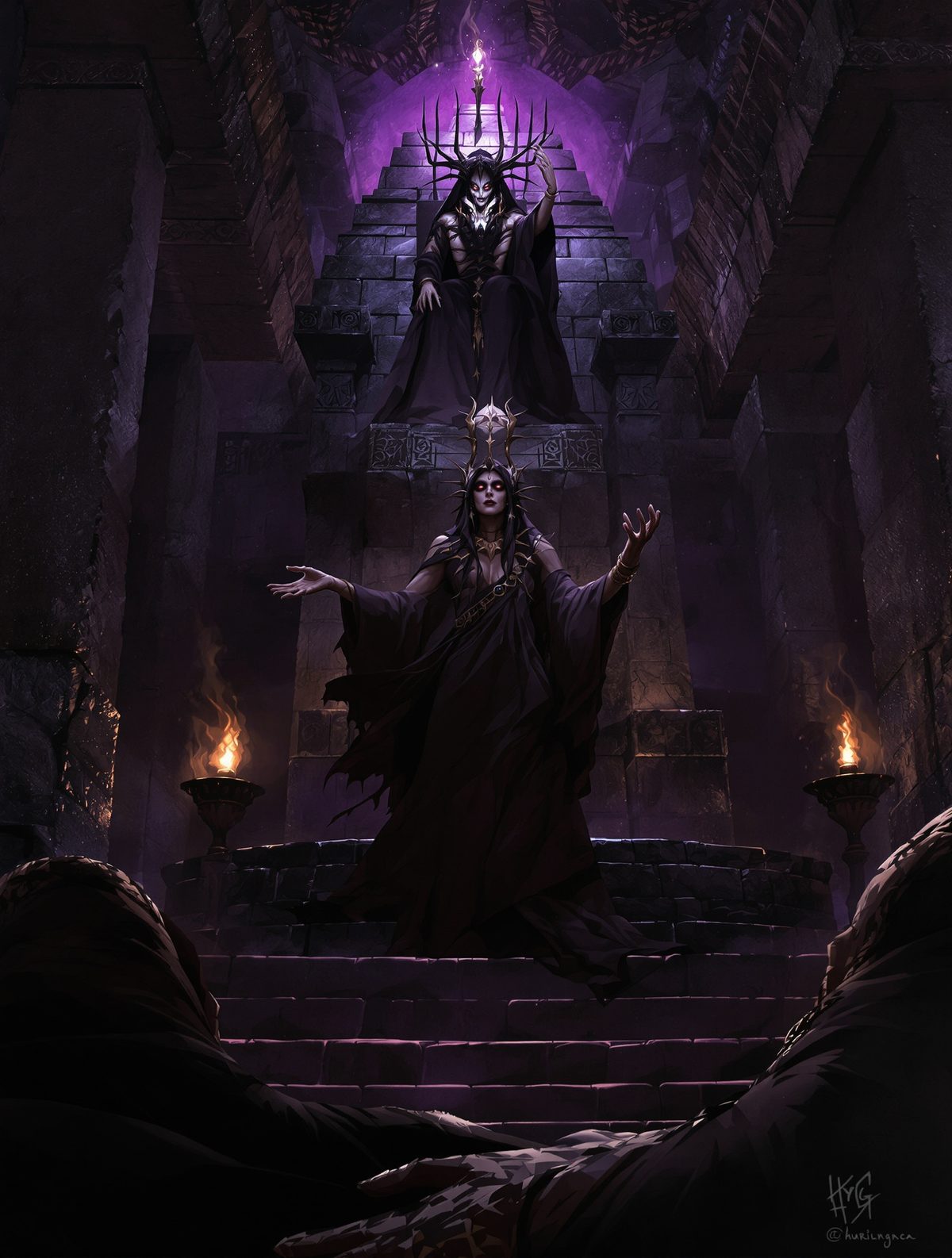
When Inanna finally stood before her sister's throne, she faced a goddess who was everything she was not. Where Inanna embodied life, passion, and desire, Ereshkigal represented death's cold finality. Ancient artwork depicts Ereshkigal as a fierce figure with bird talons for feet, sometimes shown nursing a lion—death nurturing its own savage nature.
The confrontation was swift and brutal. Ereshkigal didn't engage in dramatic speeches or lengthy negotiations. Instead, she simply looked upon her naked, powerless sister and pronounced judgment: death. The Anunnaki, the seven judges of the underworld, fixed their eyes upon Inanna "like eyes of death," and she was immediately transformed into a corpse.
But Ereshkigal wasn't finished. In what ancient audiences would have recognized as the ultimate humiliation, she ordered Inanna's corpse hung on a meat hook—the same treatment given to slaughtered animals. For three days and three nights, the goddess who had once commanded the devotion of millions hung rotting in the depths of the underworld, stripped of every shred of dignity.
This detail reveals something crucial about Mesopotamian culture that often gets overlooked: they believed even gods could truly die, and death was the great equalizer that reduced everyone—divine or mortal—to mere meat.
The Price of Resurrection
Inanna's story doesn't end with her death, but her rescue comes at a cost that reveals the harsh logic of the ancient world. When her faithful servant Ninshubur raised the alarm, most gods refused to help—crossing Ereshkigal was simply too dangerous. Only Enki, the god of wisdom and water, dared to intervene.
Enki created two sexless beings from the dirt under his fingernails—creatures that belonged neither to the world of the living nor the dead, allowing them to slip between realms. They descended to the underworld, where they found Ereshkigal in the throes of childbirth, screaming in pain. When they offered sympathy for her suffering—something no one in the underworld had ever done—the grateful queen offered them a gift.
They asked for the corpse hanging on the hook.
Ereshkigal had no choice but to agree, but the laws of the underworld demanded a substitute. Inanna could leave, but someone had to take her place. When she emerged and discovered that her husband Dumuzi had not mourned her death but instead sat proudly on her throne, her choice was swift and merciless. She condemned him to the underworld, though later myths suggest his sister Geshtinanna volunteered to share his sentence, each spending half the year among the dead.
The Power Behind the Myth
Modern readers might wonder why this brutal family drama captivated Mesopotamian audiences for over two millennia. The answer lies in what the story reveals about power, family, and the natural world. Inanna's descent wasn't just entertainment—it was a sophisticated exploration of seasonal cycles, political authority, and the limits of divine power.
The three days Inanna spent dead likely represented the three days each month when Venus disappears from the night sky, and her annual journey to retrieve Dumuzi explained why vegetation died and returned each year. But on a deeper level, the myth addressed fundamental questions about whether anyone—even gods—could escape death's dominion.
Ereshkigal's refusal to show mercy, even to family, wasn't portrayed as evil but as necessary. Death cannot play favorites, or the entire cosmic order collapses. Her character embodied a truth that Mesopotamians, living in a harsh environment where drought, flood, and war could claim lives without warning, understood intimately: nature doesn't care about your personal relationships.
Perhaps most remarkably, this 4,000-year-old story gave ultimate authority to a female deity who answered to no one—not even her fellow gods. In Ereshkigal, the Mesopotamians created a figure who wielded absolute power in her domain, making decisions based on cosmic law rather than emotion or family loyalty.
Today, as we grapple with questions about justice, family loyalty, and the abuse of power, Ereshkigal's story offers an uncomfortable but valuable lesson: sometimes the most important decisions require us to set aside personal feelings and relationships in favor of larger principles. The Queen of the Dead knew that mercy, however tempting, could undermine the very foundations of existence itself. In our age of nepotism and favoritism, perhaps we could learn something from a goddess who refused to let blood ties corrupt her judgment—even when it meant condemning her own sister to hang on a meat hook in the realm of the dead.