Picture this: the most cunning god in Norse mythology, desperately galloping through ancient forests as a mare in heat, pursued by a stallion whose supernatural strength could doom the very gods themselves. What began as a clever scheme to save Asgard would end nine months later with Loki giving birth to the most extraordinary horse in all the Nine Worlds—a creature that would carry Odin himself into battle at Ragnarok.
This is no sanitized fairy tale. This is the raw, unfiltered mythology that reveals just how far the Norse gods were willing to go when their backs were against the wall. And sometimes, the consequences of desperate measures echo through eternity.
The Bargain That Threatened Heaven
It all started with what seemed like the deal of a lifetime. A mysterious builder arrived at the gates of Asgard shortly after the Æsir-Vanir war had left the realm's defenses in shambles. The stranger made an audacious proposal: he would construct an impregnable wall around Asgard in just eighteen months, asking for only three things in payment—the sun, the moon, and the goddess Freyja as his bride.
The gods scoffed at the impossible timeline. No single man could complete such a monumental task before winter's end, they reasoned. So they agreed to the bargain, confident they'd get their wall for free. There was just one catch they hadn't anticipated: the builder wasn't working alone.
As dawn broke on the first day of construction, the gods watched in growing horror as the stranger's stallion, Svaðilfari, began hauling stone blocks the size of houses as if they were pebbles. This wasn't just any horse—this was a creature of supernatural power, working with mechanical precision and tireless endurance. By the calculations of the terrified Æsir, the wall would be completed with time to spare.
The gods faced a catastrophic problem: they were bound by their oath, but losing the sun, moon, and Freyja would spell doom for both gods and mortals. As panic set in, all eyes turned to the one who had convinced them to accept the bargain in the first place—Loki.
The Shapeshifter's Desperate Gambit
With just three days left before the deadline, Loki knew that conventional solutions wouldn't work. The builder and his stallion had proven immune to threats, bribes, and sabotage. But Loki possessed something his fellow gods lacked: a complete disregard for conventional boundaries, including those of gender and species.
Drawing upon his mastery of seiðr—the Norse magical practice often associated with feminine power and transformation—Loki underwent one of the most radical shapeshifts in mythological history. He didn't just take the form of a mare; he became a mare in every biological sense, complete with the powerful scents and instincts of a female horse in estrus.
As twilight approached and Svaðilfari began his final crucial night of hauling stones, a beautiful mare emerged from the treeline. The sight and scent of her drove the mighty stallion into an immediate frenzy. Here was something more compelling than duty, stronger than magic—pure, primal desire.
What happened next was a chase that would become legend. Loki, now fully committed to his role, led Svaðilfari deep into the forests surrounding Asgard. The stallion, abandoning his work entirely, pursued the mare with single-minded determination. For hours they ran, deeper and deeper into the wilderness, until the sounds of construction fell silent behind them.
When Gods Pay the Ultimate Price
The plan worked flawlessly—perhaps too flawlessly. When dawn broke, the builder found his stallion missing and his deadline impossible to meet. In his rage, he revealed his true nature as a jötunn (giant), leading to his destruction at the hands of Thor's hammer. Asgard was saved, the bargain broken, and the gods celebrated their narrow escape.
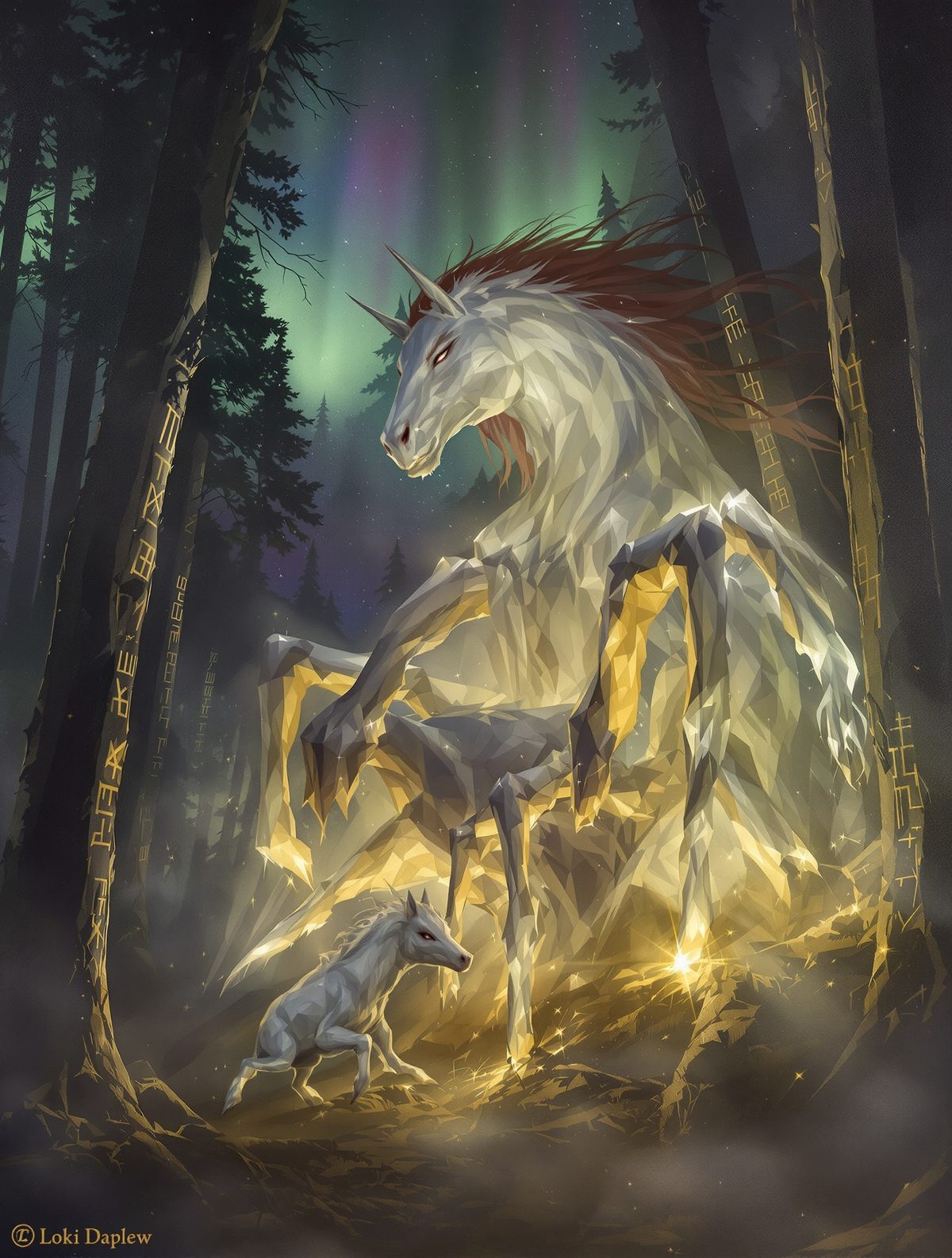
But Loki didn't return with the dawn. Days turned to weeks, weeks to months, and still the trickster god remained absent from Asgard. When he finally reappeared, he brought with him one of the most extraordinary beings in Norse mythology: an eight-legged foal of impossible beauty and power.
This was Sleipnir, whose name means "the gliding one." Born from the union of divine cunning and giant strength, Sleipnir possessed abilities that defied the natural order. His eight legs allowed him to gallop across land, sea, and sky with equal ease. He could carry riders between the worlds of the living and the dead, traverse the branches of Yggdrasil itself, and outrun death—literally.
But perhaps the most shocking aspect of Sleipnir's birth wasn't his extraordinary nature—it was the fact that Loki had actually given birth. This wasn't metaphorical or symbolic; according to the Prose Edda and other sources, Loki experienced pregnancy, labor, and childbirth as a biological female. In a culture that often emphasized rigid gender roles, this myth presents us with a god who transcended every boundary imaginable.
Odin's Eight-Legged Throne
What happened next reveals the complex dynamics of power and ownership in Asgard. Despite being Loki's biological offspring, Sleipnir became the exclusive mount of Odin, the All-Father. This wasn't theft exactly—it was more like the ultimate expression of divine privilege, where the most powerful god simply claimed the most powerful horse.
Odin and Sleipnir became inseparable, appearing together in countless myths and battles. The eight-legged horse carried Odin on his journeys to Midgard (Earth), bore him into battle against giants and monsters, and most significantly, would carry him into the final battle of Ragnarok. In the Hávamál, Odin himself describes riding Sleipnir to the underworld, using the horse's unique abilities to traverse the boundary between life and death.
Archaeological evidence supports Sleipnir's central importance in Norse culture. Eight-legged horses appear on countless Viking Age artifacts, from the famous Tjängvide stone on Gotland to small bronze figurines found across Scandinavia. These weren't just decorative motifs—they were religious symbols representing divine power, shamanistic travel between worlds, and the conquest of death itself.
The Price of Salvation
But what did this transformation cost Loki? Norse mythology rarely dwells on the emotional aftermath of its more shocking events, but we can read between the lines. Loki's sacrifice went far beyond simple shapeshifting—he had experienced pregnancy, birth, and the immediate separation from his child. In a society where family bonds were sacred, this represented a profound loss.
The myth also reveals the complex relationship between Loki and the other gods. They were willing to pressure him into increasingly extreme solutions to their problems, yet they never fully accepted the consequences of his actions. Loki's gender-fluid nature, demonstrated so dramatically in Sleipnir's conception, may have contributed to the suspicion and eventual hostility that would lead to his binding and the onset of Ragnarok.
Some scholars argue that this myth represents ancient Norse understanding of the prices paid for survival. Every solution creates new problems; every victory carries hidden costs. Loki saved Asgard through his sacrifice, but in doing so, he may have planted the seeds of his own alienation from the divine community.
Echoes in Our Modern World
Today, Loki's transformation challenges our assumptions about gender, identity, and sacrifice in ways that feel remarkably contemporary. Long before modern discussions of gender fluidity, Norse mythology presented us with a divine figure who moved seamlessly between male and female roles, who experienced both fatherhood and motherhood, and who paid real emotional costs for his transformations.
The story of Sleipnir's birth also speaks to the unintended consequences of our solutions to impossible problems. Like the gods of Asgard, we often find ourselves accepting bargains that seem too good to be true, only to discover that someone must pay a price we hadn't anticipated. And like Loki, those who volunteer to pay that price may find themselves forever changed by the experience.
In our age of rapid technological change and moral complexity, perhaps we need Loki's willingness to cross boundaries and challenge assumptions. But we also need to remember that transformation—real transformation—always comes with a cost. The question isn't whether we're willing to change, but whether we're prepared to live with the consequences of becoming something new.
Somewhere in the myths, Sleipnir still gallops between the worlds, carrying riders across impossible distances and forbidden boundaries. He remains the eternal proof that sometimes the most extraordinary solutions require the most extraordinary sacrifices—and that the children of such sacrifices may outlive the very gods who made them necessary.