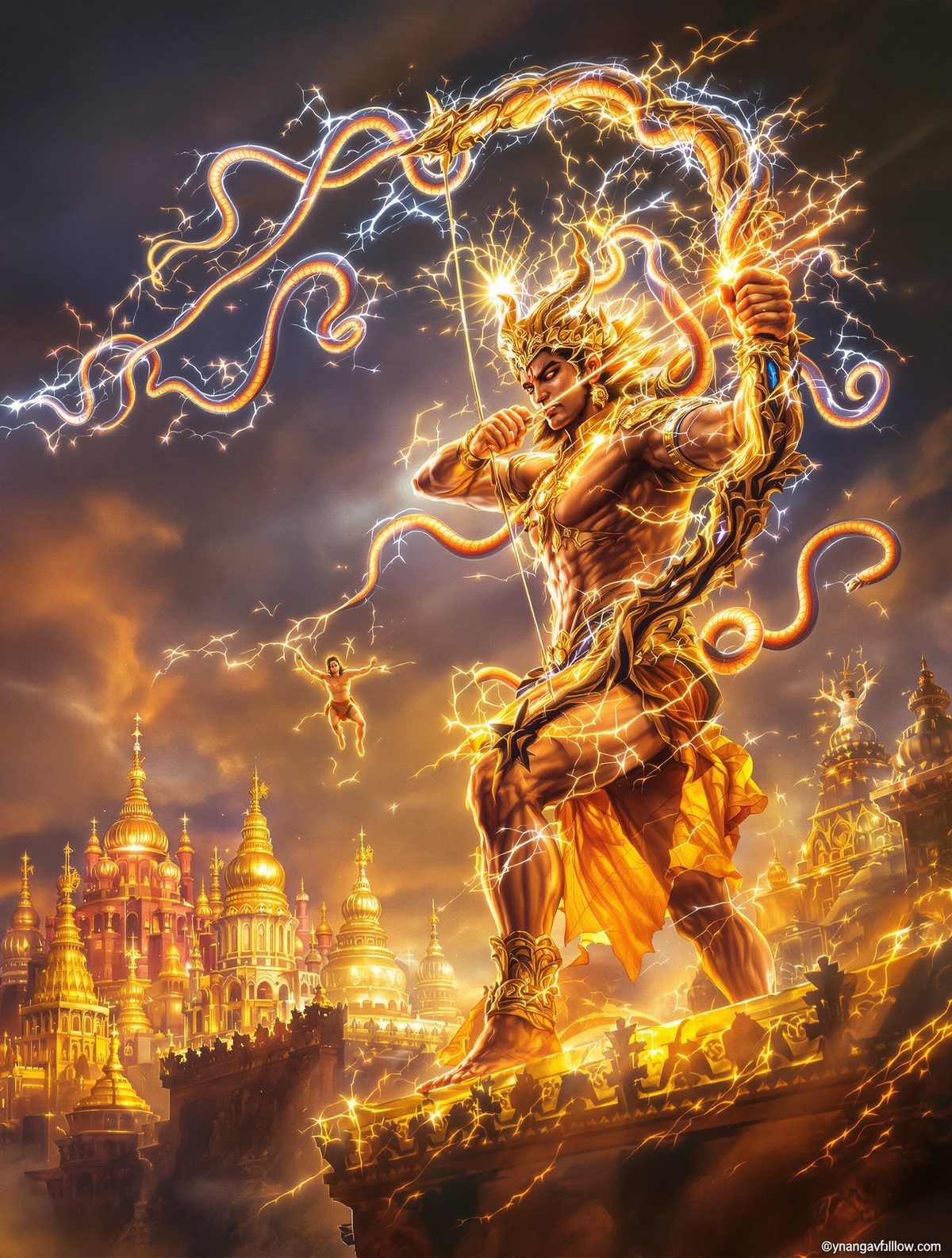
The golden city of Lanka trembled as the great Hanuman carved a path of destruction through its magnificent palaces. Buildings crumbled beneath his massive fists, demon warriors fled in terror, and even the mighty Rakshasas of Ravana's army found themselves powerless against the son of Vayu, the Wind God. But high atop the Pushpaka tower, a young prince with eyes like burning coals reached for an arrow that would change the course of the greatest war in Hindu legend. This was no ordinary weapon—it was the Nagastra, blessed by Brahma himself, and it carried with it a curse so ancient and powerful that even the mighty Hanuman would fall helpless before its serpentine embrace.
The Unstoppable Force Meets Lanka
When Hanuman first leaped across the hundred-yojana expanse of ocean separating the mainland from Lanka—a distance of roughly 800 miles—the demons of Ravana's kingdom had never encountered anything like him. Standing forty feet tall when fully manifested, with the strength to lift entire mountains and the speed to circle the earth in moments, Hanuman embodied divine power in its purest form.
The Valmiki Ramayana describes his rampage through Lanka in vivid detail: "Like a great wind uprooting trees, like fire consuming a forest, the mighty Hanuman moved through Lanka's streets." He had already accomplished his primary mission—finding Sita in the Ashoka grove—but what happened next would demonstrate both his devastating power and, ultimately, his vulnerability to forces beyond even divine strength.
The young Hanuman's destruction wasn't random violence. Every building he toppled, every garden he trampled, served a strategic purpose: to send Ravana an unmistakable message that Rama's army possessed warriors of unimaginable might. As news of the monkey warrior's rampage reached the ten-headed king, panic spread through the demon court. Their greatest champions—warriors who had conquered the three worlds—seemed like children before this incredible force.
The Prince Who Conquered Heaven
Enter Indrajit, whose very name meant "conqueror of Indra." This wasn't mere boasting—at the age of sixteen, Ravana's eldest son had actually defeated Indra, king of the gods, in single combat and dragged him in chains through the streets of Lanka. The Padma Purana records that Indrajit possessed knowledge of 32 different types of divine weapons, making him perhaps the most formidable archer in the three worlds.
But Indrajit's greatest advantage wasn't his collection of celestial weapons—it was his mastery of Maya, the power of illusion. He could become invisible at will, strike from any direction, and create phantom armies that seemed utterly real to his enemies. The Ramayana describes him as "one who could not be seen even by the gods when he chose to remain hidden."
When reports reached him of Hanuman's rampage, Indrajit didn't react with the panic that had seized the rest of Lanka's defenders. Instead, he climbed to his chariot—a vehicle that could travel faster than thought itself—and began preparing for battle with calm, methodical precision. He knew that conventional weapons would prove useless against Hanuman, but fortunately, Indrajit possessed something far from conventional.
Brahma's Inescapable Curse
The Nagastra wasn't simply an arrow—it was a living weapon, animated by the essence of Vasuki, the king of serpents who serves as Shiva's sacred necklace. According to the Brahmanda Purana, this weapon was created when Brahma, the creator god, needed a force that could bind anyone regardless of their power or divine protection. The arrow contained within it the collective strength of all the world's serpents, woven together by Brahma's own divine will.
What made the Nagastra truly terrifying wasn't its physical power, but the curse embedded within it. Brahma had decreed that anyone struck by the weapon would be bound helplessly, unable to break free through strength, magic, or divine intervention. There was only one way to escape the Nagastra's coils: the serpents themselves had to choose to release their victim.
Here lies one of the most fascinating aspects of this weapon that rarely appears in simplified retellings: the Nagastra operated on the principle of cosmic justice rather than mere force. It wouldn't kill its target—instead, it would hold them until the universal balance could be restored. In Hanuman's case, this meant being captured so that Ravana could learn about Rama's intentions, serving the greater cosmic plan that would eventually lead to the demon king's downfall.
The Moment Heaven's Strength Failed
The battle between Indrajit and Hanuman began at sunset, painting the sky above Lanka in shades of blood and gold. Invisible to mortal eyes, Indrajit circled the great monkey warrior, loosing arrow after arrow from his celestial bow. The Valmiki Ramayana describes how Hanuman grew increasingly frustrated, swinging his massive arms at an enemy he couldn't see, his roars of challenge echoing across the island kingdom.
For nearly an hour, the battle raged without either combatant gaining a decisive advantage. Hanuman's incredible speed and strength meant that even Indrajit's divine arrows could barely penetrate his defenses, while the prince's invisibility made it impossible for Hanuman to land a crushing blow. Watching from the ramparts of his palace, Ravana began to wonder if even his most accomplished son could subdue this incredible foe.
Then Indrajit reached for the Nagastra. The arrow itself appeared unremarkable—a simple shaft of bamboo with white fletching—but the moment it touched his bowstring, the very air around Lanka seemed to hold its breath. Even the winds, which obeyed Hanuman's father Vayu, grew still and silent.
When Indrajit released the arrow, witnesses later described seeing what appeared to be a streak of silver light that moved not in a straight line, but in the sinuous pattern of a striking serpent. The moment it touched Hanuman's chest, the weapon transformed, becoming countless coils of ethereal rope that wrapped around the mighty warrior faster than lightning.
When Gods Bow to Greater Laws
What happened next shocked even Indrajit. Hanuman, who could grow to the size of mountains or shrink to the size of a thumb, who possessed the strength of a thousand elephants and the speed of thought itself, found himself completely helpless. No matter how he strained against the serpentine bonds, no matter how he called upon his divine heritage as son of the Wind God, the coils only grew tighter.
The Kritika Ramayana preserves a detail often omitted from popular versions: Hanuman actually began to weep—not from pain or fear, but from the profound spiritual anguish of encountering a force that transcended even his divine nature. For the first time in his existence, the mighty warrior faced something he couldn't overcome through strength or devotion.
But here's where the story reveals its deeper wisdom. Hanuman's capture wasn't a defeat in the conventional sense—it was a necessary step in the cosmic dance that would ultimately liberate Sita and destroy Ravana. The serpents of the Nagastra, being creatures of ancient wisdom, understood this. They held Hanuman only long enough for him to be brought before Ravana, to deliver Rama's message, and to demonstrate that even Lanka's greatest weapon couldn't truly harm Rama's devoted servant.
The Wisdom Hidden in Defeat
This episode from the Ramayana offers a profound meditation on the nature of power and surrender that resonates strongly in our modern world. In an age when we often equate strength with the ability to overcome any obstacle through force or determination, Hanuman's encounter with the Nagastra suggests a different truth: sometimes the most powerful act is to accept temporary defeat in service of a greater victory.
The story reminds us that even our greatest strengths can become limitations if we're not prepared to transcend them when cosmic necessity demands it. Hanuman's "defeat" by Indrajit's serpent arrow ultimately served Rama's cause far more effectively than destroying Lanka would have—it allowed him to meet Sita, deliver Rama's message, and return with crucial intelligence about Ravana's defenses.
Perhaps most remarkably, this ancient tale anticipates modern concepts about the interconnectedness of all actions and the way apparent setbacks often serve purposes we can't immediately perceive. In a world where we're constantly encouraged to break through barriers and never accept defeat, the story of Hanuman and the Nagastra whispers a different wisdom: sometimes the greatest victory comes from allowing ourselves to be bound by forces greater than our individual will, trusting that the universe has patterns and purposes that transcend our immediate understanding.