The ancient Mediterranean held terrors that would make modern sailors weep. But none was more feared than the churning vortex lurking in the narrow strait between Sicily and the Italian mainland—a watery grave that could crack the hull of the mightiest trireme and drag its screaming crew into the abyss. What ancient mariners didn't know was that this destroyer of ships had once been a woman, a devoted daughter whose loyalty to her divine father would become her eternal curse.
Her name was Charybdis, and her transformation from sea-nymph to monster reveals one of mythology's most chilling tales of divine justice gone wrong.
The Faithful Daughter of the Sea God
Long before she became the terror of the Strait of Messina, Charybdis was among the most beautiful of the sea-nymphs, her crystalline laughter echoing across Poseidon's underwater palace. Unlike her more rebellious sisters who dallied with mortal men, Charybdis remained devoted to her father, the earth-shaking god of the seas.
Ancient sources describe her as possessing an otherworldly beauty—skin that shimmered like moonlight on water, hair that flowed like ocean currents, and eyes that reflected the deepest blue of the Mediterranean. But it wasn't her beauty that set her apart; it was her unwavering loyalty to Poseidon's will.
The sea god had grand ambitions in those days. While his brother Zeus ruled the heavens and Hades commanded the underworld, Poseidon chafed at his dominion being limited to the waters. He dreamed of expanding his realm onto dry land, of drowning the coastal cities and claiming them for his oceanic kingdom. And in Charybdis, he found the perfect agent for his aquatic conquest.
"She was the extension of her father's will," wrote the 2nd-century scholar Apollodorus, "swift as the tide, relentless as the storm." When Poseidon needed the coastlines flooded to expand his domain, it was Charybdis who would steal onto shore in the dead of night, opening channels for the sea to pour through, washing away homes and drowning fertile farmland beneath salt water.
The Theft That Changed Everything
The turning point came when Heracles—called Hercules by the Romans—arrived at the strait during his legendary tenth labor. The hero had just completed his most arduous task yet: stealing the cattle of the three-bodied giant Geryon from the distant island of Erytheia. These weren't ordinary cattle, but sacred beasts whose hides gleamed like polished bronze and whose eyes held an inner fire.
As Heracles rested his mighty herd on the shores near what would become the city of Rhegium, Poseidon saw an opportunity too tempting to resist. These cattle, blessed by the sun-god Helios himself, would make the perfect sacrifice to fuel his next great flood. But he couldn't steal them himself—not without risking open war with Zeus, who had sanctioned Heracles' labors.
So he turned to his most faithful daughter.
Under cover of darkness, Charybdis emerged from the waves like a living tsunami. Ancient accounts describe her theft as a supernatural cattle drive—she conjured walls of water to coral the divine beasts, using whirlpools as lassoes to drag them into the sea. One by one, the bronze-hided cattle disappeared beneath the waves, their divine fire extinguished in the salt water as they became sacrifices to Poseidon's ambition.
By dawn, Heracles found himself facing empty beaches where hundreds of sacred cattle had grazed. His roar of fury, they say, cracked stones and sent birds fleeing from trees three miles inland.
Zeus's Thunderous Justice
The theft didn't go unnoticed by the king of the gods. Zeus had been watching his nephew's labors with keen interest, knowing that each completed task brought Heracles closer to immortality and a place among the Olympian gods. When he discovered that Poseidon had sabotaged the tenth labor through his daughter's thievery, his rage shook Mount Olympus itself.
What many don't realize is that Zeus's anger wasn't just about the stolen cattle—it was about the violation of cosmic law. The labors of Heracles had been ordained by the Oracle at Delphi as penance for a terrible crime. By interfering, Charybdis hadn't just stolen cattle; she had disrupted the divine order of justice itself.
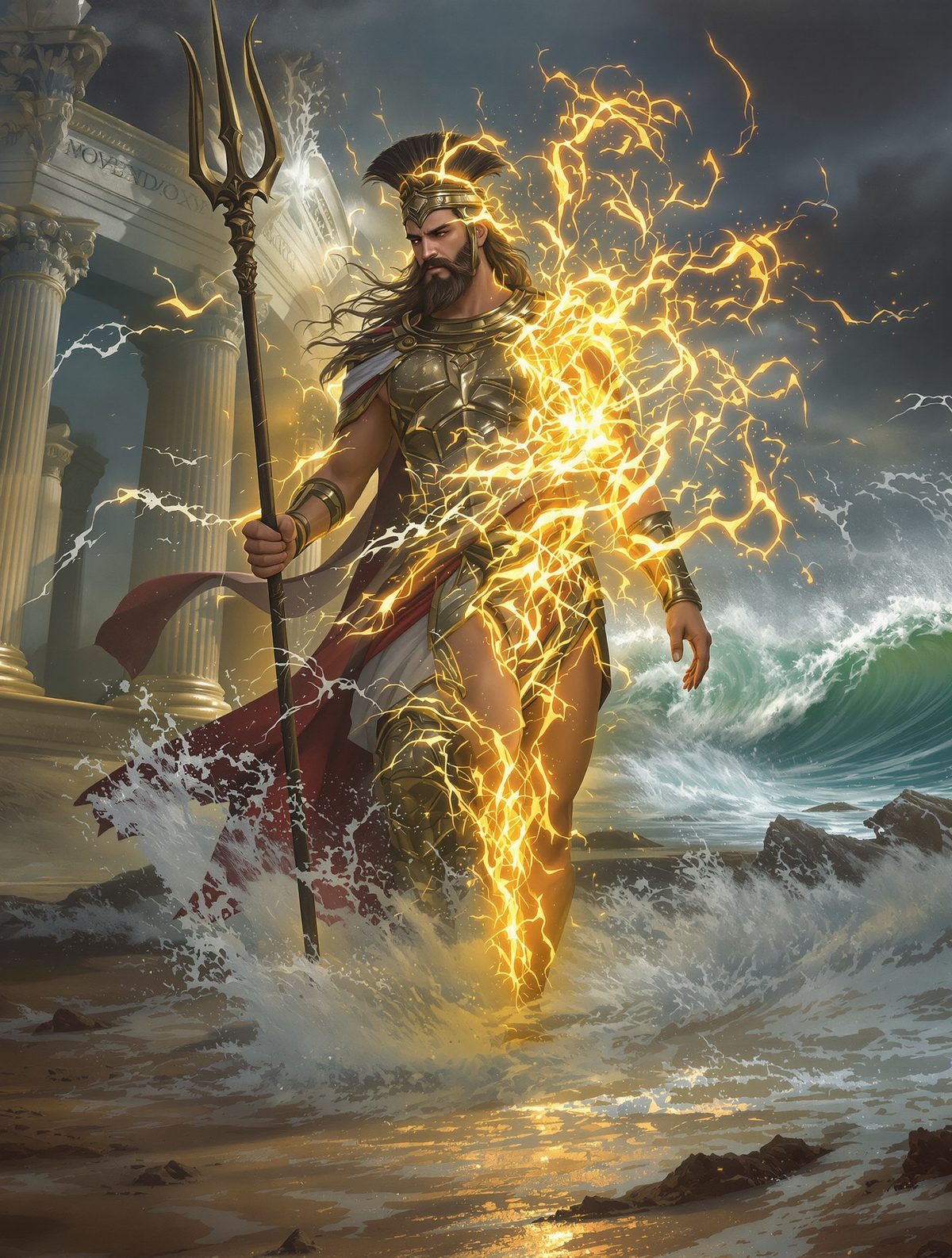
Zeus's punishment was swift and merciless. As Charybdis basked in her father's praise in the depths of his palace, the sea god's throne room suddenly blazed with impossible light. Zeus appeared in all his terrible glory, thunderbolt crackling in his fist like captured lightning.
"You have stolen what was not yours to take," his voice boomed through the water itself. "You have disrupted justice for the sake of your father's pride. Let your loyalty become your curse, your hunger your eternal torment."
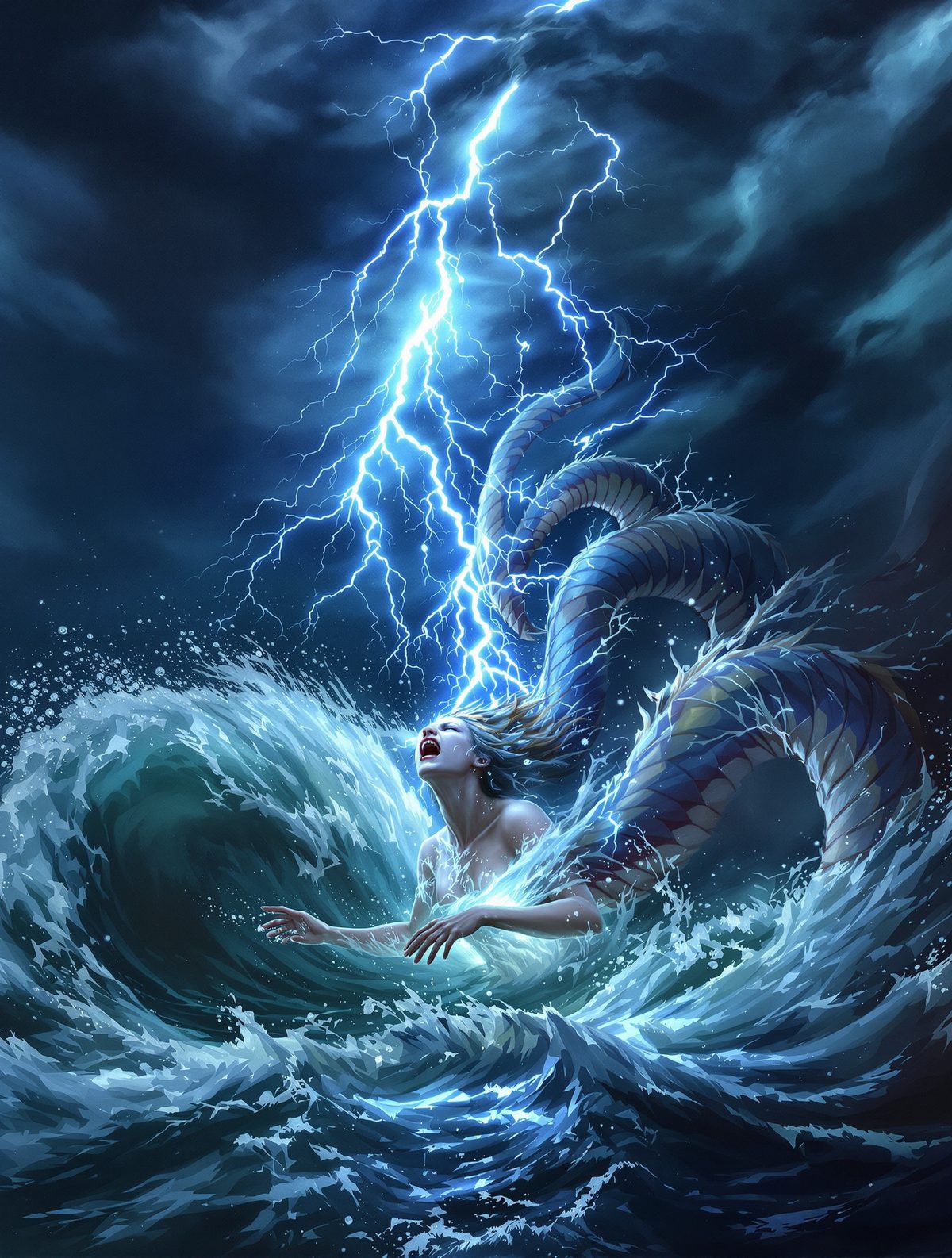
The thunderbolt he hurled wasn't meant to kill—it was meant to transform. As the divine lightning struck Charybdis, her beautiful form began to change. Her graceful limbs fused into a massive, bloated body. Her lovely mouth stretched into a gaping maw that could swallow a warship whole. Most cruelly of all, Zeus cursed her with an insatiable thirst—she would be forever compelled to drink the sea, only to regurgitate it in violent, ship-destroying whirlpools.
Birth of the Monster
The transformed Charybdis plummeted to the bottom of the strait, her massive body creating the underwater cavern that would become her eternal prison. Chained to the seafloor by Zeus's curse, she began the terrible cycle that would make her name synonymous with destruction.
Three times each day, her monstrous thirst would compel her to drink. And three times each day, she would violently expel the water, creating whirlpools so powerful they could be seen from shore—massive spirals of churning sea that could drag down vessels twice the size of modern destroyers.
Ancient navigators learned to time their passages carefully. The Greek astronomer Hipparchus calculated that Charybdis's feeding cycle followed a precise schedule: she would drink at dawn, noon, and sunset, with each session lasting exactly forty-seven minutes. Ships that found themselves in the strait during these times faced almost certain doom.
But perhaps the cruelest aspect of her curse was that Charybdis retained her human consciousness. Trapped in her monstrous form, she was fully aware of every ship she destroyed, every sailor whose screams were cut short by the crushing depths. Ancient sources speak of mariners who survived her whirlpools reporting a sound beneath the roar of churning water—a sound like weeping.
The Terror That Shaped Heroes
The whirlpool of Charybdis became one of the most feared hazards in ancient navigation, second only to her neighbor across the strait—the six-headed monster Scylla. Together, they created the ultimate maritime nightmare: a narrow passage where avoiding one monster meant sailing perilously close to the other.
When Odysseus faced this choice during his epic journey home from Troy, he chose to brave Scylla rather than risk his entire ship to Charybdis's whirlpool. The decision cost him six men but saved the rest—a tactical sacrifice that became legendary among ancient strategists. "Better to lose a few to the snatcher than all to the swallower," became a common saying among Mediterranean sailors.
Jason and the Argonauts, returning from their quest for the Golden Fleece, only survived the strait thanks to divine intervention—Hera herself parted the waters to allow their ship, the Argo, safe passage. Even Aeneas, fleeing the ruins of Troy to found what would become Rome, was forced to take a longer route around Sicily rather than risk the strait.
These weren't just stories to ancient peoples—they were navigation guides, warnings passed down from sailor to sailor about the very real dangers of the narrow waters between Sicily and Italy. The Strait of Messina does indeed feature powerful whirlpools caused by conflicting currents, tidal changes, and the unique underwater geography. Ancient mariners, lacking modern meteorological knowledge, attributed these natural phenomena to the cursed hunger of a transformed sea-nymph.
The Eternal Price of Loyalty
The tale of Charybdis forces us to confront uncomfortable questions about loyalty, justice, and the price of blind obedience. Here was a daughter so devoted to her father that she willingly became a thief, so loyal that she never questioned whether his commands were right or wrong. Her transformation serves as a cautionary tale that resonates just as powerfully today as it did three thousand years ago.
In our modern world of corporate whistleblowers, political scandals, and institutional cover-ups, Charybdis's story feels remarkably contemporary. How many careers have been destroyed by individuals who chose personal loyalty over moral principles? How many have found themselves becoming the very monsters they never intended to be, simply because they followed orders without question?
Perhaps most haunting of all is the fact that Charybdis was punished not for malice, but for love. Her crime was caring too much about her father's approval, being too willing to compromise her own moral compass for the sake of family loyalty. In a world where we're constantly balancing competing loyalties—to family, employers, nations, and our own consciences—her eternal curse reminds us that some prices are simply too high to pay.
The next time you face a choice between doing what's right and doing what's expected, remember the sea-nymph who became a monster. Remember that loyalty, however pure its intentions, can become the most dangerous curse of all when it blinds us to justice. And perhaps, in the space between those competing demands, you'll find the wisdom that Charybdis, in her eternal hunger, never could.