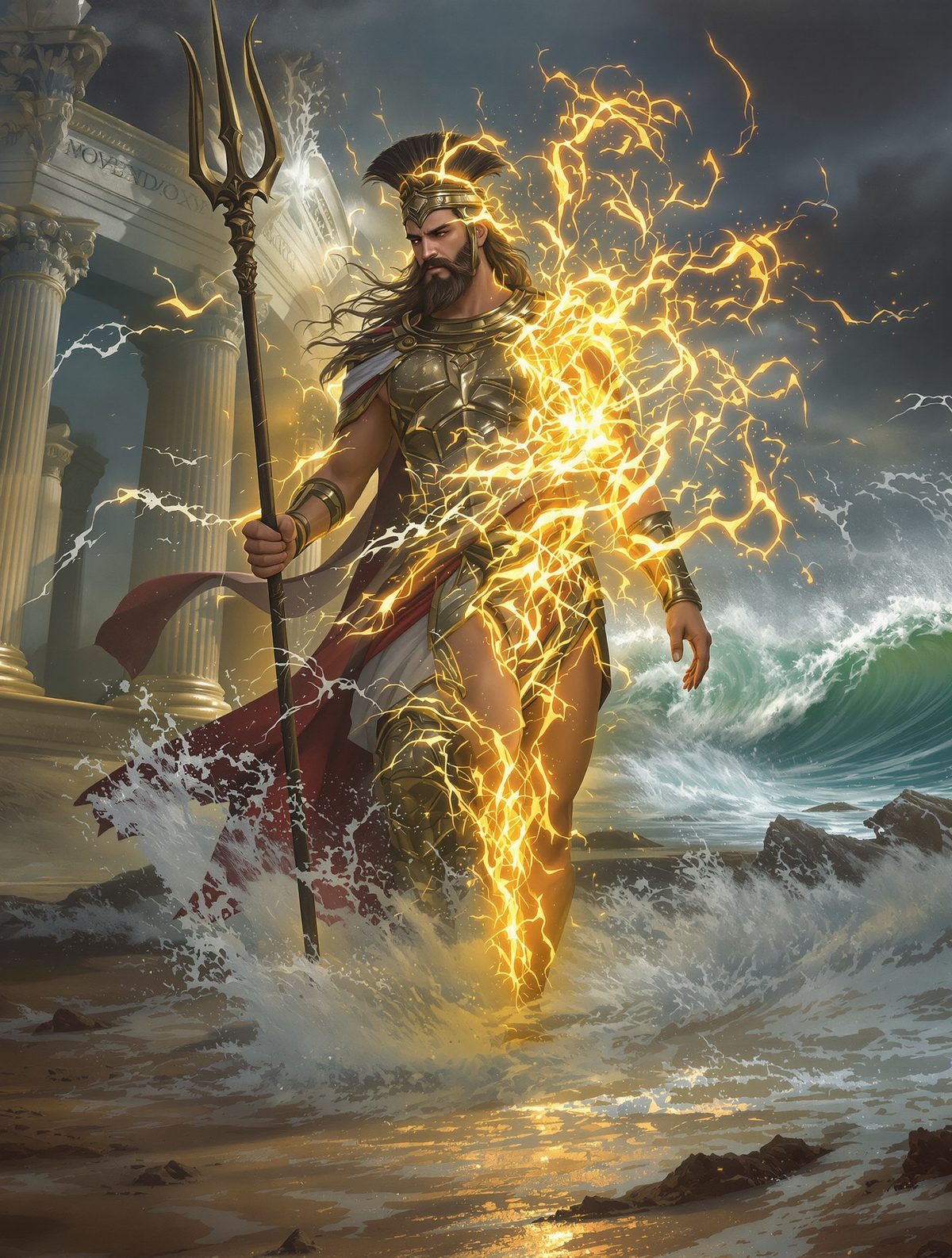
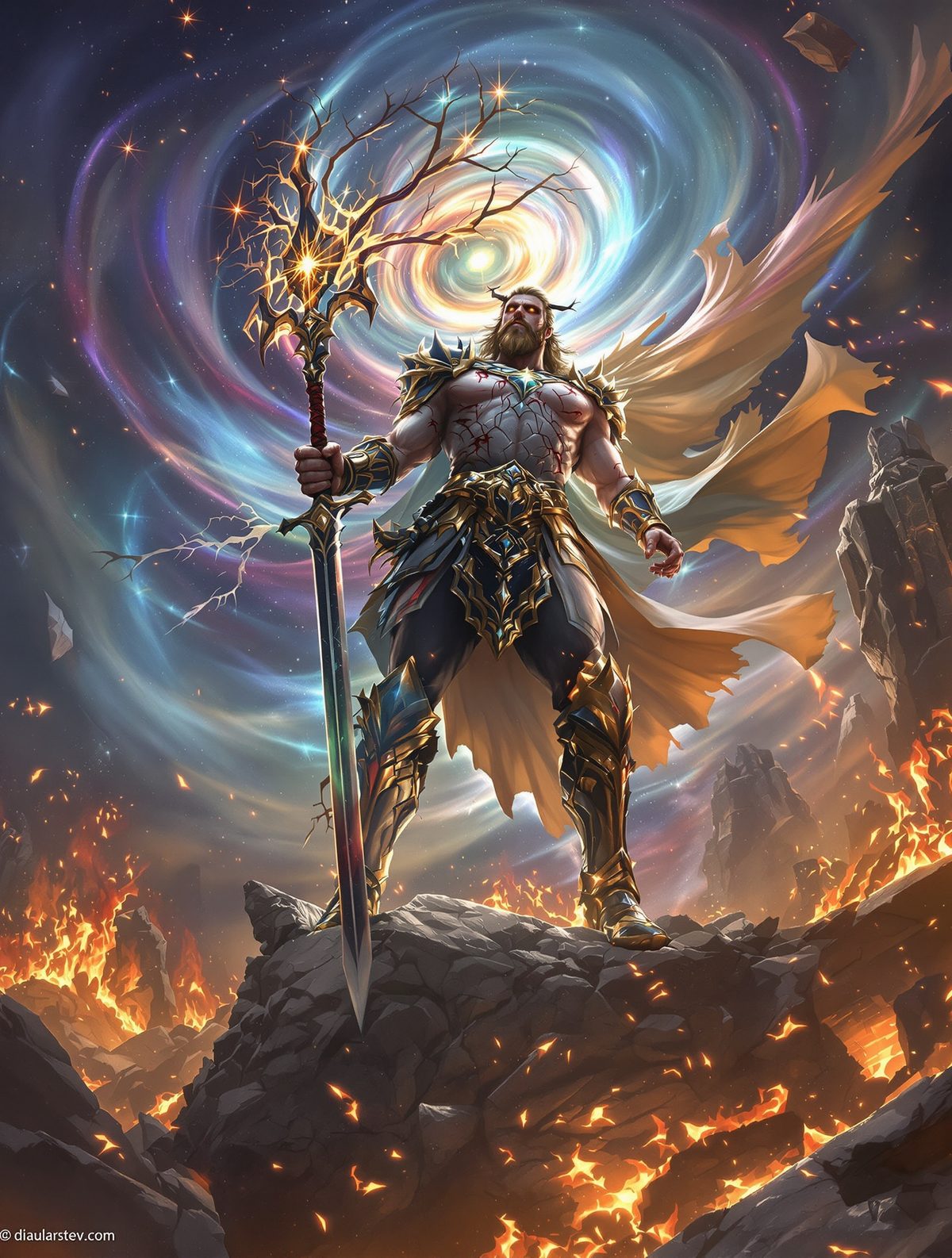
In the dying light of the world's final dawn, two ancient enemies stand face to face on a battlefield littered with the corpses of gods. One bears the horn that once summoned heroes to Valhalla; the other carries chains still smoking from his thousand-year imprisonment beneath the earth. They have circled each other through countless ages, watchman and deceiver, guardian and destroyer. Now, as the very fabric of reality tears apart around them, Heimdall and Loki prepare for a dance of death that will claim them both.
This is the story of Ragnarök's most personal duel—a confrontation so inevitable that the Norns themselves wove it into the threads of fate before time began.
The White God of the Rainbow Bridge
Long before their final meeting, Heimdall stood as perhaps the most enigmatic figure in the Norse pantheon. Called the "White God" for his gleaming teeth and pure complexion, he possessed abilities that made him uniquely suited to his role as Asgard's eternal sentinel. Ancient sources describe vision so acute he could spot a leaf falling in Midgard while standing atop Bifrost, and hearing so sensitive that grass growing in distant meadows sounded like thunder in his ears.
But here's what the popular retellings rarely mention: Heimdall required less sleep than a bird. The Prose Edda tells us he could remain vigilant with mere moments of rest, making him the perfect guardian for the rainbow bridge that connected the realm of the gods to the other eight worlds. His sword, Hofund, never dulled, and his golden-maned horse, Gulltoppr, could ride across sky and sea as easily as solid ground.
Most intriguingly, several scholars believe Heimdall may have originally been a sea-god, born of nine mothers who were likely waves personified. This maritime connection explains his association with rams and his title as "the one who moistens the world" in some obscure kennings. The transformation from sea-deity to bridge-guardian represents one of Norse mythology's most fascinating evolutionary adaptations.
The Trickster's Long Road to Damnation
Loki's relationship with the Æsir gods followed a trajectory that modern psychologists might recognize as a textbook case of escalating antisocial behavior. Initially accepted as Odin's blood brother—their oath sealed with mingled blood according to ancient ritual—Loki served valuable functions within the divine community. His shape-shifting abilities and silver tongue repeatedly saved the gods from their own rash promises and poor decisions.
The turning point came with Baldr's death. While most people know Loki engineered the killing of Odin's beloved son using mistletoe and the blind god Höðr, fewer realize the depth of his subsequent mockery. At the funeral feast, disguised as an old woman named Þökk, Loki refused to weep for Baldr—the one act of universal mourning that could have brought the shining god back from Hel's realm. His words still echo through the centuries: "Let Hel hold what she has."
The gods' vengeance was swift and merciless. They bound Loki with the entrails of his own son Narfi, transformed into unbreakable bonds. Above his head, they placed a serpent whose venom dripped continuously onto his face. Only his wife Sigyn's devotion—catching the poison in a bowl—provided intermittent relief. But when she turned to empty the bowl, the venom would strike Loki's flesh, and his agonized thrashing would shake the earth itself, creating what mortals called earthquakes.
Signs and Portents of the Final Age
The approach of Ragnarök didn't arrive like a sudden storm—it crept across the nine worlds like a slowly spreading plague. The Völuspá, our most complete prophetic account, describes a world growing steadily darker and more corrupt. The Fimbulwinter, a brutal three-year winter with no intervening summers, would freeze hope itself from mortal hearts. Brothers would turn against brothers, fathers against sons. The very bonds of kinship that held society together would snap like rotten rope.
From his position on Bifrost, Heimdall witnessed every disturbing sign. Wolves grew bold enough to hunt in broad daylight. The sun and moon, pursued by the giant wolves Sköll and Hati since time's beginning, began to slow their celestial race. Most ominously, the roots of Yggdrasil, the World Tree that supported all existence, began to shudder and crack.
When Loki finally broke free from his torments—the very earthquakes he had caused eventually shattering even divine bonds—Heimdall's horn Gjallarhorn rang out across all nine worlds. Its voice, audible from Hel's frozen realm to the burning wastes of Muspelheim, announced that the final battle had begun. Gods and heroes sleeping in Valhalla's great hall awakened to find their eternal war had arrived.
The Battlefield at the End of the World
Vígríðr, the plain where Ragnarök's climactic battles would unfold, stretched a hundred leagues in every direction—a space vast enough to accommodate the armies of all creation. Here, the forces of order and chaos would meet in conflicts that had been prophesied since the world's beginning. Thor would face the Midgard Serpent, Odin would battle the wolf Fenrir, and Freyr would fall before Surtr's flaming sword.
But among all these predetermined duels, none carried the personal weight of Heimdall versus Loki. These two had watched each other across the centuries—the guardian who never slept observing the trickster who never rested. Every scheme Loki hatched, every crisis he created, played out under Heimdall's unwavering gaze. The watchman had become witness to every step of Loki's transformation from reluctant ally to cosmic destroyer.
When they finally met on Vígríðr's blood-soaked earth, both gods had already been marked by battle. Heimdall's white armor bore dents from fighting frost giants and fire demons. Loki, leading the forces of chaos, showed wounds from his thousand-year imprisonment and the desperate battles that had brought him this far. Around them, the very sky burned as Surtr's flames began consuming the World Tree itself.
A Dance of Mutual Destruction
The final duel between Heimdall and Loki represents something unique in Norse mythology—a perfectly balanced confrontation where neither opponent held any decisive advantage. Unlike other Ragnarök battles where one side's victory was assured, the sources consistently describe this fight as ending in mutual annihilation. Both gods would die, their weapons finding fatal marks simultaneously.
Some scholars interpret this mutual destruction as symbolic of the eternal balance between order and chaos, vigilance and deception. Heimdall, representing divine oversight and protection, could not survive in a world where the ultimate deceiver had been allowed to run rampant. Similarly, Loki's chaotic nature required constant opposition—without the watchman's eternal vigilance to define himself against, the trickster god's own existence became meaningless.
The Prose Edda offers few details about the mechanics of their final battle, stating simply that they "will be the death of each other." But this brevity only adds to the scene's terrible weight. After all the words, all the schemes, all the watched and the watching, the ending came down to two gods locked in combat, each delivering the blow that would destroy them both.
The Legacy of the Final Watch
In our modern age of surveillance technology and social media, Heimdall's story resonates with unexpected relevance. We live in a world where watchmen—whether digital algorithms, security cameras, or citizen journalists—maintain constant vigilance over our actions. Yet we also inhabit a reality where trickster figures use these same technologies to spread chaos, misinformation, and discord.
The mutual destruction of Heimdall and Loki suggests that perfect security and perfect freedom cannot coexist indefinitely. The watchman's eternal vigilance eventually becomes indistinguishable from paranoia, while the trickster's creative chaos ultimately transforms into destructive nihilism. Their final battle reminds us that even the gods struggled with the balance between safety and liberty, between order and innovation.
Perhaps most importantly, their story warns us that some conflicts have no winners—only the hope that from the ashes of mutual destruction, something new and better might eventually grow. After Ragnarök's fires died down, the surviving gods would build a new world on the ruins of the old. The watchman's final sacrifice had not prevented the end, but it had helped ensure that ending was not permanent. In losing everything, both Heimdall and Loki had, in their way, saved everything that would come after.