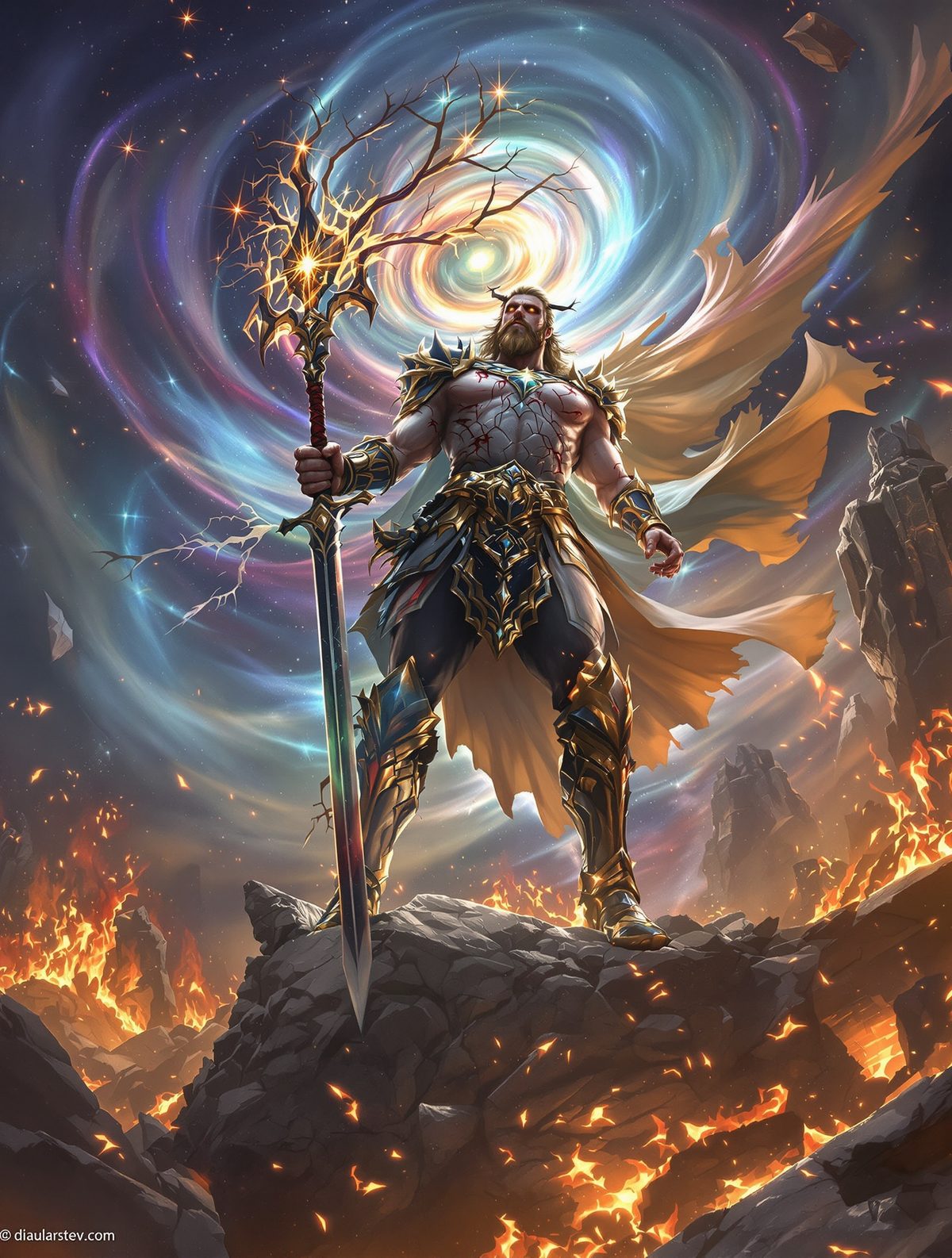

The first light of dawn crept across the Trojan shore, painting the blood-soaked sand in shades of gold and crimson. In his tent, Ajax the Great—son of Telamon, cousin to the fallen Achilles, and the most fearsome warrior left among the Greeks—drew his sword one final time. But this blade would taste no Trojan blood. Instead, the bronze point found its mark between his ribs, piercing the heart of a man who had never retreated from any battle, who had held the Greek ships against Hector's flames, who had carried Achilles' lifeless body from the killing fields of Troy.
What could drive such a titan to turn his weapon upon himself? The answer lies not in the heat of battle, but in the cold calculations of politics—and a suit of armor that would prove more deadly than any Trojan spear.
The Divine Arsenal That Started It All
When Achilles first strode onto the plains of Troy, he wore armor forged by no mortal hand. Hephaestus himself, god of the forge, had crafted this divine panoply at the request of Thetis, Achilles' sea-nymph mother. The shield alone was a masterpiece that defied description—Homer devoted 130 lines of the Iliad to cataloging its wonders. Upon its surface, the smith-god had wrought entire worlds: cities at peace and war, farmers harvesting golden wheat, dancers whirling at wedding feasts, and at the rim, the great river Ocean that encircles all lands.
The breastplate gleamed like captured starlight, the greaves fitted perfectly to divine calves, and the helmet bore a crest of golden horsehair that struck terror into enemy hearts. This wasn't merely armor—it was a symbol of divine favor, of heroic destiny, of the thin line between mortal and immortal glory.
But even divine armor couldn't turn Paris's arrow, guided by Apollo's hand. When Achilles fell, struck in his famous heel, the greatest question wasn't who would fill the void he left in battle—everyone knew that would be Ajax. The question was who would inherit the physical symbols of his greatness.
Ajax the Tower: The Warrior Who Never Broke
If you had stood among the Greek ranks and asked any common soldier who deserved Achilles' armor, the answer would have been immediate and unanimous: Ajax, son of Telamon. Standing nearly seven feet tall, wielding a shield "like a tower" crafted from seven layers of bull's hide, Ajax had earned his reputation through deeds that lesser men couldn't even imagine.
During Achilles' famous sulk—when the golden warrior withdrew from battle after his quarrel with Agamemnon—it was Ajax who held the line. When Hector led the Trojans in their greatest assault on the Greek ships, setting them ablaze with torches, Ajax fought alone on the deck of the vessels, hurling javelins at wave after wave of attackers. For twelve hours straight, he stood like a living wall between the Trojans and total Greek annihilation.
But Ajax's greatest moment came after Achilles' death, when Patroclus's killer, Hector, finally fell to Achilles' spear. As Paris's arrow found its mark and Achilles crumpled, it was Ajax who strode into the melee, fighting off Trojans like a lion protecting its cubs. With his massive shield protecting both warriors, he carried Achilles' body from the field while Odysseus covered their retreat. For Ajax, this wasn't just duty—it was sacred obligation, the bond between kinsmen and warriors.
Here's what the textbooks rarely mention: Ajax and Achilles were cousins, both grandsons of Aeacus, and their friendship ran deeper than blood. They had trained together as boys, competed in games, shared the dreams of young heroes. Ajax didn't just want the armor—in his mind, he had already earned it through sweat, blood, and unwavering loyalty.
Odysseus the Fox: When Words Triumph Over Swords
But the Greek expedition to Troy had produced another kind of hero entirely. Where Ajax was a mountain of bronze and muscle, Odysseus of Ithaca was quicksilver—brilliant, adaptable, and possessed of a tongue that could convince Helen herself to return willingly to Sparta. The contrast couldn't have been starker: Ajax fought battles, Odysseus won wars.
While Ajax held the ships, Odysseus had infiltrated Troy itself, disguised as a beggar to gather intelligence. When the Greeks needed to retrieve the sacred Palladium statue that protected Troy, Odysseus slipped into the city by night and stole it from Athena's temple. Most famously, it was Odysseus who conceived the plan of the Wooden Horse—the stratagem that would finally bring down the mighty walls of Priam's city.
Here's the detail that changes everything: the contest for Achilles' armor wasn't decided by combat, but by debate. The Greek leaders established a trial where both heroes would present their cases, and captured Trojan prisoners would serve as judges—reasoning that the enemy would know best which Greek warrior they feared most.
Ajax's speech was exactly what you'd expect: straightforward, honest, powerful. He recounted his deeds, his wounds, his unwavering service. "I saved your ships," he thundered. "I carried Achilles from the field while others fled. My spear has never missed its mark, my shield has never failed, my back has never been turned to the enemy."
Then Odysseus rose to speak. And everything changed.
The Trial That Broke a Hero
Odysseus understood what Ajax could not: that wars are won in the mind before they're decided on the battlefield. His speech was a masterpiece of rhetoric, psychological warfare disguised as humble honesty. He didn't just list his accomplishments—he painted a picture of two different kinds of heroism and asked which one had truly brought the Greeks closer to victory.
"Ajax speaks of his strength," Odysseus said, his voice carrying easily across the assembled Greeks. "But strength without wisdom is mere brutality. Yes, Ajax is mighty in battle—but what battles would we have faced if my cunning hadn't prevented them? When I convinced Achilles to join our cause, when I retrieved Neoptolemus and the bow of Heracles without which Troy cannot fall, when I walked among our enemies and learned their secrets—these victories saved more Greek lives than any spear."
Then came the killing stroke: "Ajax carried Achilles' body from the field, this is true. But I defended our retreat, and more—I saved both Achilles' body and his armor. Ajax preserved the man; I preserved the legend."
The Trojan prisoners, when asked to judge, chose Odysseus. Not because they feared his sword—Ajax was far more dangerous in single combat—but because they recognized that Odysseus posed an existential threat to their city. Strength could be countered with walls and numbers. Cunning was another matter entirely.
The vote was close, closer than most accounts suggest. Later sources claim it came down to a handful of voices, with some Trojans openly stating that while Ajax might kill more of them, Odysseus would be the one to actually end their civilization.
The Dawn of Madness and Honor's Last Stand
Ajax left the trial in silence, but those who knew him recognized the signs. His jaw was clenched like a trap, his massive hands opening and closing around his spear shaft, his eyes holding a look that his enemies had learned to fear. For the first time in his life, Ajax had been defeated—not by superior force or divine intervention, but by words. By politics. By the suggestion that his simple, honest heroism was somehow lesser than Odysseus's cleverness.
What happened next depends on which version you believe, but the outcome was always the same. In some tellings, Athena herself, patron goddess of Odysseus, drove Ajax mad to prevent him from taking revenge on the Greek leaders. In his madness, he slaughtered a flock of sheep, believing them to be his enemies, awakening at dawn covered in animal blood and facing the laughter of the entire army.
In other versions, Ajax remained sane but couldn't bear the shame of losing face before his men. For a warrior whose entire identity was built on being the strongest, the most reliable, the most honorable, this defeat cut deeper than any physical wound.
But here's the detail that makes this tragedy even more poignant: Ajax's sword was a gift from Hector himself, given during a brief period when the two great warriors fought in single combat, neither able to defeat the other, and parted with mutual respect and an exchange of gifts. Now, as dawn broke over the Greek camp for the last time Ajax would see, he drew the Trojan sword and placed its point against the sand.
"The armor goes to a better man," he said, according to Sophocles' account. Then, with the same unflinching courage he'd shown in a hundred battles, Ajax let his weight carry him down onto the blade.
The Price of Choosing Cleverness Over Courage
The Greeks had gained Achilles' armor for Odysseus, but they had lost something irreplaceable: their greatest remaining warrior, and perhaps more importantly, their moral center. Ajax's death sent shockwaves through both armies. Even the Trojans, who should have celebrated the loss of their most implacable foe, mourned him as a worthy enemy.
The immediate consequences were severe. Ajax's warriors, the men from Salamis who had followed him across the wine-dark sea, nearly abandoned the expedition entirely. Only Teucer, Ajax's half-brother, convinced them to stay and see the war through to its end—but their hearts were no longer in it. Some scholars argue that Ajax's death did more damage to Greek morale than even the loss of Achilles himself.
But the deeper wound was to the Greek conception of heroism itself. Ajax represented the old way: straightforward courage, unwavering loyalty, strength used in service of honor. His defeat and death marked the triumph of a new kind of hero—one who won through intelligence, adaptability, and psychological warfare rather than sheer virtue and physical prowess.
Odysseus himself seemed to understand what had been lost. In later accounts, he visited Ajax's shade in the Underworld during his famous journey, attempting to reconcile with his former comrade. Ajax's response was silence—eternal, contemptuous silence that spoke louder than any words.
Perhaps Ajax's tragedy resonates so powerfully today because we live in his world—a place where cleverness is rewarded over character, where image matters more than substance, where the ability to craft a narrative trumps the simple virtue of doing what's right. In choosing Odysseus over Ajax, the Greeks may have won their war, but they lost something essential about what it means to be heroic.
The armor of Achilles was eventually lost, sunk with Odysseus's ship during his long journey home, claimed by the same wine-dark sea that had carried these heroes to their destinies. But Ajax's example—of a man who would rather die than compromise his principles—remains as sharp as the Trojan sword that took his life, challenging us to ask ourselves what, in the end, we're really fighting for.