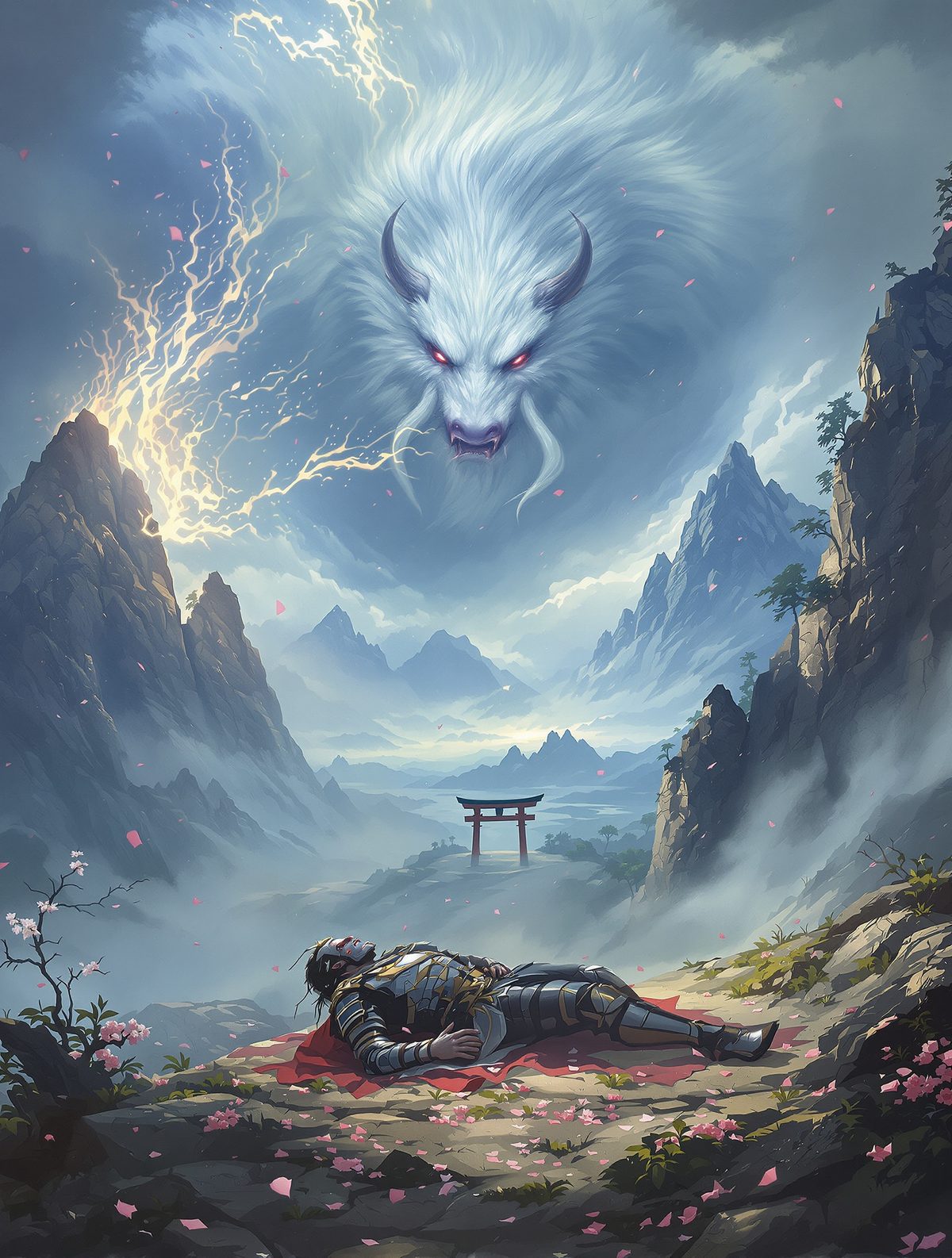
The mountain loomed before him like a sleeping giant, its slopes shrouded in morning mist that seemed to whisper warnings he chose not to hear. Prince Yamato-takeru, the empire's most feared warrior, had never met an enemy he couldn't conquer with his legendary sword Kusanagi-no-Tsurugi. He had crushed the Kumaso rebels in Kyushu, outwitted the Emishi tribes in the frozen north, and brought every corner of ancient Japan under his father's imperial rule. But on this fateful day in the early centuries CE, as he prepared to climb the sacred slopes of Mount Ibuki in what is now Shiga Prefecture, he was about to face an opponent that no mortal weapon could defeat.
The Unbreakable Prince Who Broke All the Rules
Yamato-takeru—whose name translates roughly to "Brave One of Yamato"—wasn't born to be a hero. According to the Kojiki and Nihon Shoki, Japan's earliest historical chronicles, he was originally called Prince Ousu, the younger twin son of the legendary Emperor Keiko. His path to greatness began with an act of shocking violence: when his older twin brother failed to appear at dinner for several days, their father asked Ousu to "admonish" him. The young prince took this instruction literally, killing his brother and dismembering the body—a deed so brutal that even his own father feared him.
Perhaps to rid himself of this dangerous son, Emperor Keiko began sending the newly-renamed Yamato-takeru on increasingly perilous missions across the archipelago. What the emperor intended as exile, however, became the stuff of legend. The prince's military campaigns read like a greatest hits collection of ancient warfare tactics: he disguised himself as a beautiful woman to infiltrate and assassinate the Kumaso chieftains, used cunning and divine intervention to defeat the Emishi, and wielded the sacred sword Kusanagi—one of Japan's three imperial regalia—with supernatural skill.
But here's what the textbooks often miss: Yamato-takeru's success wasn't just about martial prowess. He was a master of psychological warfare and cultural assimilation. When conquering new territories, he would often marry into local ruling families, adopt regional customs, and integrate indigenous deities into the expanding Shinto pantheon. His conquests weren't just military victories—they were cultural transformations that helped forge the foundation of unified Japan.
The Sacred Mountain That Demanded Respect
Mount Ibuki stands 1,377 meters above sea level, its distinctive profile visible from across the Kansai region. To the ancient Japanese, this wasn't just another mountain—it was a shintai, a physical dwelling place of the gods. The Ibuki-yama-no-kami, the mountain's resident deity, was considered one of the most powerful and temperamental spirits in the Japanese pantheon, controlling weather, disease, and the boundary between the physical and spiritual worlds.
Local traditions required specific rituals before ascending the sacred slopes: offerings of rice wine, prayers at designated shrines, and purification ceremonies that could take days to complete. The mountain had its own ecosystem of spiritual power—sacred stones that couldn't be moved, springs that required specific prayers, and ancient trees where spirits were said to dwell. Even local hunters and herb gatherers, people who knew every ridge and valley intimately, approached Ibuki with elaborate ceremonies of respect.
What makes Yamato-takeru's decision to climb without these rituals so shocking is that he wasn't ignorant of spiritual protocol. His previous campaigns had shown deep respect for local deities and customs. He carried sacred objects, consulted oracles, and performed appropriate ceremonies before major battles. His aunt, the legendary priestess Yamato-hime, had specifically instructed him in the proper relationship between imperial power and divine authority. Yet when he reached the base of Mount Ibuki, flush with decades of military success, something had changed in the prince's character.
The Fateful Encounter with Divine Wrath
The Kojiki preserves the details of what happened next with the precision of an eyewitness account. As Yamato-takeru climbed the mountain's lower slopes, a massive white boar appeared on the path before him—not just large, but impossibly huge, with tusks like gleaming swords and eyes that held an otherworldly intelligence. Any experienced traveler in ancient Japan would have immediately recognized this as a divine manifestation, a clear warning to retreat and perform proper purification rituals.
Instead, Yamato-takeru did something that still sends chills through Japanese folklore enthusiasts today: he laughed. Looking directly at this obvious manifestation of the mountain god, he declared, "This must be a messenger of the deity of this mountain. I don't need to kill it now—I can do that on my way back down." Then, in an act of breathtaking hubris, he simply walked past the divine boar and continued his climb.
The mountain god's response was swift and terrible. As the prince reached the summit, a supernatural hailstorm erupted from a cloudless sky. Ice stones the size of eggs pummeled him, but worse than the physical assault was the spiritual attack that accompanied it. The god struck Yamato-takeru with a curse that medieval Japanese texts describe as "bewilderment of spirit"—a combination of fever, disorientation, and creeping madness that no amount of courage or skill could combat.
The Slow Death of an Immortal Warrior
What followed was perhaps the most poignant decline in all of Japanese mythology. The man who had never known defeat stumbled down from Mount Ibuki like a broken fever victim, his legendary strength ebbing with each step. The curse manifested as a wasting disease that seemed to drain not just his physical power but his very essence as a warrior and leader.
His final journey reads like a meditation on mortality and regret. Unable to return directly to the capital, Yamato-takeru wandered eastward, stopping at springs and shrines, trying desperately to purify himself of the divine curse. At a place called Otagi, he tried to lift a massive stone—something that would have been trivial in his prime—and found he could barely move it. "How my legs have become tired," he reportedly said, giving the location its name (which means "my legs").
The most heartbreaking moment came at Nobono plain, where the dying prince composed one of the most famous poems in Japanese literature: "Yamato wa / kuni no mahoroba / tatanazuku / aoshigaki / yamagomori ni / yashi uruwashiki / Yamato" ("Yamato is the most beautiful of all lands, surrounded by green hedges of mountains—oh, beautiful Yamato"). It was the lament of a homesick warrior who knew he would never see his homeland again.
When death finally came, even that was touched by the supernatural. According to legend, Yamato-takeru's spirit transformed into a great white bird that flew toward Yamato, while his mortal remains were buried at what became the Otori Shrine in modern-day Osaka. His wives and children could only watch as the bird—carrying the essence of their husband and father—disappeared into the western sky.
The Mountain God's Lesson That Echoes Through Time
The story of Yamato-takeru's death isn't just ancient folklore—it's a sophisticated meditation on the relationship between human ambition and natural forces that feels startlingly relevant today. In an era when humanity's technological prowess seems to offer mastery over every aspect of the natural world, the tale of Japan's greatest warrior brought low by a mountain god serves as a potent reminder of the limits of that mastery.
The prince's fatal flaw wasn't military incompetence or political miscalculation—it was hubris in the face of forces larger than human understanding. His dismissal of the white boar represents a broader dismissal of the spiritual protocols that had governed human interaction with nature for millennia. In choosing to see the mountain as just another obstacle to conquer rather than a sacred space demanding respect, Yamato-takeru embodied a attitude toward the natural world that many would argue defines our current environmental crisis.
Perhaps most importantly, the story suggests that some victories come at too high a cost. Yamato-takeru had built an empire through conquest and cultural assimilation, but his final encounter with Mount Ibuki revealed the spiritual emptiness at the heart of pure domination. The mountain god's curse wasn't just punishment—it was a teaching, forcing the greatest warrior in Japanese history to confront the ultimate futility of trying to conquer the unconquerable.
In our own age of seemingly limitless technological capability, when humans routinely attempt to reshape landscapes and climate systems, the death of Yamato-takeru stands as a warning wrapped in legend. Some forces—whether we call them gods, nature, or simply the complex systems that sustain life on Earth—demand not conquest but respect, not mastery but partnership. The prince who could defeat any human enemy learned too late that the greatest battles aren't always meant to be won.