The sound that shattered the dawn air over ancient Ireland had never been heard before in all the world's turning. It was not the clash of bronze on bronze, nor the thunder of hooves across the battlefield of Magh Tuireadh. It was something far more primal, more devastating—the first keen ever uttered by mortal or immortal throat. The goddess Brigid, her hands stained crimson with her son's life-blood, lifted her face to the grey sky and released a wail that would echo through Irish culture for the next four thousand years.
But how did the most beloved goddess of the Celtic pantheon, patron of smithcraft, poetry, and healing, come to cradle her dying child on a battlefield soaked with divine blood? The answer lies in one of mythology's most tragic tales of family loyalty torn asunder by war.
When Gods Chose Sides: The Second Battle of Magh Tuireadh
The year was beyond mortal reckoning, in that misty time when the Tuatha Dé Danann—the divine tribe of the goddess Danu—ruled over Ireland with wisdom and magic. Yet even paradise had its serpents. The Fomorians, ancient chaotic forces of sea and storm, had grown restless under the rule of their king Balor of the Evil Eye, whose single glance could kill a hundred warriors.
Tension had been building for generations. The first battle at Magh Tuireadh (the Plain of Pillars) had ended in an uneasy truce, but now the young god Lugh Lámfada—Lugh of the Long Arm—had united the Tuatha Dé Danann against their ancient enemies. What made this conflict particularly bitter was that it split families down divine bloodlines that had intertwined for eons.
Brigid found herself caught in an impossible position. As daughter of the Dagda, the Good God and father-king of the Tuatha Dé Danann, her loyalty should have been absolute. But love, as it often does, complicated everything. She had taken as her husband Bres the Beautiful, whose father was the Fomorian prince Elathan. Their union had been meant to seal peace between the warring peoples—instead, it became a source of agonizing division when that peace crumbled.
The Son Who Carried Two Bloods
Ruadan mac Bres embodied this divine contradiction in his very essence. From his mother Brigid, he inherited the gifts of craftsmanship and the fierce protective instincts that made her beloved throughout Ireland. From his Fomorian father, he carried the wild unpredictability of the sea-gods and their absolute loyalty to kin. Ancient texts describe him as tall and fair, with his mother's bright eyes but his father's restless spirit—a young god torn between two worlds.
When war erupted, Bres sided with his Fomorian kindred, as honor demanded. But what of their son? The medieval text Cath Maige Tuired tells us that Ruadan chose his father's people, though his heart surely bled to oppose the tribe that had raised him. Some scholars suggest this choice was less about loyalty than about love—a son's desperate attempt to protect a father already despised by many of the Tuatha Dé Danann for his harsh rule during a brief period as their king.
The irony was sharp as any blade: Ruadan, trained in smithcraft by his divine mother, would use those very skills to attempt assassination in the heart of enemy territory.
The Perfect Plan That Went Perfectly Wrong
Goibniu the Smith was not just any target—he was perhaps the most crucial figure in the Tuatha Dé Danann's war effort. The god of smithcraft and brewing, Goibniu possessed a supernatural gift that made him invaluable: every spear he forged hit its mark without fail, and every sword he crafted cut through any armor. More importantly, anyone who attended his otherworldly feast became immune to age and death. Lose Goibniu, and the Tuatha Dé Danann would lose their greatest advantage.
Ruadan's plan was elegant in its simplicity. He would approach Goibniu's forge disguised as a messenger requesting weapons for the Tuatha Dé Danann forces. Once Goibniu crafted a spear, Ruadan would turn it on its maker. The smith-god would die by his own perfect workmanship—there was a cold poetry to it that must have appealed to the young god's sense of justice.
But Goibniu had not survived eons as the divine smith by being easily fooled. The moment Ruadan's fingers closed around the spear-shaft, something in the young god's bearing—perhaps the set of his shoulders, or the way his eyes measured distance to his target—betrayed his true intent. As Ruadan lunged forward, Goibniu was already moving.
The spear bit deep, piercing the smith-god's shoulder and drawing immortal blood that sizzled as it hit the forge-fire. But Goibniu's reflexes, honed by millennia at the anvil, were faster than thought itself. His massive hand closed around the spear-shaft, and with a roar that shook the mountains, he wrenched the weapon free and hurled it back at his attacker.
The Sound That Changed Everything
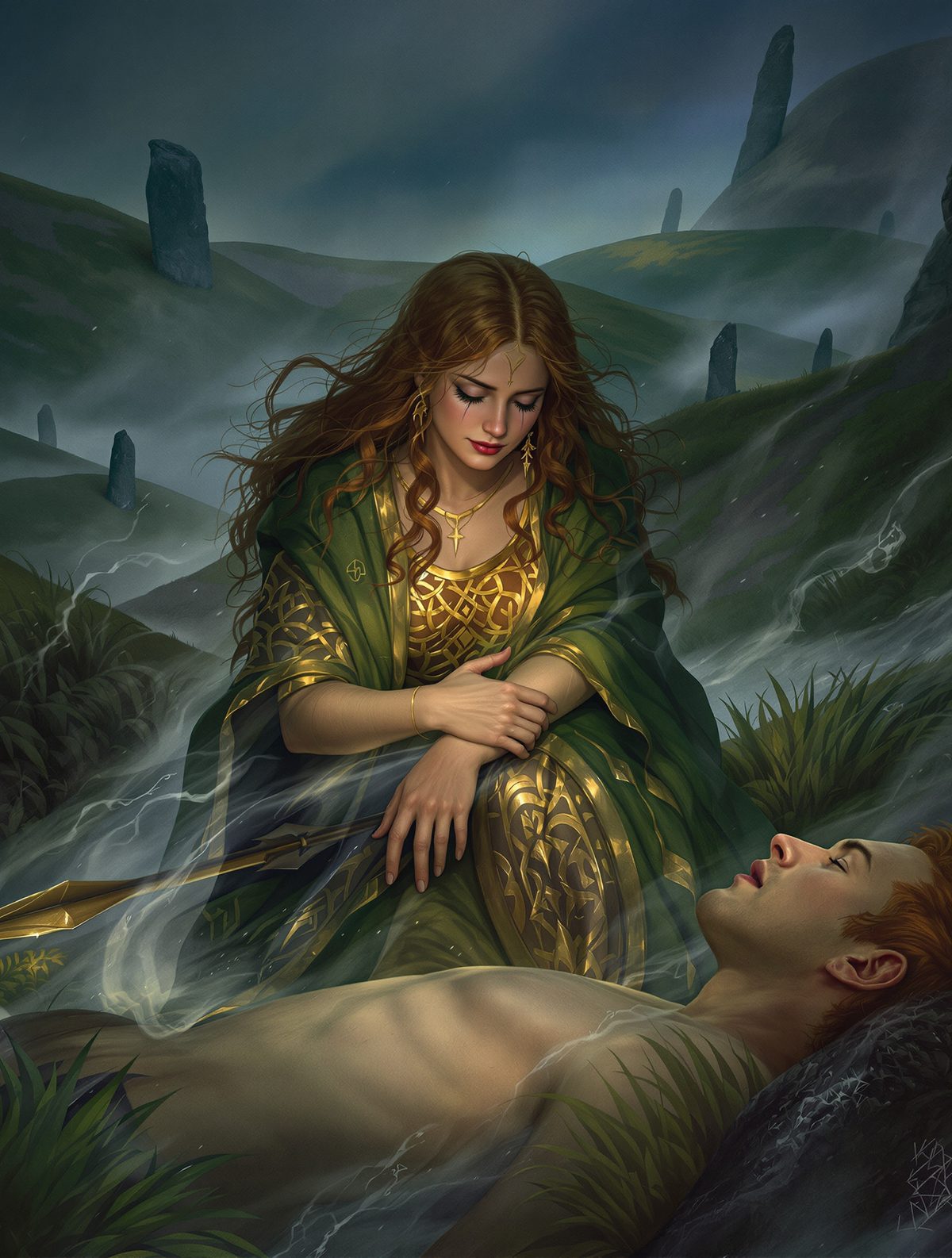
A perfect spear, thrown by the god who forged it, cannot miss. The weapon took Ruadan through the chest, and he had just enough strength left to stumble away from the forge, leaving a trail of silver-bright divine blood across the battlefield of Magh Tuireadh. He collapsed at his mother's feet as she rushed toward him, her healer's instincts overwhelming any consideration of which side he had chosen.
But even Brigid's legendary healing powers could not mend what Goibniu's spear had wrought. As she cradled her dying son, watching the light fade from eyes so like her own, something broke inside the goddess that had never broken in any being before. The sound that emerged from her throat was raw, primal—part wail, part song, part prayer to gods who were not listening.
The Cath Maige Tuired tells us that this was the first caoine (keen) ever heard in Ireland, and that Brigid wept tears not of water but of molten silver that hardened as they fell, creating the first truly precious metal known to mortals. The warriors on both sides of the battle stopped their fighting to listen, recognizing instinctively that they were witnessing the birth of something sacred and terrible—the sound that would accompany every Irish death thereafter.
When Mothers Lose Sons: The Legacy of Divine Grief
The keening tradition that began with Brigid's grief became one of the most distinctive elements of Irish culture. For over three millennia, Irish women would gather around deathbeds and raise their voices in the ancient ululation that echoed the goddess's first terrible lament. The bean charrán (keening woman) held a position of honor and necessity in every community, carrying forward Brigid's role as the divine mourner who transforms loss into something transcendent.
But perhaps the most profound aspect of this myth is what it reveals about the nature of love and loyalty in times of conflict. Brigid never condemned her son for choosing his father's side—her grief was pure and uncomplicated by anger or disappointment. She mourned not a traitor, but a child caught between impossible choices, and in doing so, she gave voice to every mother who has ever lost a son to war.
The silver tears that fell from her eyes were said to have been gathered by the other gods and formed into the first torcs—the sacred neck rings that would become symbols of Celtic nobility for centuries to come. Thus, even in her deepest sorrow, Brigid continued to give gifts to humanity, transforming her pain into beauty that would endure long after the reason for her weeping was forgotten.
Today, when we hear the keen wail of bagpipes at a military funeral, or watch a mother collapse at a gravesite, we are witnessing echoes of that first terrible morning when a goddess learned that even immortal hearts can shatter. Brigid's story reminds us that love—not power, not glory, not even duty—is often the force that drives our most consequential choices, and that grief, when given voice, becomes a bridge between the mortal and divine. In our age of endless conflicts, perhaps we need to remember the goddess who wept silver tears and ask ourselves: what songs of sorrow are we teaching our children to sing?