Picture this: a seven-year-old boy decides to take a bath, and within minutes, he's committed what amounts to divine genocide. Not just any child, mind you, but a deity whose tantrum would make the gods themselves tremble. The East Sea runs crimson, a dragon prince lies dead, and somewhere in the heavens, the cosmic order just cracked a little. Welcome to the world of Nezha—where childhood innocence meets apocalyptic fury.
This isn't your typical coming-of-age story. In Chinese mythology, few tales capture the raw, unbridled power of divine childhood like Nezha's bloody encounter with Ao Bing, the Third Prince of the Dragon King. It's a story that has fascinated audiences for over a thousand years, yet remains largely unknown in the West. Today, we're diving deep into the crimson waters of the East Sea to uncover one of mythology's most shocking displays of celestial violence.
The Child God Who Terrorized Heaven
Nezha wasn't born—he was constructed. According to the Fengshen Yanyi (Investiture of the Gods), written during the Ming Dynasty (1368-1644), Nezha emerged from his mother's womb after an unprecedented three years and six months of pregnancy, not as a crying infant, but as a fully formed ball of flesh. When his father, the military commander Li Jing, struck this mysterious orb with his sword, out sprang a boy who could walk, talk, and—most unnervingly—fight with the skill of a seasoned warrior.
But here's what most retellings leave out: Nezha was essentially a divine weapon given human form. The Primordial Heavenly Worthy had crafted him from lotus roots and celestial fire, then placed his essence into mortal flesh. This wasn't reincarnation—it was weaponization of innocence itself.
Standing barely three feet tall with the face of a cherub, Nezha possessed strength that could shatter mountains. He wielded the Universe Ring around his neck, carried the Heaven and Earth Bow, and most famously, owned the Huntian Ling—a seven-foot-long silk sash that could extend infinitely and possessed a mind of its own. These weren't toys. They were instruments of cosmic destruction disguised as childhood accessories.
When Bathing Becomes Warfare
The fateful day began with something every parent recognizes: a child who needed a bath. Seven-year-old Nezha, dusty from playing in the mortal realm (though his version of "playing" usually involved demolishing temples), wandered to the East Sea for a refreshing dip. But when gods bathe, the very elements respond.
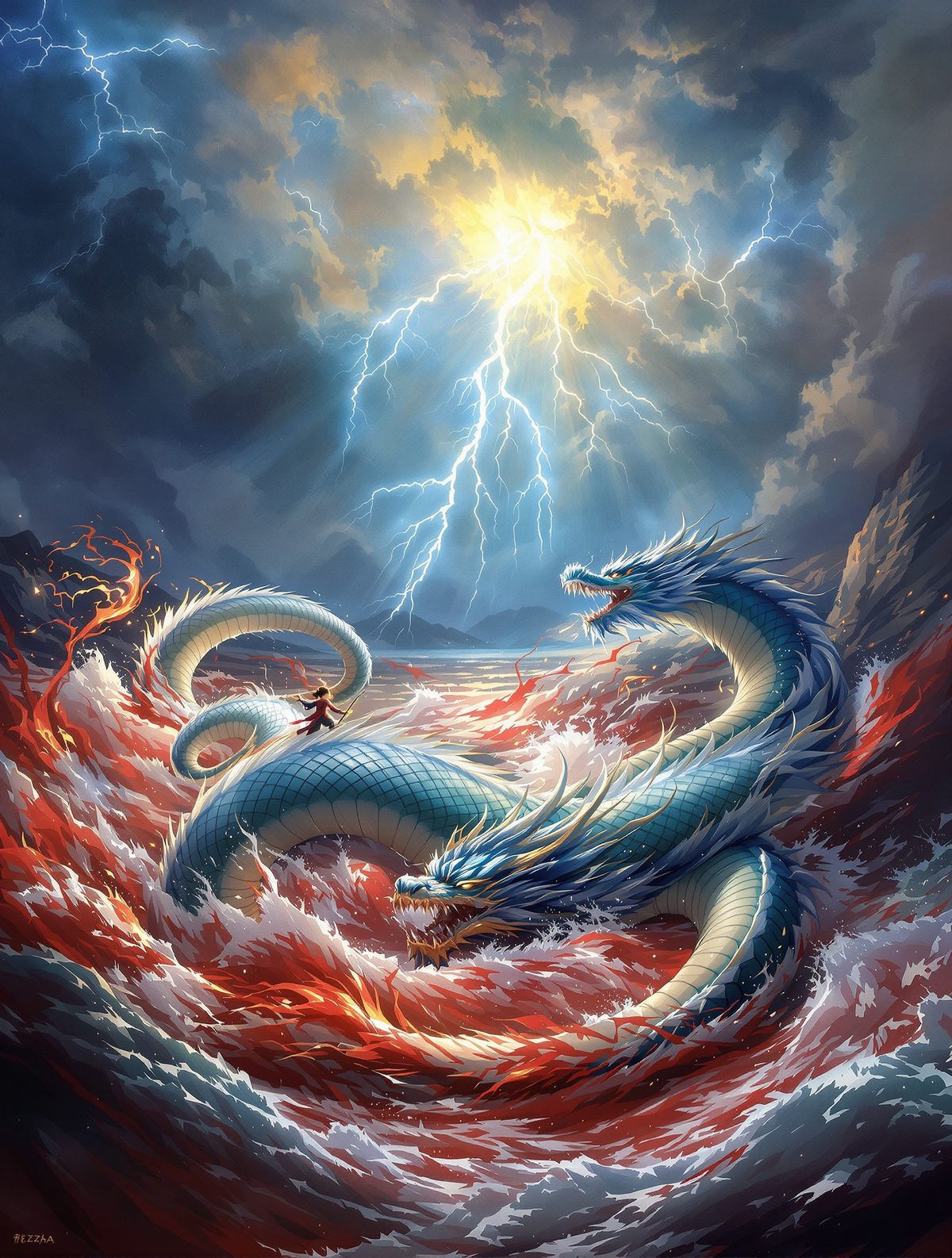
As Nezha waded into the crystal-clear waters, he began washing himself with his Huntian Ling sash. The moment the magical silk touched the sea, something extraordinary—and terrifying—occurred. The sash began to glow with an otherworldly light, its power rippling outward in concentric waves. Within moments, the entire East Sea transformed from peaceful blue to a deep, blood-red crimson that stretched beyond the horizon.
What most versions of this tale don't explain is the why behind this transformation. The Huntian Ling wasn't just getting wet—it was absorbing the sea's spiritual energy and converting it into raw, destructive force. Ancient texts describe the water as "boiling with heaven's wrath," reaching temperatures that would have been lethal to any mortal creature. Fish died by the millions, their bodies floating to the surface in a grotesque carpet of marine life.
The Dragon Palace Trembles
Deep beneath the East Sea lay the Crystal Palace of the Dragon King Ao Guang, one of the Four Dragon Kings who controlled China's waters. Imagine a structure carved from living coral and pearls the size of boulders, populated by thousands of dragon spirits, sea generals, and aquatic demons. This underwater metropolis had stood unchanged for millennia, a testament to draconic power and ancient order.
Then Nezha started his bath.
The palace began to shake as if gripped by an earthquake. Coral pillars cracked, pearl walls developed fissures, and the very foundation of the underwater realm groaned under an invisible assault. What witnesses described wasn't just structural damage—the palace itself seemed to be screaming. Ancient protective spells, woven into the building's very essence over thousands of years, were unraveling in real-time.
Dragon King Ao Guang, in the middle of his court session with various sea spirits, watched in horror as his throne room filled with that unnatural red light filtering down from the surface. His advisors fled. His guards cowered. And somewhere in the depths of the palace, a war drum that hadn't sounded in three thousand years began to beat on its own.
Ao Bing: The Prince Who Chose War
Enter Ao Bing, the Third Prince of the Dragon King—and here's where the story gets really interesting. Unlike his father's other sons, Ao Bing was considered the most human of the dragon princes. He spent time in the mortal world, understood human customs, and was known for his diplomacy rather than his fury. In modern terms, he was the progressive royal, the one who believed dragons and humans could coexist peacefully.
Which makes what happened next all the more tragic.
When Ao Bing rose from the crimson depths to confront whatever was destroying his home, he probably expected to negotiate. Maybe he thought he'd find a rogue sorcerer or a wayward demon—something he could reason with. Instead, he found a small boy playing in the water, seemingly oblivious to the apocalyptic chaos he was causing.
"Child," Ao Bing called out, his voice carrying the authority of centuries, "do you not know that you're destroying the Dragon Palace? Cease this magic at once!"
Nezha looked up with the innocent curiosity of a seven-year-old who'd just been told he couldn't play with his favorite toy. "I'm just taking a bath," he replied, genuinely confused. "What dragon palace?"
Death in an Instant
What happened next took less than three seconds and would echo through the heavens for eternity.
Ao Bing, realizing that diplomacy had failed and his kingdom was literally crumbling around him, transformed into his true dragon form. Picture a serpentine creature three hundred feet long, scales like shields of jade, eyes like burning coals, and claws that could rend reality itself. This was a being who had commanded typhoons and redirected rivers, a prince whose roar could shatter mountains.
Nezha saw the massive dragon rising from the crimson water and did what any seven-year-old might do when confronted by a monster: he defended himself. But when gods defend themselves, mortals—and apparently, dragon princes—die.
With movements too fast for even divine eyes to follow, Nezha's Universe Ring flew from his neck. The golden circlet, no larger than a bracelet, struck Ao Bing directly in the forehead with the force of a falling star. The impact was so powerful that it created a shockwave visible from the shore, a perfect circle of displaced water that revealed the seafloor for miles around.
Ao Bing died instantly. Three hundred feet of divine dragon crashed into the sea with a sound like thunder, his jade scales already beginning to fade from brilliant green to lifeless gray.
But Nezha wasn't finished.
The Sinews of a God
Here's where the story takes a turn that would make even seasoned mythology readers wince. Standing over the massive corpse of the dragon prince, Nezha made a decision that would forever mark him as something beyond human understanding—even by divine standards.
"Father always complains that his armor doesn't fit right," Nezha mused aloud, examining the dead dragon with the clinical detachment of a child studying a broken toy. "Dragon tendons are supposed to be the strongest material in existence."
What followed was a scene of such casual brutality that ancient scholars often glossed over the details. Using his bare hands—remember, this is a seven-year-old child—Nezha began extracting Ao Bing's dragon sinews. These weren't ordinary tendons, but crystallized divine essence that held the dragon's supernatural strength. Each sinew glowed with residual power, flexible as silk yet stronger than tempered steel.
The process took hours. Nezha worked with the methodical precision of a master craftsman, carefully removing each tendon without damaging its integrity. By the time he finished, the sun was setting, painting the still-crimson sea in shades of gold and amber. The dragon prince's body, now nothing but hollow scales and bone, sank slowly into the depths while Nezha wrapped the gleaming sinews around his waist like a belt.
"Father will be so pleased," he said to himself, apparently oblivious to the fact that he'd just committed what amounted to regicide.
Why This Tale Still Matters
Modern readers might dismiss this as simply another violent myth from a more brutal time, but Nezha's battle with Ao Bing represents something far more complex and relevant than mere divine bloodlust. This story emerged during the Yuan Dynasty (1271-1368), when China was under foreign rule and traditional power structures were crumbling. Nezha—a being who looked like a child but possessed godlike power—represented the ultimate outsider, someone who could challenge established order precisely because he didn't understand it.
Consider the parallels to today's disruptive technologies and social movements. Like Nezha's innocent bath that destroyed an ancient kingdom, our modern "improvements" often have consequences we never intended. The child god's casual brutality toward Ao Bing mirrors how innovation frequently destroys old systems without malice, simply because it doesn't recognize their value.
More unsettling still is Nezha's complete lack of remorse. He doesn't celebrate his victory or mourn his victim—he simply moves on to the next practical concern. In an age where we're increasingly disconnected from the consequences of our actions, whether through technology, social media, or global capitalism, Nezha's detached efficiency feels uncomfortably familiar.
Perhaps that's why this ancient tale of a bathing child and a dead dragon continues to resonate. It reminds us that power without wisdom, innovation without compassion, and strength without understanding don't just risk destroying our enemies—they risk destroying the very foundations of the world we're trying to improve. In Nezha's crimson sea, we might just recognize the reflection of our own times.