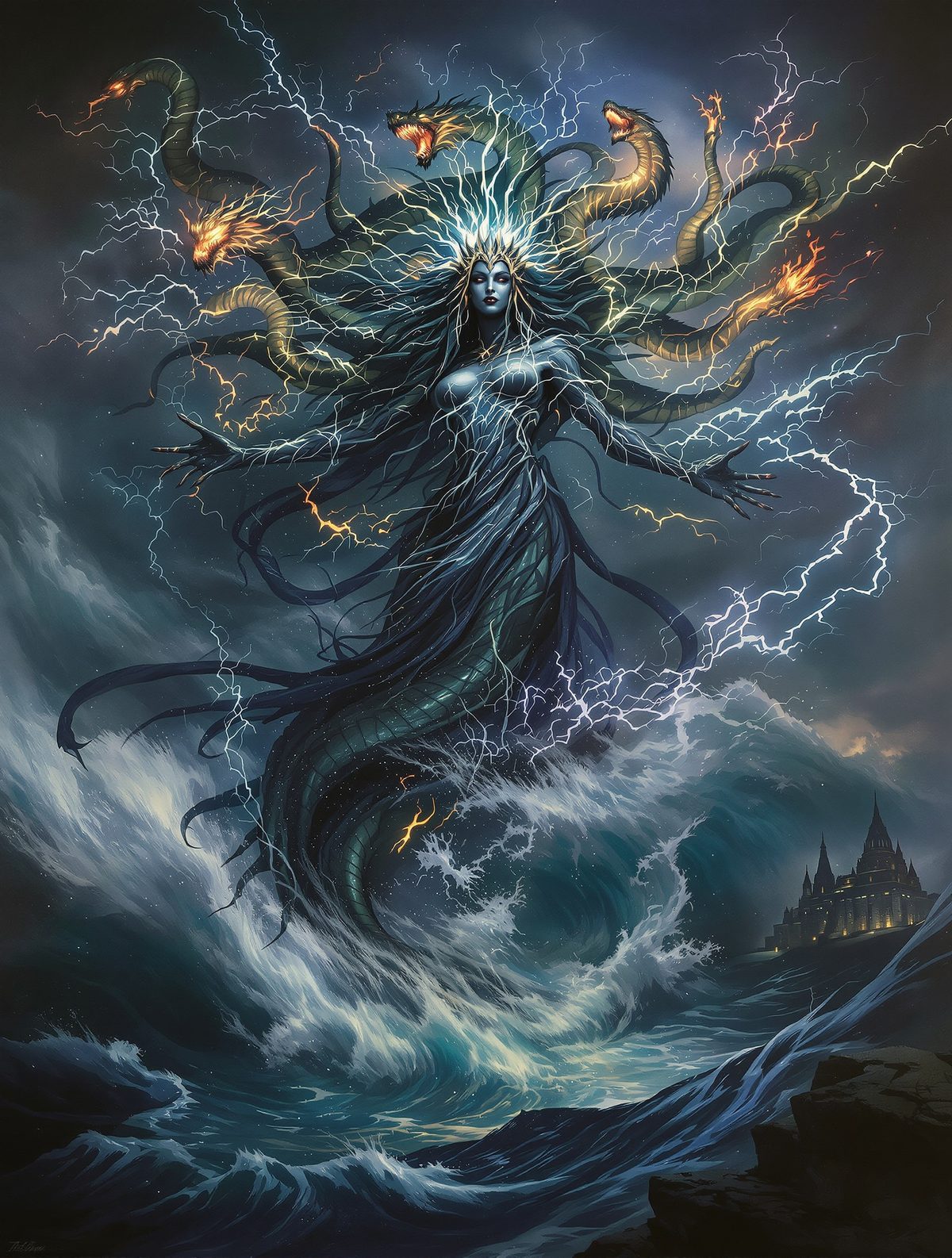
In the primordial darkness before creation, when the universe was nothing but swirling waters of chaos, a goddess wept tears that would birth nightmares. Tiamat, the ancient Mesopotamian embodiment of the saltwater ocean, had just received the most devastating news imaginable: her beloved husband Apsu was dead, murdered by their own children. As her grief transformed into something far more terrible, she would open her womb one final time—not to create life, but to unleash an army of monsters so horrifying that their names still echo through humanity's darkest myths.
The Mother of All Things Becomes the Mother of All Monsters
To understand Tiamat's transformation from creator to destroyer, we must first grasp who she was in the Mesopotamian cosmos. Dating back to at least 2100 BCE in Sumerian texts, Tiamat represented the primordial saltwater ocean—chaotic, infinite, and pregnant with possibilities. Her name literally means "sea" in Akkadian, but she was far more than water. She was the womb from which all existence emerged.
According to the Enuma Elish, Babylon's creation epic carved into cuneiform tablets around 1100 BCE, Tiamat and her freshwater husband Apsu were the first divine beings. From their mingled waters came the first generation of gods—beings who would prove to be loud, disruptive, and ultimately murderous children. The younger gods' constant noise and chaos disturbed Apsu's sleep, leading him to plot their destruction. But the wise god Ea discovered the plan and struck first, killing Apsu in his watery realm.
Here's where most textbooks end the story—but they miss the most terrifying part. Tiamat's revenge wasn't swift. It was calculated. Archaeological evidence from Neo-Assyrian texts reveals that Mesopotamians believed grief could literally reshape reality. When Tiamat learned of Apsu's death, her sorrow was so profound it altered the fundamental nature of creation itself.
The Womb That Birthed Nightmares
What emerged from Tiamat's final pregnancy defied every natural law. The Enuma Elish provides a catalog of horrors that reads like a manual for creating the perfect apocalypse. She birthed giant serpents with venom for blood, their fangs crackling with lightning. Dragons emerged whose very breath could melt bronze and whose roars shattered stone. These weren't metaphors—to the Mesopotamians, these creatures were as real as the flooding Tigris or the scorching desert wind.
But perhaps most unsettling were the hybrid creatures: the ušumgallū (great dragon-serpents), bašmu (venomous serpents with legs and wings), and mušhuššu (serpent-dragons that would later become associated with the god Marduk himself). These beings combined the most feared aspects of different animals—the stealth of serpents, the power of lions, the reach of eagles, and the bulk of bulls. Modern reconstructions based on Mesopotamian art suggest these creatures stood up to fifteen feet tall, with wingspans that could block out the sun.
Archaeological discoveries at Babylon have uncovered ritual texts describing eleven specific monster types, each designed for maximum psychological warfare against the younger gods. The ancient scribes weren't just telling stories—they were documenting what they believed to be the actual blueprint for cosmic destruction.
The General of Chaos Takes Command
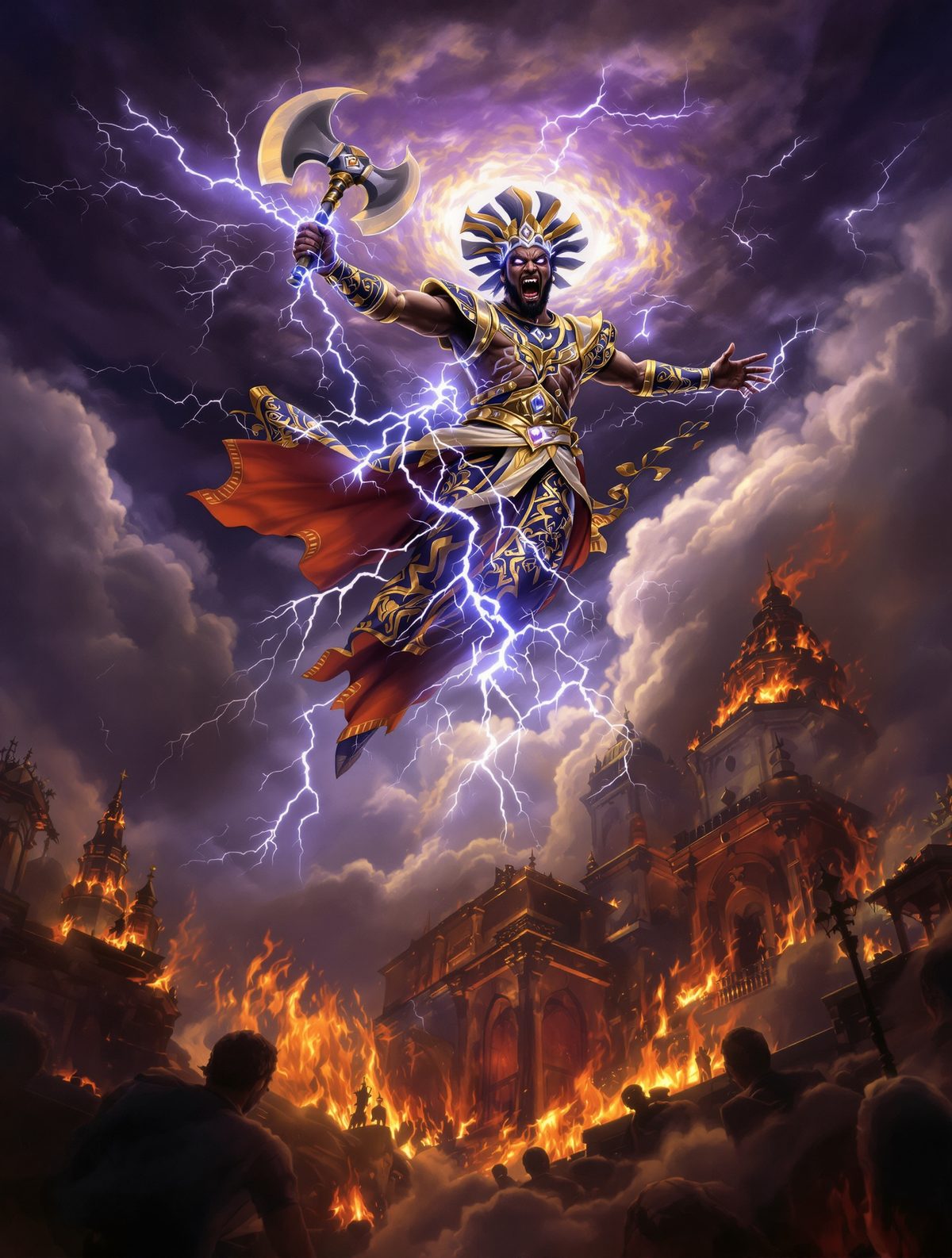
Tiamat's masterstroke wasn't just creating monsters—it was her choice of general. She elevated Qingu, her new consort, to lead the army and gave him the Tablets of Destiny, artifacts that controlled the fate of all existence. This wasn't merely a military appointment; it was a fundamental reordering of cosmic authority. By placing ultimate power in the hands of chaos, Tiamat was essentially declaring that the universe itself was illegitimate.
Recent translations of fragmentary texts from the library of Ashurbanipal reveal that Qingu's appointment sent shockwaves through the divine realm. The younger gods, who had seemed so confident after defeating Apsu, suddenly found themselves facing an enemy who could rewrite the laws of reality at will. Imagine facing an army where the general could decide that gravity worked upward or that fire froze instead of burned.
The psychological warfare was devastating. Cuneiform tablets from the Neo-Babylonian period describe how even mighty gods like Anu and Ea—deities who commanded sky and wisdom—were paralyzed by fear when they heard of Tiamat's preparations for war. The cosmic order they had murdered Apsu to protect was crumbling before they even faced their first monster in battle.
When Gods Learned to Fear the Dark
The army that assembled under Tiamat's banner was unlike anything the cosmos had ever seen. Modern analysis of Mesopotamian iconography suggests that each monster type served a specific tactical purpose. The flying serpents controlled the skies, the bull-men dominated the earth, and hybrid fish-beasts commanded the waters. This wasn't random chaos—it was organized, strategic, and terrifyingly effective.
What makes this myth particularly fascinating is how it reflects real Mesopotamian military tactics. Assyrian and Babylonian armies were famous for their combined arms approach, using different unit types in coordinated attacks. Tiamat's monster army mirrors this sophistication, suggesting that the myth-makers understood that even cosmic chaos needed strategy to succeed.
The terror wasn't just physical. Mesopotamian texts describe how Tiamat's approach changed the very nature of existence. Stars began moving backward, rivers flowed uphill, and the boundaries between life and death became permeable. Reality itself was unraveling as the primordial chaos from which it emerged returned to reclaim what was rightfully hers.
The Mother's Last Stand
When the final confrontation came, it would be Marduk, the young Babylonian god, who stepped forward to face Tiamat. But even he required all the weapons of heaven and the authority of every god combined. The battle itself was less a fight than a cosmic reshaping—Marduk would split Tiamat's body to create the sky and earth, transforming the mother of monsters into the foundation of ordered reality.
Yet here's the detail that chills: according to several variants of the myth, Tiamat could have won. She possessed the power to unmake creation itself, to return everything to the peaceful, undifferentiated waters from which it came. Her defeat wasn't inevitable—it was contingent, desperate, and bought at a price that would echo through every subsequent generation of gods and mortals.
The monsters she created didn't simply disappear after her defeat. Mesopotamian magical texts from as late as the Persian period reference these creatures, treating them as real entities that could still be summoned or encountered in the wild places of the world. In their cosmology, chaos wasn't destroyed—it was contained, always threatening to break free.
Why Ancient Monsters Still Matter
Tiamat's story resonates today because it captures a fundamental human truth: creation and destruction are inextricably linked. Every act of building something new requires the destruction of what came before. Every generation must, in some sense, "kill" its parents to establish its own order. But as Tiamat's revenge demonstrates, those we destroy in the name of progress rarely go quietly.
In our modern world of rapid technological change and social upheaval, we face our own primordial forces threatening to unleash chaos. Climate change, artificial intelligence, genetic engineering—all represent powers that could remake or unmake the world as we know it. Like the younger gods who disturbed Apsu's sleep with their noise, we may discover that our innovations have consequences we never anticipated.
The ancient Mesopotamians understood something we often forget: the forces of chaos aren't evil—they're necessary. Without Tiamat's destructive potential, creation becomes stagnant. Without the threat of monsters, gods grow complacent. The mother of all monsters reminds us that in the space between order and chaos, in that fertile darkness where anything might be born, both our greatest fears and our most necessary transformations await.