In a modest workshop in ancient Lydia, the rhythmic click of a loom echoed through the morning air. The hands working the threads moved with supernatural precision, creating patterns so intricate they seemed to breathe with life. Golden sunlight filtered through the window, illuminating tapestries that would make kings weep with envy. But the young woman at the loom harbored a dangerous secret: she believed herself superior to the gods themselves.
This is the story of Arachne—a tale that reveals the razor-thin line between divine talent and mortal hubris, where the price of perfection became an eternity of horror.
The Prodigy of Lydia
Arachne was no ordinary weaver. Born in the ancient kingdom of Lydia (modern-day western Turkey) around the mythical period when gods still walked among mortals, she possessed a gift that defied explanation. Her father, Idmon, was a simple dyer of wool who worked with the famous Lydian purple—that precious pigment more valuable than gold. But his daughter's talent far exceeded his own humble craft.
From childhood, Arachne's fingers seemed to possess their own intelligence. She could weave scenes so lifelike that birds would attempt to perch on the embroidered branches of her tapestries. Her flowers appeared to sway in an unfelt breeze, and her human figures seemed ready to step from the fabric itself. Word of her extraordinary skill spread throughout the ancient world like wildfire.
What many don't realize is that weaving held sacred significance in ancient Greece. It wasn't merely women's work—it was divine art. The very fabric of fate itself was said to be woven by the three Moirai, the goddesses of destiny. To claim mastery over the loom was to claim power over the fundamental forces of existence.
Arachne's workshop became a pilgrimage site. Nobles traveled hundreds of miles to commission her work. Even the nymphs—those elusive daughters of rivers and mountains—would abandon their hidden groves to witness her artistry. But as her reputation grew, so did something far more dangerous: her pride.
The Boast That Shook Olympus
"My skill surpasses even that of grey-eyed Athena herself," Arachne declared one fateful morning, her voice carrying across the marketplace of her hometown. The crowd that had gathered to admire her latest creation fell silent. In ancient Greece, such words weren't mere boasting—they were a direct challenge to the divine order.
Athena, goddess of wisdom, warfare, and crafts, was considered the patron of all weavers. According to Hesiod's genealogies, she had sprung fully formed from Zeus's head, already master of all intellectual and artistic pursuits. Her tapestries adorned the very halls of Olympus, depicting the great deeds of gods with threads spun from starlight and cloud-silk.
But here's what the textbooks often omit: Athena wasn't merely offended by Arachne's claim—she was genuinely curious. For centuries, no mortal had dared challenge her supremacy in the arts. The goddess found herself facing an unprecedented situation that would test not only Arachne's skill but her own divine nature.
The challenge rippled through the supernatural realm. The Muses whispered about it in their sacred groves, and even Zeus himself took notice from his throne atop Mount Olympus. A mortal woman had thrown down the gauntlet to one of the most powerful Olympians. The very fabric of the cosmic order seemed to tremble on its loom.
The Stranger at the Door
Three days after Arachne's boast, as the sun dipped low behind the Lydian hills, a bent figure approached her workshop. The stranger appeared to be an ancient crone, her white hair wispy as mountain fog, her hands gnarled with age. She leaned heavily on a walking stick carved from olive wood—though none who saw her that evening would have recognized the significance of that particular detail.
"Child," the old woman said, her voice carrying an odd authority despite its frailty, "I have lived many lifetimes and seen the rise and fall of kingdoms. Take an old woman's advice: honor the gods, and be content with your mortal gifts. Athena's skill is beyond human comprehension."
Arachne looked up from her loom, irritation flashing in her dark eyes. "Old woman, keep your superstitions to yourself. I have no need of divine favor—my hands create beauty that surpasses anything the gods have ever wrought."
What Arachne couldn't have known was that she was addressing Athena herself. The goddess had assumed this disguise not out of mere deception, but following an ancient divine protocol. Greek gods were bound by certain cosmic laws—they couldn't directly punish mortals without first offering a chance for redemption. This visit was Arachne's final opportunity to step back from the precipice.
The disguised goddess pressed on: "I've seen the tapestries of Athena herself, child. They capture the very essence of existence—the birth of stars, the dreams of sleeping heroes, the whispered prayers of mothers. No mortal hand, however skilled, could match such artistry."
Arachne's laughter rang sharp as breaking pottery. "Then let your precious Athena come and prove it! Let her face me in contest, and we shall see whose skill reigns supreme!"
The Revelation and the Challenge
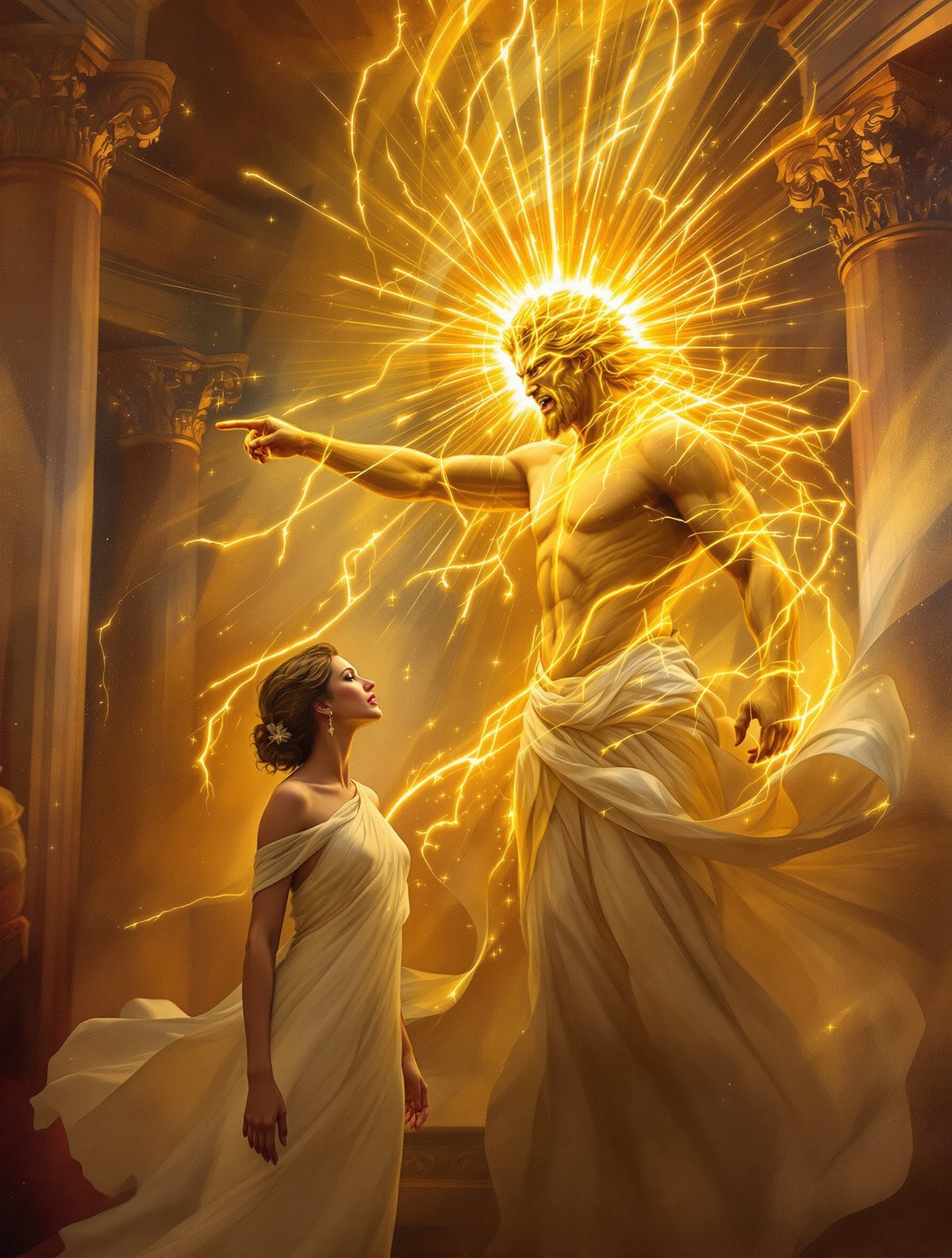
The air in the workshop suddenly grew thick, as if charged with an approaching storm. The old woman's bent frame began to straighten, her withered hands growing smooth and strong. Her grey rags transformed into a magnificent peplos of deepest blue, adorned with golden owls that seemed to blink with living eyes. Most dramatically, her elderly features shifted to reveal the ageless beauty of an Olympian goddess.
Grey eyes—the color of storm clouds and battlefield steel—fixed upon Arachne with an intensity that should have reduced her to ash. The goddess now stood revealed in all her terrible glory, her presence filling the small workshop like barely contained lightning.
"Your wish is granted, mortal," Athena spoke, her voice now carrying the weight of divine authority. "But know this—I offered you mercy, and you have chosen pride instead."
Here's a fascinating detail often overlooked: Arachne didn't cower. Historical accounts suggest that true artistic genius often comes paired with an unshakeable core of self-belief. Even faced with a goddess who could unmake her with a thought, Arachne stood her ground. Whether this was courage or madness remains a subject of debate among scholars of mythological psychology.
Two looms were prepared—magnificent constructions of silver and gold that materialized from divine will. The contest would take place at dawn, with the nymphs of wood and stream serving as witnesses. Word spread throughout the supernatural realm with impossible speed. By sunrise, every creature of myth and legend had gathered to witness this unprecedented challenge to divine supremacy.
The Contest of Creation
As Apollo's chariot crested the eastern mountains, the two weavers took their positions. Athena began her work with threads that seemed to capture pure light—gold that held the warmth of summer afternoons, blue deeper than the Mediterranean at its most profound depths, silver that reflected not just light but hope itself.
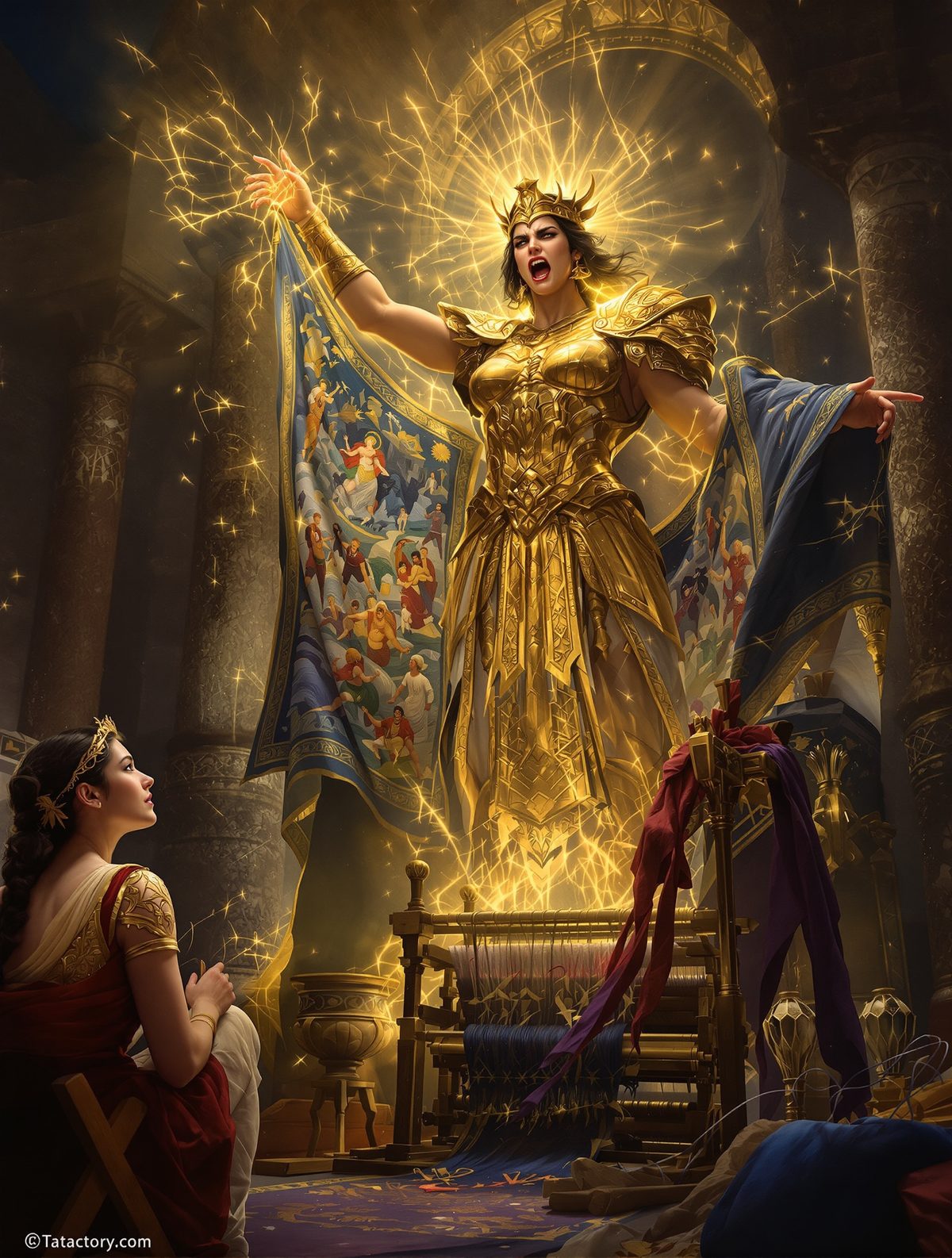
Her tapestry depicted the glory of the gods: Zeus hurling thunderbolts that seemed to crackle with real electricity, Poseidon raising waves that appeared to crash against the fabric's edges, Apollo playing music so beautifully rendered that observers swore they could hear the melody. Each figure possessed divine perfection, their faces noble and serene, their actions heroic and just.
But Arachne—Arachne chose a different subject entirely. Her tapestry showed the gods as they truly were: Zeus disguising himself to seduce mortal women, Poseidon forcing himself upon unwilling nymphs, Apollo pursuing maidens who fled in terror from his advances. Every scene was woven with technical brilliance that matched the goddess herself, but the content was far more subversive than anyone had anticipated.
The watching crowd grew hushed as Arachne's work progressed. Her threads—mere mortal materials compared to Athena's divine silk—somehow achieved effects that seemed impossible. The expressions on her figures conveyed complex emotions: fear, betrayal, desperate hope. Her color work created shadows and depth that drew the eye into the scenes as if they were windows rather than weavings.
Most shocking of all: Arachne's technical execution was flawless. Not a single thread was out of place, not one color muddied or unclear. The goddess of crafts herself could find no fault in the mortal woman's technique.
Rage, Destruction, and Transformation
When both tapestries were complete, a profound silence fell over the assembled witnesses. Even the wind seemed to hold its breath. Athena's work blazed with divine beauty and technical perfection—but so did Arachne's. The mortal woman had achieved the impossible: she had matched a goddess in skill while simultaneously exposing the moral failings of the entire pantheon.
What happened next reveals a crucial truth about power that resonates even today. Faced with work that equaled her own—and worse, work that used that equality to level devastating criticism—Athena didn't respond with wisdom or justice. She responded with pure, uncontrolled rage.
The goddess raised her hands, and divine fire erupted from her fingertips. Arachne's tapestry—that masterwork of mortal achievement—burst into flames that burned with unnatural colors. Purple fire consumed the scenes of divine misconduct, while golden flames licked away hours of perfect craftsmanship. In moments, nothing remained but ash and the bitter smell of destroyed dreams.
But Athena's fury was far from spent. She turned to Arachne herself, her grey eyes blazing with a wrath that had never been seen before or since. "You want to weave forever, mortal?" she hissed. "Then weave you shall—for all eternity."
The transformation was as terrible as it was swift. Arachne's fingers elongated and multiplied, becoming eight spindly legs. Her body contracted into a bulbous abdomen capable of producing silk. Her human face compressed into the simple features of a spider, though her eyes—those proud, defiant eyes—remained disturbingly aware and intelligent.
Thus was born the first spider, condemned to weave not beautiful tapestries but simple webs, forever creating and forever destroying her own work, never again to know the joy of creating art that could move the hearts of those who beheld it.
The Legend's Lasting Web
The story of Arachne speaks to something fundamental about the relationship between power and creativity that remains painfully relevant today. How often do we see established authorities—whether in art, business, or politics—react with destructive fury when challenged by newcomers who dare to match or exceed their skills?
Arachne's fate serves as both warning and inspiration. Her pride certainly led to her downfall, but her refusal to bow before unjust authority—even divine authority—resonates with anyone who has ever dared to challenge the status quo. She may have been transformed into a spider, but she was never broken. Even today, every spider's web stands as a testament to her defiant artistry.
Perhaps most importantly, Arachne's story reminds us that true art often involves risk—the risk of offending power, of telling uncomfortable truths, of placing one's very existence on the line for the sake of authentic expression. In a world where creators still face destruction for challenging authority, Arachne's eight-legged legacy continues to weave its way through our collective consciousness, reminding us that sometimes the most dangerous thing an artist can be is absolutely, undeniably perfect.