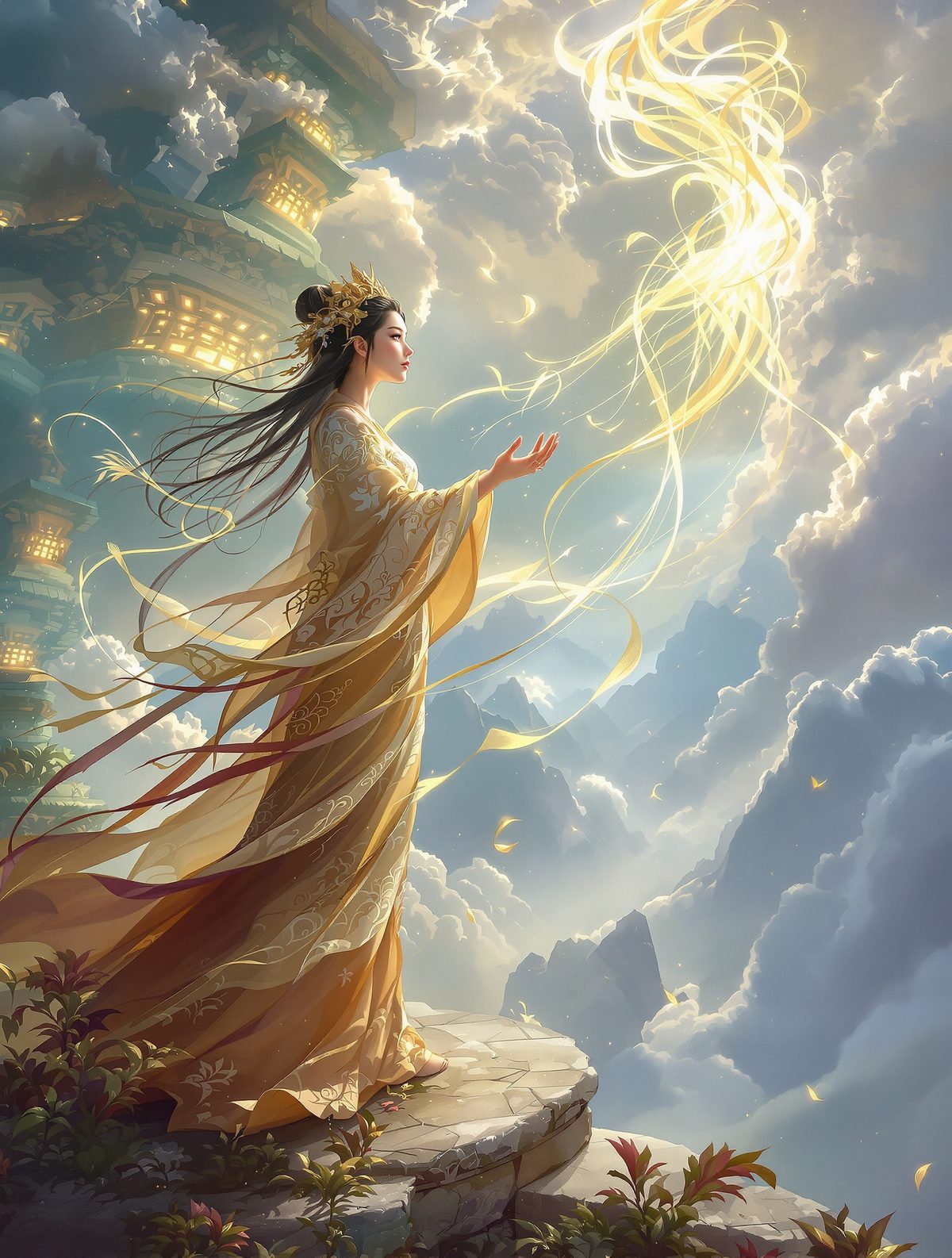
Picture this: high above the celestial realm, where clouds shimmer like silk and stars dance in eternal patterns, a young goddess sits at her cosmic loom. Her fingers move with divine precision, weaving clouds into being, spinning the very fabric of the sky. But tonight, something is different. Tonight, Zhinü—the seventh daughter of the Jade Emperor himself—lets her shuttle fall idle as she gazes down at the mortal world below. What she sees there will spark the greatest forbidden love story in Chinese mythology, and ultimately reshape the very heavens themselves.
This is no ordinary tale of star-crossed lovers. This is the story of how defying the gods created one of the most enduring symbols in the night sky, and why millions of people across Asia still celebrate this ancient romance every summer.
The Divine Daughter Who Grew Tired of Paradise
In the glittering court of the Jade Emperor, ruler of all celestial beings, Zhinü held a position of tremendous honor. As the seventh and youngest daughter, she was blessed with supernatural weaving abilities that surpassed even her six elder sisters. Her celestial loom produced the clouds that drifted across mortal skies, the rainbow bridges that connected earth to heaven, and the delicate silk garments worn by the highest immortals.
But here's what the traditional stories often gloss over: Zhinü was essentially trapped in golden chains. Despite her divine status, she had no freedom to leave the celestial realm, no choice in her eternal duties, and certainly no say in matters of the heart. Day after day, century after century, she sat at her loom, creating beauty for others while her own spirit yearned for something more meaningful than perfect stitches and endless silk.
The turning point came during the annual inspection of the mortal realm—a duty that rotated among the celestial court. When Zhinü's turn arrived, she descended through the silver mists to observe the human world below. What she discovered there would change everything: mortals who worked with their hands not out of divine obligation, but out of love for their craft and care for their families.
The Cowherd Who Caught Heaven's Eye
In the verdant valleys of ancient China, far from the imperial palaces and bustling market towns, lived a young man whose life seemed unremarkable by mortal standards. Niulang—literally "Cowherd"—had lost his parents early and lived with his elder brother's family, tending cattle and working the fields. By all accounts, he should have been invisible to celestial eyes.
But Niulang possessed something that caught Zhinü's divine attention: a profound gentleness with animals and an unshakeable integrity that shone like a beacon to her supernatural sight. Ancient texts describe how he would sing to his oxen during long days in the pasture, share his meager meals with stray dogs, and work tirelessly to help neighboring farmers during harvest time—expecting nothing in return.
Here's a detail that most retellings miss: Niulang owned a magical ox, a fallen celestial being who had been banished to earth for minor infractions against heavenly protocol. This ox, recognizing Zhinü's divine nature when she began secretly visiting the mortal realm, became the unlikely matchmaker between goddess and cowherd. The ox could speak—though only to those pure of heart—and it was he who revealed to Niulang that the beautiful woman who had been appearing by the riverside each evening was no ordinary mortal.
A Wedding Woven from Starlight and Secrecy
The courtship between Zhinü and Niulang unfolded over the course of several seasons, conducted entirely in secret during her authorized visits to the mortal realm. She would complete her celestial duties with unprecedented speed, then slip away to the riverside where they would meet. He taught her about mortal joys: the taste of fresh fruit picked from wild trees, the simple pleasure of walking barefoot in cool grass, the warmth of sharing stories around a fire.
In return, she showed him wonders beyond mortal imagination: how to read the secret messages written in cloud formations, how to understand the ancient language of wind through leaves, and how to see the invisible threads that connected all living things. Their love grew like silk on a loom—delicate at first, then strong enough to span the distance between earth and heaven.
The wedding ceremony itself was a masterpiece of secrecy and magic. With only the magical ox as witness, they exchanged vows beneath a canopy of stars that Zhinü had secretly rearranged to form an auspicious pattern. She wore a gown woven from moonbeams and morning mist, while he adorned himself with wildflowers that bloomed only at midnight. Ancient poems describe how the very earth seemed to celebrate their union—flowers bloomed out of season, streams ran sweeter, and the ox shed tears of joy.
For exactly 100 days—a number considered perfectly balanced in Chinese cosmology—they lived as husband and wife. Zhinü learned to cook mortal food, tend a garden, and experience the profound satisfaction of creating a home rather than just beautiful objects. Niulang discovered that love could elevate the mundane into the magical, that even simple farm work became meaningful when shared with someone who chose to be there.
The Jade Emperor's Wrath Splits the Heavens
But divine accounting is precise, and Zhinü's prolonged absences from her celestial loom had consequences that rippled across both realms. Clouds began forming irregularly, creating drought in some regions and floods in others. The silk supplies for celestial garments dwindled, causing embarrassment at important heavenly functions. Most damning of all, other celestial beings began whispering about favoritism and the breakdown of cosmic order.
When the Jade Emperor's investigators finally traced the disruptions to his youngest daughter, his rage was legendary—literally earth-shaking. Ancient texts record that his anger caused earthquakes, tidal waves, and solar eclipses across the mortal world. The discovery that his divine daughter had not merely neglected her duties, but had married a mortal man without permission, represented the most serious breach of celestial law in recorded heavenly history.
The punishment was swift and brutal. Celestial soldiers descended to earth, forcibly separating the lovers and dragging Zhinü back to the heavenly realm. But the Jade Emperor's true masterstroke of cruelty was yet to come: using his supreme power, he took the Milky Way—that great river of stars stretching across the night sky—and positioned it as an eternal barrier between his daughter and her mortal husband.
Zhinü was banished to the star Vega, forced to resume her weaving duties under constant supervision. Niulang, along with their two young children (a detail often omitted from sanitized versions), was elevated to the star Altair. They could see each other across the cosmic divide, but never touch, never speak, never embrace.
When Magpies Became Messengers of Love
But this story contains one of the most beautiful examples of compassion triumphing over divine law. The lovers' grief was so profound, their weeping so constant, that it began affecting the natural world. Rivers ran salt with tears, flowers refused to bloom, and even the celestial court found the constant sound of sobbing disruptive to their eternal harmony.
According to tradition, it was the Queen Mother of the West—the Jade Emperor's own wife—who finally proposed a compromise. Moved by the couple's devotion and perhaps remembering her own ancient romance with the emperor, she negotiated a single concession: once each year, on the seventh day of the seventh lunar month, all the magpies in the world would fly to the heavens and form a bridge across the Milky Way.
This detail reveals something profound about Chinese cosmology: even divine punishment can be tempered by collective compassion. The magpies—ordinary birds acting with extraordinary purpose—became symbols of how small acts of kindness can overcome seemingly impossible barriers. The annual reunion became known as Qixi Festival, still celebrated today across China, Japan, Korea, and Vietnam as a celebration of enduring love.
A Love Story Written in Stars
Today, when you look up at the summer night sky, you can see Zhinü (Vega) and Niulang (Altair) separated by the luminous band of the Milky Way. Vega, one of the brightest stars in the northern hemisphere, appears to pulse with longing, while Altair flickers with steadfast devotion. The ancient Chinese saw in this celestial arrangement not just a punishment, but a testament to love's power to endure even divine wrath.
This myth resonates across millennia because it speaks to universal human experiences: the courage required to defy unjust authority, the pain of love constrained by social barriers, and the hope that genuine devotion can overcome any obstacle. In modern China, the Qixi Festival has become a celebration comparable to Valentine's Day, with couples gazing at stars and making wishes for lasting love.
But perhaps the most remarkable aspect of this ancient tale is its quiet revolution against absolute authority. Zhinü's choice to abandon her divine duties for love represents one of mythology's earliest examples of individual desire trumping societal expectations—a theme that continues to inspire artists, writers, and dreamers worldwide. In choosing a mortal cowherd over celestial privilege, she demonstrated that the heart recognizes no hierarchy, that authentic love transcends all boundaries, even those drawn by gods across the very heavens themselves.