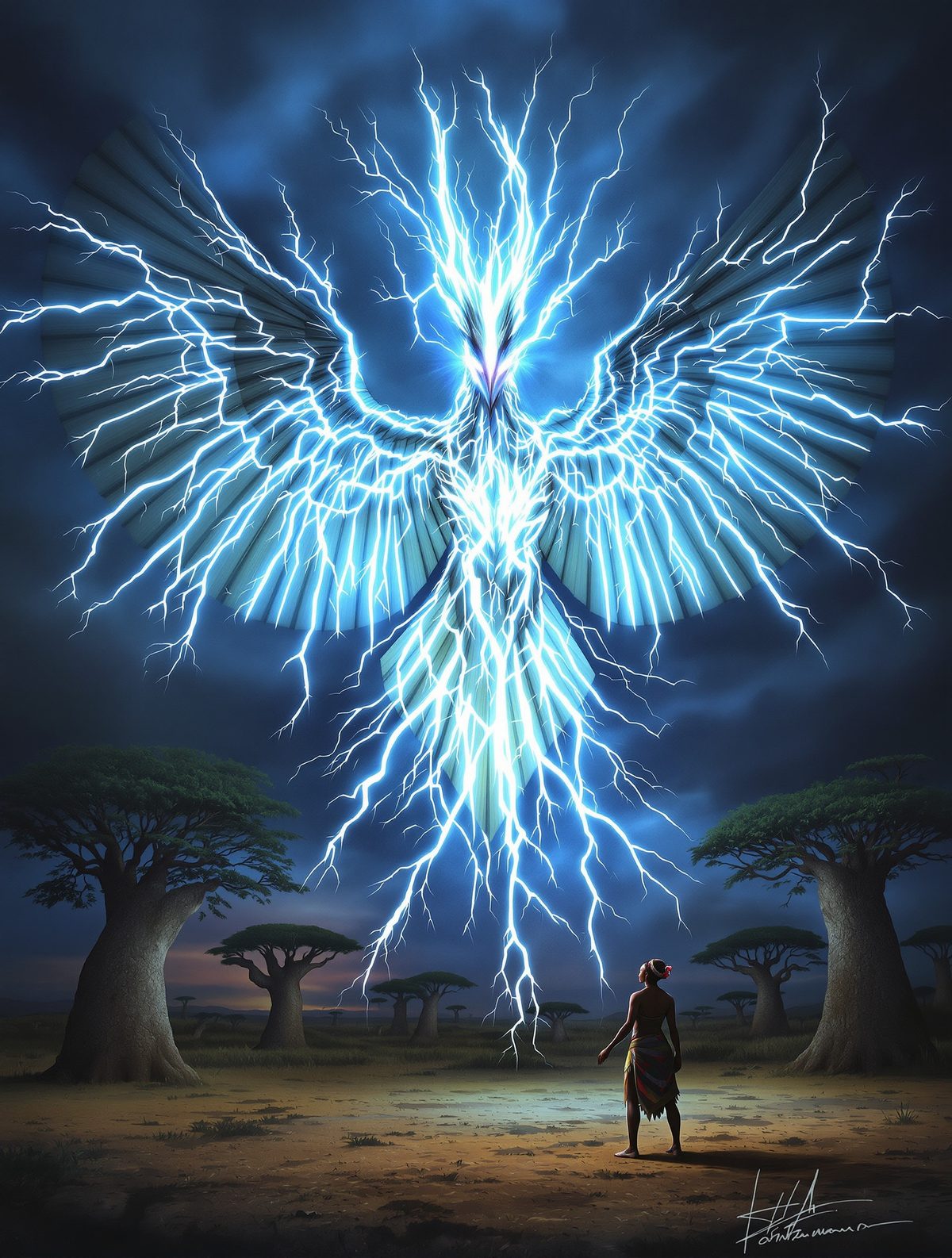
The storm clouds gathered with unnatural speed across the Drakensberg Mountains, their dark bellies pregnant with electricity that made the very air hum with menace. In the valley below, the sangoma Nomsa raised her weathered hands toward the churning sky, her voice cutting through the wind like a blade. She had waited three moons for conditions to align—for the ancestors to whisper their approval, for her power to reach its peak. Tonight, she would summon the Impundulu.
What happened next would haunt her bloodline for generations, a reminder that some prices are too terrible to pay, even for those who traffic in the supernatural. The massive lightning bird that descended from the storm-wracked heavens would demand not gold, not cattle, not even her own life. It would demand something far more precious: a bride from her own family.
The Ancient Compact Between Healer and Storm
Across the vast tapestry of Southern African mythology, few creatures inspire as much awe and terror as the Impundulu. Known by various names throughout the region—Uthekwane among the Xhosa, Koma among the Venda—this colossal bird of pure lightning energy has been both blessing and curse to traditional healers for over a millennium.
The earliest recorded encounters with Impundulu date back to the 13th century, when Zulu oral historians began documenting the exploits of powerful sangomas who could bend the very storms to their will. These weren't mere shamans or herbalists, but individuals possessed of such extraordinary spiritual power that they could negotiate with elemental forces themselves.
The ritual of summoning was never undertaken lightly. Historical accounts from the 1800s describe preparations that could take months, requiring the sangoma to fast for weeks, gather lightning-struck wood from seven different trees, and perform purification ceremonies that left them barely clinging to life. The great healer Makoma ka Nkosana, who lived near present-day KwaZulu-Natal in the 1850s, reportedly lost thirty pounds during his preparation to call forth an Impundulu, subsisting on nothing but river water and the bitter roots of the African potato plant.
But those who succeeded in the summoning gained power beyond imagination. The Impundulu could control weather patterns across hundreds of square miles, strike down enemies with precision lightning bolts, and grant its summoner the ability to see across vast distances through the eyes of the storm itself. Colonial records from 1879 describe British forces near Isandlwana reporting impossible weather phenomena that seemed to follow the movements of Zulu impis—storms that struck with surgical precision, leaving enemy camps in ruins while leaving Zulu positions untouched.
The Shape-Shifting Terror That Walks Among Us
What made the Impundulu particularly fearsome was its ability to assume human form. Standing seven feet tall in the shape of a man, the creature retained telltale signs of its true nature: eyes that flickered with electric fire, a voice that rumbled like distant thunder, and an unnatural beauty that could seduce even the most cautious observer.
The transformation served a dark purpose. While in human form, the Impundulu would infiltrate communities, often targeting the families of rival sangomas or those who had offended its summoner. Nineteenth-century missionary accounts from the Eastern Cape describe a series of mysterious deaths in 1863, where healthy young men would simply collapse during thunderstorms, their bodies showing no wounds but bearing strange burn marks in the pattern of bird talons.
Dr. Heinrich Temporal, a German anthropologist who lived among the Zulu from 1871 to 1884, documented over forty cases of suspected Impundulu attacks. In his private journals, discovered in the Pretoria Archives in 1962, he wrote: "The creature's human disguise is nearly perfect, save for one detail that native informants consistently report—it casts no reflection in still water, as if the lightning within cannot bear to see itself trapped in earthbound form."
Perhaps most disturbing were the reports of the Impundulu's insatiable appetites. The creature was said to consume human blood, but more specifically, it craved the life force of the young and vital. Elderly residents of the Mpumalanga province still tell stories passed down through five generations about the "Lightning Man" who would appear during fierce storms, courting young women with gifts of gold that would turn to ash by morning.
The Price Written in Blood and Thunder
The true horror of summoning an Impundulu lay not in its initial arrival, but in its demands for payment. Unlike demons or spirits that might accept material offerings, the Impundulu required something that bound it intimately to the summoner's bloodline: a human bride.
Traditional accounts are remarkably consistent on this point. The creature would serve faithfully for a period—usually between seven and thirteen years—growing in power and becoming increasingly indispensable to its summoner. Then, without warning, it would demand marriage to a female relative of the sangoma, preferably a daughter or granddaughter in the prime of youth.
The case of Nomakhosi, a powerful sangoma from the Lebombo Mountains, illustrates the terrible nature of this bargain. According to oral histories preserved by the University of the Witwatersrand, Nomakhosi summoned her Impundulu in 1834 during the upheavals of the Mfecane. The creature served her brilliantly, protecting her people from raiding parties and calling down rains during severe drought. But in 1847, as her granddaughter Sibongile reached her eighteenth birthday, the Impundulu appeared at their homestead in human form.
"Beautiful as the morning star, terrible as the storm's heart," the oral account describes him. He demanded Sibongile as his bride, threatening to turn his powers against the entire clan if refused. Nomakhosi, faced with an impossible choice, attempted to negotiate. The creature's response was swift and devastating—lightning struck the family's cattle kraal, killing forty head of precious livestock in an instant.
The marriages themselves were unions of supernatural horror. Women wed to Impundulu in human form reported that their husbands would disappear during thunderstorms, returning days later with no memory of their absence. Children born from these unions often displayed unusual abilities—precognitive dreams, the power to predict weather changes, or the disturbing talent of being able to call small lightning strikes with their bare hands.
When the Lightning Bird Turns Against Its Master
The relationship between sangoma and Impundulu was always precarious, balanced on a knife's edge of mutual need and barely contained hostility. Historical accounts suggest that the creature could never truly be controlled, only temporarily convinced to cooperate through a mixture of respect, fear, and proper tribute.
The downfall often came when a sangoma grew old and weak, unable to maintain the spiritual strength necessary to keep their Impundulu in check. The creature, no longer bound by the original compact, would turn its terrible powers against its former master's family line. This reversal, known in Zulu tradition as "ukuphenduka kwezulu" (the turning of the sky), could devastate entire bloodlines for generations.
Colonial administrator James Stuart documented one such case in his extensive collection of Zulu oral histories. The sangoma Jobe ka Sithayi, who had commanded an Impundulu for over two decades near present-day Pietermaritzburg, made the fatal error of attempting to dismiss the creature without providing the human bride it demanded. The Impundulu's revenge was swift and comprehensive.
Between 1889 and 1902, thirteen members of Jobe's extended family died during thunderstorms. Each death followed the same pattern: the victim would be found in an open area, struck by lightning despite being far from any tall objects that would normally attract electrical strikes. Local British authorities initially dismissed these as coincidental accidents, but the pattern was so pronounced that even skeptical colonial officials began to take notice.
The terror only ended when Jobe's surviving relatives consulted with a powerful sangoma from the Natal Midlands, who performed a complex ritual involving the sacrifice of seven white goats and the burning of lightning-struck wood. Even then, family members reported strange dreams and electrical phenomena around their homesteads for years afterward.
Echoes of Ancient Power in Modern Times
Remarkably, belief in the Impundulu hasn't faded with the advent of modern technology and urban living. Contemporary sangomas in Johannesburg, Cape Town, and Durban still report encounters with the lightning bird, though the creature's manifestations have adapted to modern circumstances.
Dr. Nokuzola Mndende, a respected traditional healer and founder of the Icamagu Institute, conducted interviews with over 200 traditional healers between 1995 and 2010. Her findings, published in the Journal of Southern African Studies, revealed that 34% of senior sangomas claimed either direct experience with Impundulu or knowledge of colleagues who had attempted such summonings.
The stories have evolved but retained their essential terror. Modern accounts describe Impundulu appearing during severe thunderstorms that disrupt electrical grids, manifesting in human form wearing expensive suits and driving luxury cars that vanish by dawn. The creature's demands remain unchanged: service in exchange for a human bride, preferably from the summoner's own bloodline.
Perhaps most chilling are reports from traditional healers who work in urban environments. The Impundulu, they claim, has learned to navigate modern infrastructure, traveling through power lines and manifesting during electrical storms that shut down entire city blocks. Security camera footage from a 2018 storm in Soweto allegedly shows a tall figure walking unharmed through sheets of lightning, though such evidence remains frustratingly ambiguous.
The Thunder Still Remembers
The legend of the Impundulu serves as more than mere supernatural folklore—it represents the eternal human struggle with power and its consequences. In seeking to command the forces of nature itself, the sangomas who summoned these creatures embodied both humanity's greatest ambition and its most dangerous hubris.
Every thunderstorm that rolls across the highveld carries within it the echo of ancient compacts, the memory of prices paid in blood and family bonds severed by supernatural demands. The Impundulu reminds us that some powers come with costs that extend far beyond the individual who seeks them, reaching across generations to claim debts that can never truly be settled.
In our modern world of climate change and extreme weather, perhaps the lightning bird's legend has never been more relevant. As we grapple with forces beyond our control and seek to bend nature to our will through technology, the sangomas' ancient warnings about the Impundulu echo with uncomfortable relevance: Be careful what power you summon, for it may demand more than you're willing to pay.
The thunder rolls on, and somewhere in the storm clouds gathering over the African horizon, the Impundulu spreads its wings of lightning, still seeking its next bride, still demanding payment for powers that mortals were never meant to command.