In the swirling mists of cosmic time, when gods walked among mortals and demons threatened the very fabric of existence, a friendship would be tested in the most unthinkable way. Picture this: the king of gods, Indra himself, standing over his dearest friend with a blade, knowing that only through this ultimate act of love and sacrifice could the universe be saved. This isn't just another tale of divine intervention—it's the story of how the most powerful weapon in Hindu mythology was born from the bones of devotion itself.
The Drought That Devoured Worlds
Long before our modern understanding of climate and weather, the ancient Vedic seers understood something profound: water is life, and whoever controls it controls everything. Enter Vritra, whose very name means "the encloser" or "the coverer"—a serpentine demon so massive that when he coiled around the cosmic waters, entire realms began to wither and die.
Vritra wasn't just any ordinary demon. Born from the fierce penance and rage of the sage Tvashta, whose son had been killed by Indra in a previous conflict, this creature embodied drought personified. Ancient texts describe him as a dragon of impossible proportions, with scales that gleamed like burnished copper and eyes that held the darkness between stars. When Vritra wrapped himself around the rivers and clouds, holding them prisoner in his coils, the three worlds—heaven, earth, and the netherworld—began their slow descent into barren death.
The Rigveda, humanity's oldest religious text dating back over 3,500 years, describes this cosmic drought in verses that still send shivers down the spine: "The waters were held captive like cows by the cowherd. All creation gasped for the life-giving rain." Rivers ran backward into empty beds. Lakes became cracked earth. Even the celestial Ganges, flowing through the heavens, was reduced to a mere trickle.
But here's what makes Vritra truly terrifying: he was invincible by conventional means. No sword could pierce his hide, no arrow could find its mark, and no fire could burn him. The demon had received a boon that made him immune to all known weapons—both wet and dry, made of wood or metal, used during day or night. It was the ultimate cosmic catch-22.
When Gods Become Desperate
Indra, the storm king and ruler of the heavens, found himself in an impossible position. As the god of thunder, rain, and warfare, protecting the cosmic order was literally his job description. Yet every weapon in his vast arsenal proved useless against Vritra's impenetrable defenses. The Rigveda tells us that Indra first tried his traditional weapons: his golden thunderbolt, his iron club, even the deadly discus. Nothing worked.
Picture the scene: the king of gods, normally resplendent in his glory, now hollow-eyed with desperation. His elephant mount Airavata grew thin without water. The other gods watched helplessly as their domains crumbled. The celestial musician Gandharvas fell silent. Even the eternal flames of sacrifice began to flicker and die.
It was then that Brahma, the creator god, revealed a terrible truth. The only substance in all creation that could harm Vritra was something that had never been used as a weapon—something that existed in a state between the categories that protected the demon. That something was the bone of a willing sage, a material that was neither fully alive nor dead, neither purely natural nor artificial when shaped by divine hands.
And there was only one sage whose bones possessed the necessary spiritual power: Dadhichi, also known as Dadhyanch, whose very name means "he who possesses the divine vision." This wasn't just any ascetic—this was Indra's own friend, a sage so powerful that he had once helped the gods themselves learn the secrets of immortality.
The Sage Who Knew Too Much
Dadhichi's story reads like a cosmic thriller spanning eons. According to the Mahabharata and various Puranas, this remarkable sage had lived for thousands of years, accumulating spiritual power through the most intense penances imaginable. He had meditated so deeply that his bones had become harder than diamond, infused with the very essence of cosmic energy.
But here's the fascinating part often overlooked in popular retellings: Dadhichi had a complicated history with Indra. The sage had once been entrusted with a secret so dangerous that Indra himself had warned him never to share it. The secret was the Madhu Vidya—the honey doctrine—a mystical knowledge about the nature of ultimate reality that could grant immortality to anyone who understood it completely.
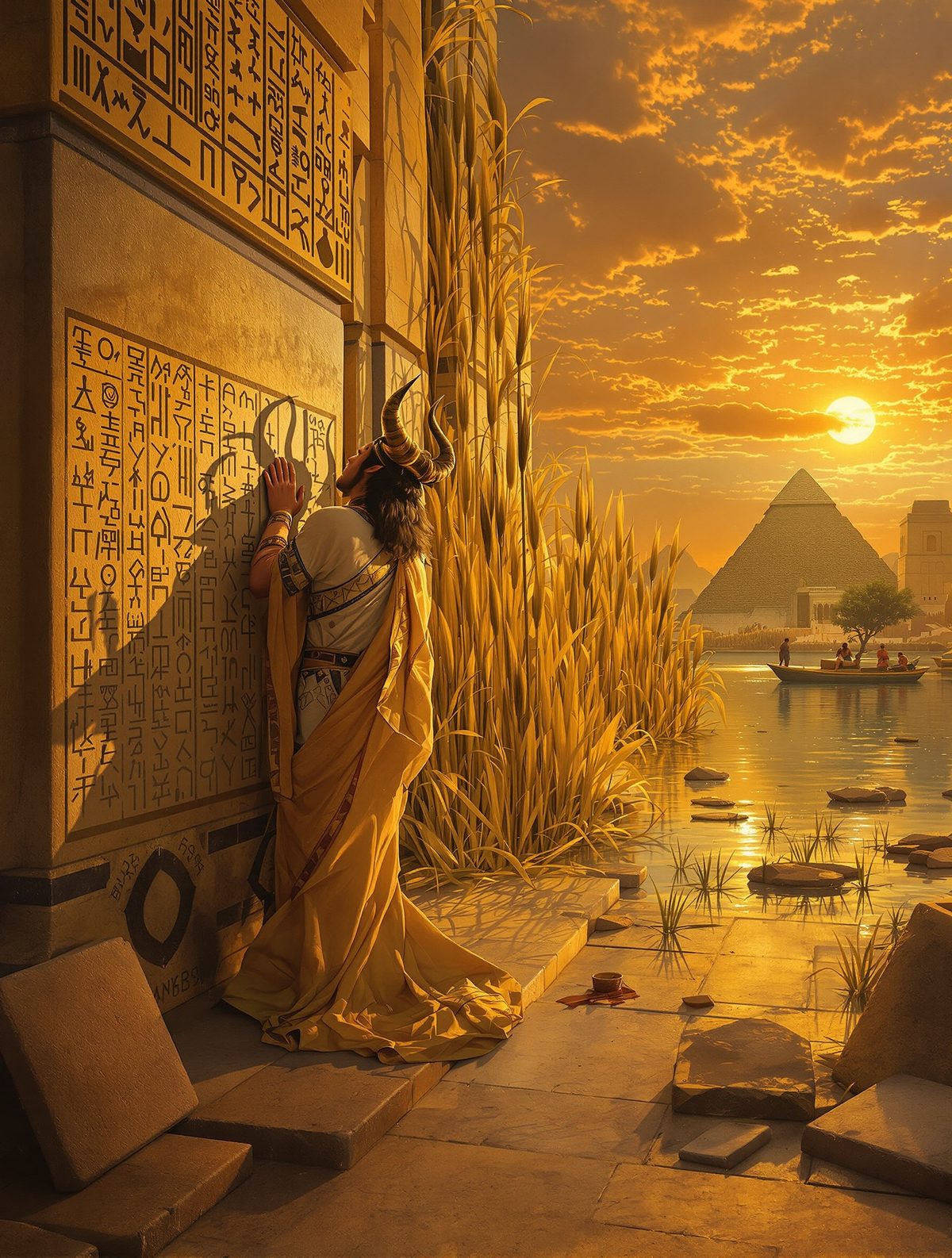
The Ashvini Kumaras, the divine physician twins, had desperately wanted this knowledge. They approached Dadhichi with a proposition that sounds like something from a supernatural thriller: they would give him a horse's head to replace his human one, teach him advanced healing arts, and then he could share the forbidden knowledge with them. If Indra discovered the betrayal and cut off his head in anger (which they knew he would), they would simply restore his original human head.
The plan worked—sort of. Dadhichi shared the knowledge, Indra discovered the betrayal and beheaded him in fury, and the Ashvini twins restored him just as promised. But this incident created a complex dynamic between the sage and the storm god: they were friends bound by mutual respect, yet marked by betrayal and forgiveness, making what was to come even more poignant.
The Ultimate Proposition
When Indra approached Dadhichi with the desperate request for his bones, the scene that unfolded challenges every assumption about heroism, friendship, and sacrifice. This wasn't a battlefield moment of split-second decision-making. According to the Bhagavata Purana, Dadhichi asked for time to consider—not because he was reluctant, but because he wanted to understand the full cosmic implications of his choice.
The sage's response, preserved in Sanskrit verses over two millennia old, reveals a mind grappling with the deepest questions of existence: "This body, which is destined to decay and become food for worms and jackals, can instead serve the highest purpose. How can I refuse when the entire universe hangs in the balance?"
But Dadhichi made one request that adds a chilling dimension to the story: he wanted to experience every possible worldly pleasure before his death. Using his yogic powers, the sage compressed lifetimes of experience into a single day. He enjoyed royal luxuries, tasted every delicacy, experienced love and friendship and beauty—an entire existence condensed into hours. It was as if he wanted to taste the fullness of the life he was about to surrender.
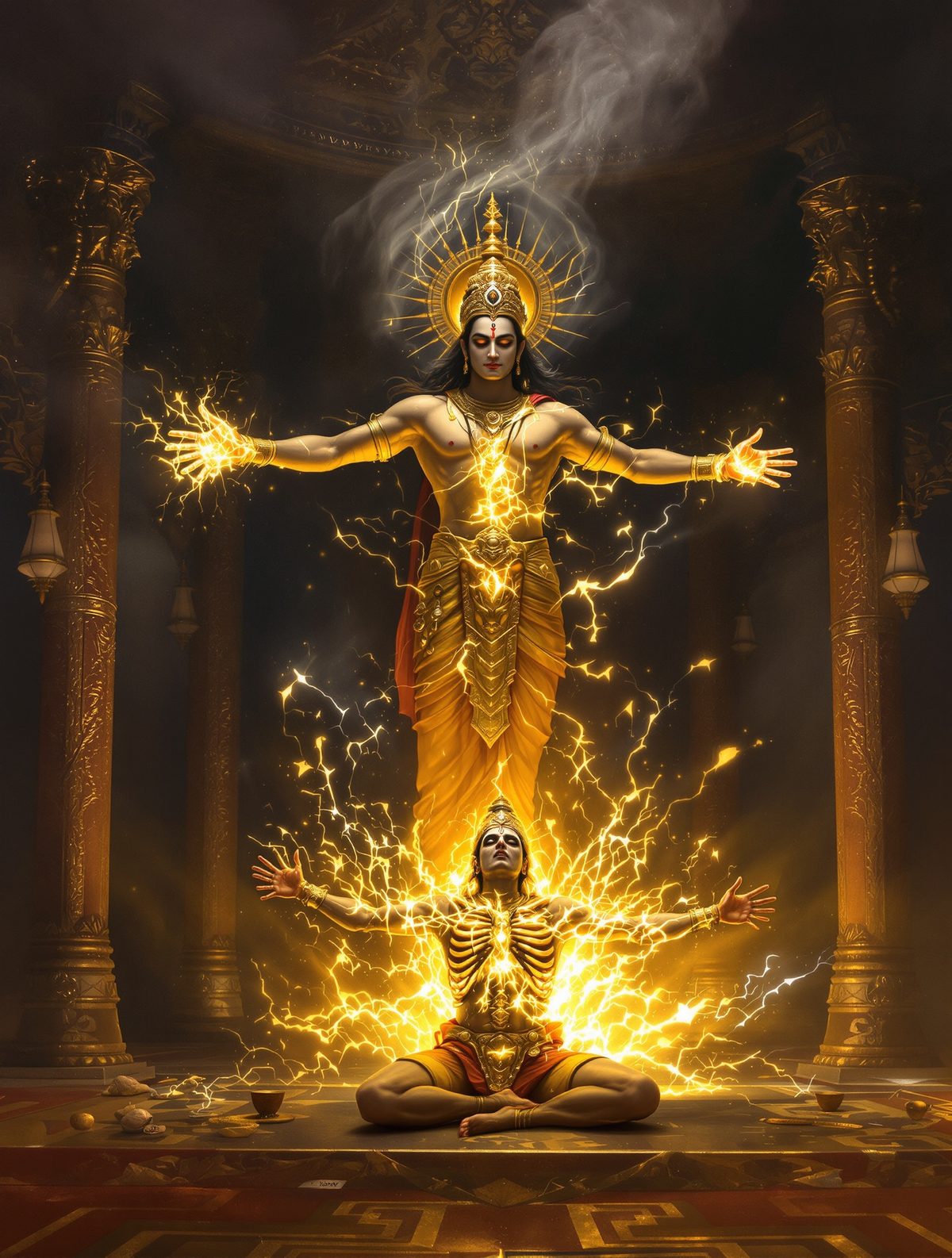
Then came the moment that would echo through cosmic history. Dadhichi sat in perfect meditation posture and, through the sheer power of his will, separated his soul from his body. Ancient texts describe light radiating from his form as his life force departed, leaving behind bones that glowed with accumulated spiritual energy—bones that had been strengthened by eons of righteous living and were now willing offerings for the greater good.
The Forging of Ultimate Power
What happened next reads like a divine blacksmithing manual written by cosmic engineers. Vishvakarma, the architect of the gods, took Dadhichi's spine—the central column that had supported thousands of years of meditation—and began the most important construction project in mythological history.
The process of creating the vajra was no simple matter. The Sanskrit texts describe a forging that required not just divine skill, but the concentrated power of all the gods. Fire gods provided flames hotter than a thousand suns. Wind gods created bellows that could forge stellar matter. The bones had to be shaped not just physically, but metaphysically—transformed from the remains of devotion into the embodiment of cosmic justice.
The resulting weapon was unlike anything that had existed before. The vajra—meaning "thunderbolt" and "diamond"—was both the hardest substance in creation and the most spiritually potent. Ancient descriptions paint it as a weapon that seemed to contain lightning trapped in crystalline form, humming with the spiritual power of Dadhichi's sacrifice and blazing with Indra's divine authority.
Here's a detail that might surprise you: the vajra wasn't just a weapon—it was alive with consciousness. Buddhist and Hindu texts describe it as a tool that could never be used for selfish purposes, only for protecting cosmic order. It carried within its structure the wisdom of Dadhichi's sacrifice, making it as much a moral compass as a destructive force.
The Battle That Reshaped Reality
Armed with the vajra, Indra flew toward his confrontation with Vritra on his white elephant Airavata, but this wasn't a simple charge into battle. The Rigveda describes a cosmic duel that makes modern superhero battles look like playground scuffles. Vritra had grown so massive from containing all the world's waters that his body stretched across multiple dimensions. His breath created hurricanes, and his movements caused earthquakes across the three worlds.
The battle's turning point came when Indra realized that the vajra's true power lay not just in its hardness, but in its origin. When he struck Vritra with the thunderbolt forged from his friend's bones, he was wielding not just a weapon, but the crystallized essence of selfless love. The demon's impenetrable defenses, designed to repel conventional weapons, had no answer for an attack made from pure sacrifice.
The moment the vajra pierced Vritra's scales, the cosmic floodgates opened. Waters that had been trapped for eons burst forth like universal liberation itself. The Rigveda's description is breathtaking: "The waters rushed forth like bellowing cattle, making their path down to the sea. Indra had released the waters; he had burst the fortresses of Vritra."
Why This Ancient Tale Still Matters
In our modern world of technological solutions and military might, the story of Dadhichi and Indra's vajra offers something profoundly different: the idea that the most powerful force in existence isn't technological superiority or brute strength, but willing sacrifice born from love.
Think about it: every crisis our world faces—climate change, social inequality, political division—requires someone to make sacrifices for the greater good. The myth suggests that such sacrifices, when made with full knowledge and willing hearts, don't just solve immediate problems; they create tools of transformation that can reshape reality itself.
The vajra went on to become one of the most important symbols in both Hindu and Buddhist traditions, representing the indestructible nature of compassion and wisdom. Today, when we see Buddhist monks holding vajra ritual implements or encounter the symbol in meditation practices worldwide, we're witnessing the continued power of Dadhichi's ancient sacrifice.
Perhaps most remarkably, this 3,500-year-old story anticipated something modern psychology is just beginning to understand: that our greatest strength often comes not from what we can acquire or achieve, but from what we're willing to give up for others. In a world that often seems as drought-stricken as Vritra's domain—lacking in empathy, generosity, and genuine connection—maybe we need to remember that the ultimate weapon against cosmic selfishness isn't force, but the transformative power of conscious, loving sacrifice.