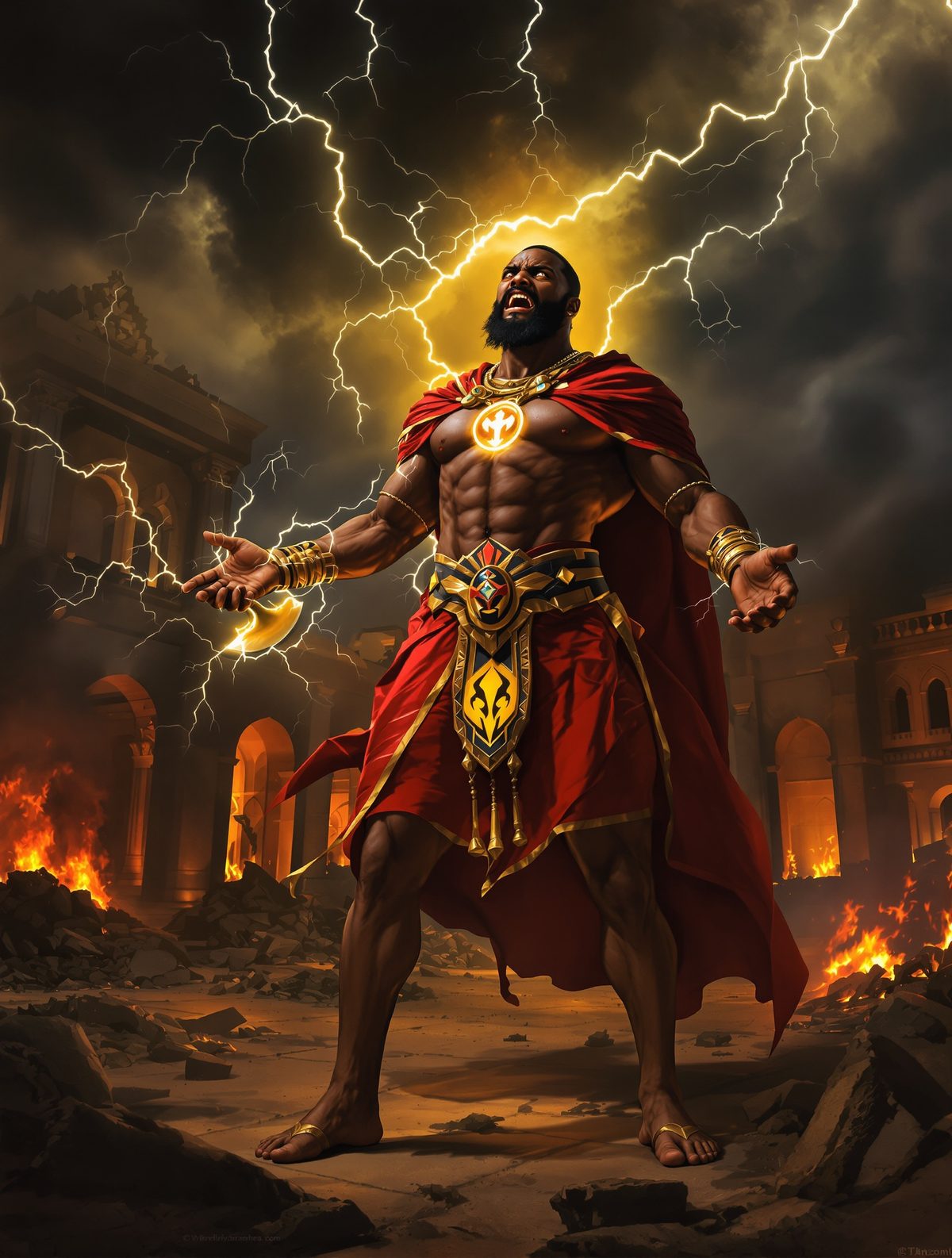

Picture this: before time began, before the first star flickered to life, before even the concept of "before" existed, there was only the Nun—an endless expanse of dark, primordial waters stretching into absolute nothingness. No light pierced this cosmic void. No sound disturbed its perfect silence. And then, from somewhere beyond comprehension, a voice spoke into the darkness. Not just any voice, but the voice of Ptah, the master craftsman of creation itself.
What happened next would make even the most spectacular Hollywood creation scene look like a children's finger painting. With each divine word that rolled from Ptah's lips, reality itself began to crystallize from the void. Mountains erupted from nothingness. Rivers carved their eternal paths. The very fabric of existence unfolded like an origami masterpiece shaped by sounds that had never been heard before—and would never be heard again.
The God Who Thought the World Into Being
Long before Moses received the Ten Commandments, before the Greeks spun tales of Zeus hurling thunderbolts, the ancient Egyptians had already crafted one of history's most sophisticated creation myths centered around Ptah, a deity whose very name meant "opener" or "sculptor." But here's what your history textbook probably never told you: Ptah didn't create the world with his hands like some cosmic potter. He didn't breathe life into clay figures or forge reality in divine flames. Instead, this remarkable god accomplished something far more extraordinary—he spoke the universe into existence through pure thought and divine utterance.
The earliest references to Ptah's creative powers appear in texts dating back to around 2400 BCE, during Egypt's Old Kingdom period. But the most complete account comes from the famous "Memphite Theology," inscribed on the Shabaka Stone around 710 BCE. This black granite slab, now housed in the British Museum, preserves what may be humanity's oldest recorded philosophy of creation through divine speech—predating similar concepts in other religious traditions by centuries.
According to these ancient texts, Ptah accomplished creation through his "heart" (meaning his mind or consciousness) and his "tongue" (representing his power of speech). The Egyptians believed that Ptah first conceived everything in his divine consciousness, then brought it into reality by speaking it aloud. As one hieroglyphic inscription puts it: "All the divine order really came into being through what the heart thought and the tongue commanded."
The Divine Workshop of Memphis
Ptah's earthly headquarters was the magnificent city of Memphis, located at the junction of Upper and Lower Egypt, about 15 miles south of modern Cairo. Founded around 3100 BCE by the legendary pharaoh Menes, Memphis served as Egypt's political and religious capital for over eight dynasties. But it wasn't just the seat of earthly power—it was literally considered the navel of creation itself.
The massive temple complex of Ptah in Memphis, known as "Hut-ka-Ptah" (meaning "House of the Soul of Ptah"), was so renowned throughout the ancient world that the Greeks called the entire country "Aegyptos" after it—giving us our modern name "Egypt." Archaeological evidence suggests this temple covered nearly 1,500 acres at its peak, making it larger than Vatican City. Within its sacred walls stood workshops where the most skilled artisans in the known world practiced their crafts, believing they were channeling Ptah's own creative powers.
Here's a detail that might surprise you: Ptah wasn't just worshipped by Egyptians. Phoenician traders carried his cult across the Mediterranean, and even the Greeks identified him with their own Hephaestus. The Romans later associated him with Vulcan. Ancient graffiti found in Memphis includes inscriptions in hieroglyphs, Greek, Aramaic, and even early Arabic—testament to this god's international appeal spanning over 3,000 years.
Words That Built Worlds
But what exactly did Ptah say when he spoke creation into being? The ancient texts provide tantalizing glimpses into this cosmic conversation with nothingness. According to the Memphite Theology, Ptah began by calling forth the primordial mound—the first solid matter to emerge from the chaotic waters of Nun. With this single utterance, the foundation of all existence was laid.
The creation process then unfolded in carefully orchestrated phases. Ptah spoke the names of the other gods into existence, beginning with Atum, who would later become associated with the sun and continue the creative process. He called forth Shu (air) and Tefnut (moisture), Geb (earth) and Nut (sky). Each divine name, when spoken by Ptah, didn't just create a deity—it established an entire cosmic principle that would govern reality itself.
Perhaps most remarkably, the texts suggest that Ptah created through a form of divine etymology. By speaking the true names of things—their essential identities—he brought them into being. This wasn't random divine chatter; it was the universe's first programming language, with Ptah as the ultimate coder writing reality itself into existence one carefully chosen word at a time.
The ancient Egyptians took this concept so seriously that they developed an entire theological framework around the power of words. They believed that knowing something's true name gave you power over it—a concept that influenced magical practices throughout the ancient Mediterranean world and beyond.
The Architect of Existence
What makes Ptah's creation story particularly fascinating is how it reflects ancient Egypt's sophisticated understanding of the relationship between thought, language, and reality. Unlike other creation myths that relied on violence, sexual generation, or divine conflict, Ptah's method was pure intellect and communication. He was, in essence, history's first cosmic architect—designing reality through conscious intention and precise articulation.
Archaeological evidence from Memphis reveals that Ptah's priests were also master architects and engineers in the literal sense. They oversaw the construction of some of Egypt's most impressive monuments, including advising on pyramid construction. The famous architect Imhotep, who designed the Step Pyramid of Djoser around 2650 BCE, was considered a son of Ptah. This wasn't coincidental—the Egyptians saw no distinction between divine creation and human craftsmanship. Both were expressions of the same fundamental principle: bringing order from chaos through skilled intention.
The priests of Ptah maintained detailed records of their construction projects, treating them as acts of religious devotion. They believed that by creating beautiful, precisely engineered structures, they were participating in the same creative process Ptah had initiated at the beginning of time. Every temple, every statue, every carefully carved hieroglyph was seen as a continuation of that first divine utterance that brought light to the primordial darkness.
Echoes Across Eternity
The influence of Ptah's creation story rippled far beyond the borders of ancient Egypt. Scholars have noted striking parallels between the Memphite Theology and later religious and philosophical traditions. The concept of divine logos—the creative word or principle—appears in Greek philosophy, early Christianity, and Islamic theology. The opening of the Gospel of John, "In the beginning was the Word," echoes themes that were already ancient when the pyramids were new.
But Ptah's legacy extends beyond religious thought into practical human endeavor. The god's association with craftsmanship and skilled labor made him patron of everyone from architects to jewelers, from sculptors to shipbuilders. Medieval European guilds traced their traditions back through Greek and Roman predecessors to the workshops of Memphis. Even today, when we speak of "craftsmanship" or someone having "the right words," we're unconsciously invoking concepts that first emerged in Ptah's temple workshops over 4,000 years ago.
The Word That Still Speaks
In our age of artificial intelligence and virtual reality, when we're literally creating new worlds through code and digital language, Ptah's ancient wisdom feels surprisingly contemporary. The Egyptian insight that consciousness, intention, and precise communication are the fundamental tools of creation resonates with anyone who has ever written a program, designed a building, or crafted a story.
Perhaps that's why this "forgotten" creation myth matters more than ever. In a world drowning in meaningless noise, Ptah reminds us that words have power—that conscious, intentional speech can literally reshape reality. Every time we choose our words carefully, every time we speak truth into existence, every time we use language to build rather than destroy, we're channeling something of that first divine utterance that called light from darkness and order from chaos.
The ancient Egyptians understood something we're only beginning to rediscover: that the gap between imagination and reality is much smaller than we think, and that the bridge between them is built from the words we choose to speak into the void. In that sense, we're all children of Ptah, armed with the same creative power that shaped the world—if only we have the wisdom and courage to use it.