The thunderstone felt warm in Shango's palm—deceptively small for something that could split mountains in half. As jeers and taunts echoed across the courtyard of his palace in Old Oyo, the fourth Alaafin of the Yoruba Empire gripped the sacred weapon tighter. His enemies had pushed too far this time, questioning not just his earthly kingship but his divine right as Orisha of thunder and lightning. What happened next would echo through Yoruba oral tradition for over a thousand years, becoming one of the most tragic cautionary tales ever told about the terrible price of unchecked rage—even for a god.
The King Who Commands the Storm
To understand the magnitude of this tragedy, you must first grasp who Shango truly was. Unlike the distant deities of many mythologies, Shango walked among mortals as both god and king, ruling the ancient Oyo Empire sometime between the 14th and 16th centuries CE. Historical records from Yoruba oral historians suggest he was the fourth Alaafin—a title meaning "Owner of the Palace"—who transformed a regional kingdom into West Africa's most powerful empire.
But Shango was no ordinary monarch. As an Orisha, he wielded dominion over thunder, lightning, fire, and drums. His very presence could summon storms from clear skies. Palace griots sang of how his voice could shake the earth, how his dancing feet could make lightning dance across the heavens. The Yoruba called him Oba Koso—"The King Who Did Not Hang"—for reasons that would become tragically clear.
Perhaps most remarkably, Shango possessed three wives, each an Orisha in her own right. Oya controlled the winds and Niger River, her tempestuous nature matching his own. Oshun commanded sweet waters and love, bringing gentleness to balance his fury. Oba ruled domestic harmony, the steady force that kept his household functioning. Together, they formed a divine quartet that governed both the natural world and human civilization across Yorubaland.
The Thunderstone of Absolute Power
Among all of Shango's divine weapons, none inspired more fear than his collection of thunderstones—edun ara in Yoruba. These weren't mere meteorites or carved rocks, but crystallized manifestations of celestial fury itself. Yoruba tradition describes them as smooth, dark stones that hummed with barely contained energy, growing hot to the touch when Shango's anger peaked.
Archaeological evidence supports the reality behind these legends. Neolithic stone axes, often called "thunderstones" by later generations who found them buried in the earth, were indeed associated with Shango worship across West Africa. These ancient tools, their original purpose forgotten, were believed to have fallen from the sky during thunderstorms. Yoruba priests still use similar stones in modern Shango ceremonies, claiming they can channel the Orisha's power.
But according to the oral traditions preserved by babalawo priests, Shango's original thunderstones possessed terrifying capabilities. A small one could level a forest. A large one could flatten entire cities. The most powerful required both hands to lift and could supposedly crack the earth itself. Here's the chilling detail the myths emphasize: once thrown in anger, even Shango couldn't recall them or redirect their path.
When Gods Face Rebellion
The crisis began during what Yoruba historians call the "Time of Two Crowns"—a period when Shango's earthly authority faced unprecedented challenges. Two of his most trusted generals, Gbonka and Timi, had grown powerful enough to command their own armies. Worse, they'd begun questioning whether a divine king should rule mortal affairs. whispers spread through Old Oyo's markets and compounds: perhaps the Alaafin had grown too distant from his people, too caught up in heavenly matters to govern effectively.
The situation exploded during a public festival celebrating the yam harvest. As thousands gathered in the palace's great courtyard, Gbonka stood before the assembled crowd and issued a challenge that would have been unthinkable just years before: "If Shango is truly master of the storm, let him prove it without his magic stones. Let him fight as a man among men."
Timi stepped forward to echo the challenge, his hand resting deliberately on his sword hilt. "We have served a king who claims godhood. But what god hides behind palace walls while his people struggle? What divine ruler needs earthly weapons to maintain power?"
The crowd fell silent. Even the drummers stopped their rhythmic praise-songs. In that moment of tense quiet, everyone present understood they were witnessing something unprecedented: mortals directly challenging an Orisha's authority.
The Fury That Shook Heaven and Earth
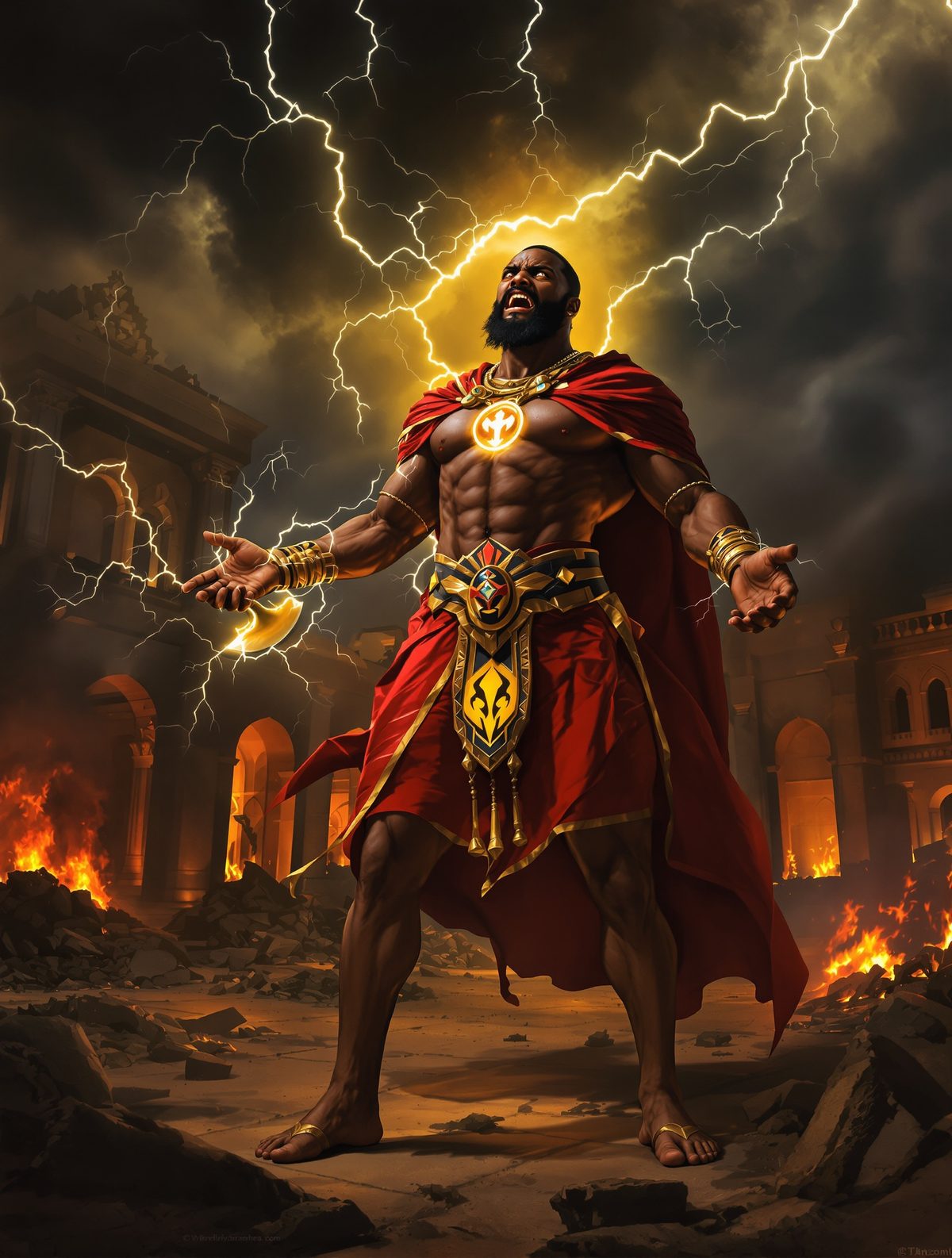
What happened next defied every protocol of divine restraint. Shango's eyes flashed—literally, according to the griots, emitting sparks of white-hot light. The sky above Old Oyo darkened instantly, clouds swirling into an unnatural vortex directly overhead. Thunder began as a low rumble but quickly crescendoed into something that felt less like sound than like the earth itself screaming.
Oya, Oshun, and Oba rushed from the palace quarters, sensing their husband's escalating rage. Palace witnesses later described seeing the three goddesses positioned themselves strategically around the courtyard—not to flee, but to help manage the crowd's panic and contain whatever was about to unfold. They had seen Shango angry before, but never like this. Never with his divine nature so completely overwhelming his human judgment.
The thunderstone materialized in Shango's palm, drawn from some celestial armory beyond mortal comprehension. This wasn't one of his smaller weapons—this was what the oral traditions call an edun ara agba, a "great thunderstone" reserved for ending wars and toppling mountains. Witnesses described it as roughly the size of a human head, perfectly spherical, and so dark it seemed to absorb light itself.
Here's where the tragedy takes its cruelest turn. As Shango raised the thunderstone above his head, his three wives moved closer, trying to reach him, trying to penetrate the red haze of his fury with their voices of reason. They called his name, pleaded for restraint, reminded him of his love for his people. But divine rage, once unleashed, follows its own terrible logic.
The Throw That Changed Everything
When Shango hurled the thunderstone, it moved faster than lightning itself—which, the griots explain, is because lightning is merely the visible trail left by such divine weapons. The stone struck the exact center of the courtyard with the force of a falling star, creating a crater that supposedly remained visible for generations afterward.
But the thunderstone's impact was only the beginning. The explosion of divine energy that followed leveled half the palace complex, turned sand to glass, and sent shockwaves racing across the Oyo Empire. The flash of light was reportedly visible from the Atlantic coast, some 200 miles away. The sound—described as every thunderclap in history occurring simultaneously—could be heard as far south as the forests of modern-day Benin.
When the dust settled and the ringing silence finally gave way to human voices, the scene was apocalyptic. Gbonka and Timi were simply gone—not dead, but erased, their bodies transformed into component atoms by energies no mortal form could withstand. Hundreds of festival-goers lay unconscious, their minds overwhelmed by proximity to such raw divine power.
But the cruelest blow was yet to be discovered. Oya, Oshun, and Oba—the three goddesses who had tried to moderate their husband's wrath—lay motionless near the crater's edge. The thunderstone's energy had struck them down not through direct impact, but through the sheer overflow of Shango's uncontrolled fury. Even their divine nature couldn't protect them from the full force of an Orisha's rage unleashed without restraint.
The Price of Divine Wrath
The aftermath of this tragedy fundamentally changed both Yoruba theology and kingship traditions. Shango, horrified by what his anger had wrought, abdicated his earthly throne and retreated permanently to the celestial realm. The phrase "Oba Koso"—"The King Who Did Not Hang"—refers to his refusal to face earthly justice, instead choosing exile among the thunder clouds.
But here's the profound twist that makes this myth so enduringly powerful: Shango's wives didn't die. Instead, their apparent deaths triggered their own transformations into pure Orisha energy, freed from physical form but forever changed by the trauma. Oya became the fierce guardian of the threshold between life and death. Oshun's nurturing nature deepened, but gained an edge of protective ferocity. Oba's domestic wisdom expanded into judicial authority over truth and consequences.
Modern Yoruba practitioners still invoke this story during conflict resolution ceremonies. The lesson isn't that anger is wrong—the Yoruba understanding of human nature is far too sophisticated for such simplistic moralizing. Instead, the myth teaches that even justified rage becomes destructive when it overwhelms love and wisdom. Even gods, when they act from unchecked fury rather than divine justice, end up destroying what they most cherish.
In our current age of instant communication and viral outrage, Shango's thunderstone serves as a particularly relevant metaphor. How many relationships, careers, and communities have been shattered by words thrown in anger with the same reckless force as that divine weapon? How often do we, like Shango, discover that our fury has wounded precisely those we meant to protect? The myth suggests that true power lies not in the ability to unleash devastating force, but in the wisdom to know when that force will destroy more than it preserves.