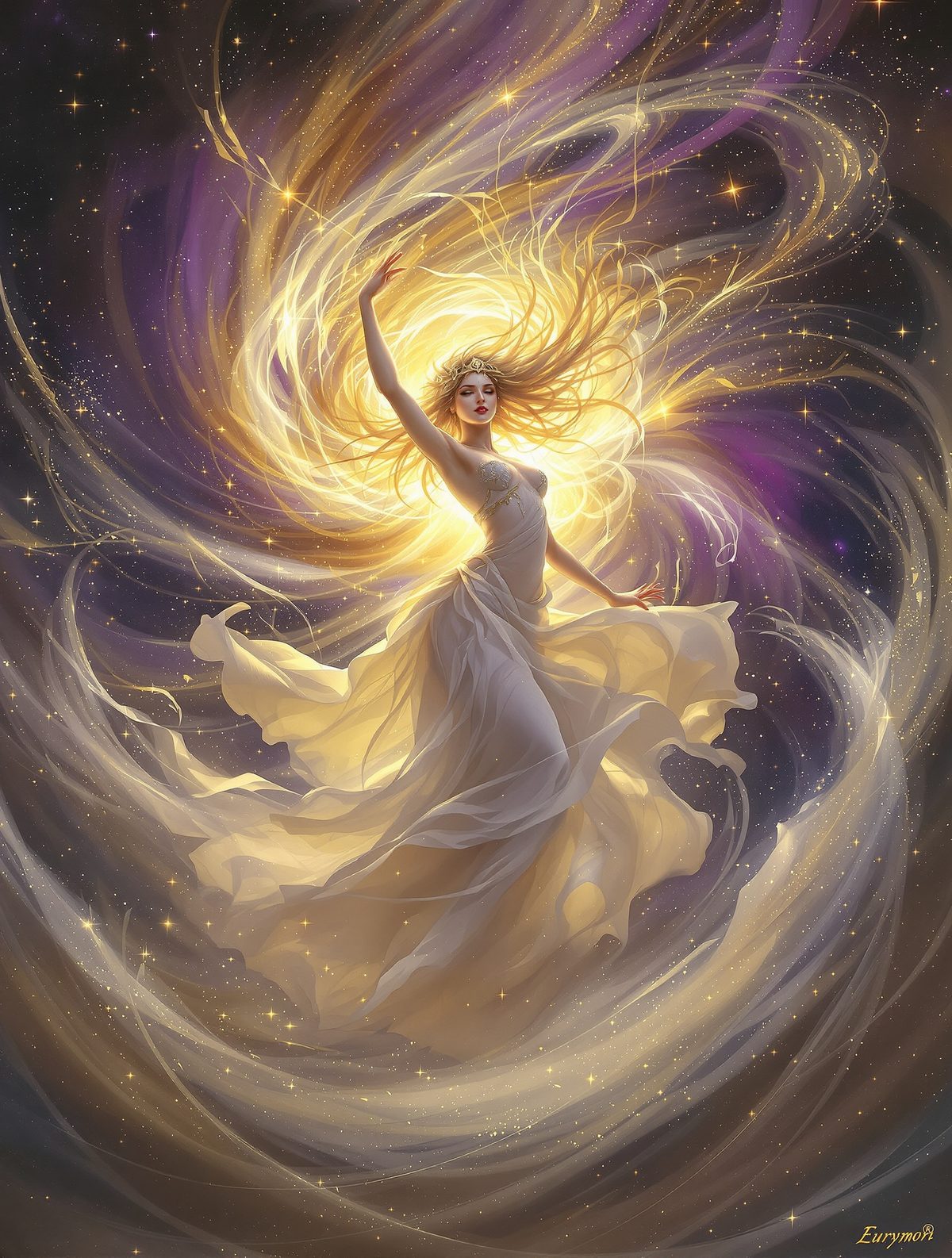
Picture this: before Zeus hurled his first thunderbolt, before the Titans warred in the heavens, before even the concept of "before" existed—there was nothing. Not darkness, not light, not even empty space. Just... chaos. And from this primordial void, a single figure emerged to literally dance reality into existence. Her name was Eurynome, and she might just be the most important goddess you've never heard of.
While most people can recite the tale of Zeus overthrowing his father Cronus, or recall Prometheus stealing fire for humanity, few know the breathtaking creation myth that predates them all. This is the story of how the universe began not with a bang, but with a dance—and why one ancient Greek goddess holds the title of the original cosmic choreographer.
The Goddess Before Gods: Eurynome's Forgotten Supremacy
Long before the Olympian pantheon dominated Greek religious thought, there existed what scholars call the "Pelasgian creation myth"—named after the Pelasgians, the mysterious pre-Greek inhabitants of the Mediterranean who may have originated this tale as early as 3000 BCE. In this primordial narrative, Eurynome wasn't just another deity in a crowded pantheon; she was the deity, the goddess of all things, emerging as the first conscious being from the formless chaos.
The name Eurynome itself offers tantalizing clues about her cosmic significance. Derived from the Greek words eurys (wide) and nomos (realm or law), it literally means "wide rule" or "universal law." This wasn't a goddess with a specific domain like love or war—she embodied the very principles by which reality would operate. Ancient sources, including fragments preserved by the mythographer Apollodorus in the 2nd century BCE, describe her as rising from chaos with an innate understanding that creation required movement, rhythm, and divine choreography.
What makes Eurynome's story particularly fascinating is how it reflects humanity's earliest attempts to explain existence itself. Unlike later creation myths that involved complex genealogies of gods and elaborate cosmic battles, this tale stripped creation down to its most essential elements: consciousness emerging from chaos, and that consciousness expressing itself through dance.
The Dance That Started Everything: Cosmic Choreography in Motion
Imagine Eurynome in those first moments of existence—a luminous figure suspended in absolute nothingness, with no ground beneath her feet, no sky above her head, no reference point for up or down. According to the ancient texts, she began to dance not out of joy or celebration, but out of necessity. In a realm without form or structure, dance became her tool for imposing order upon chaos.
The Greek poet and scholar Robert Graves, in his comprehensive analysis of Greek mythology, describes this cosmic dance as unlike any earthly movement. Eurynome's choreography wasn't bound by gravity or physics—because these concepts didn't yet exist. Her movements were three-dimensional spirals that carved space itself into being, her gestures defining the very concepts of direction and dimension.
As she danced, something extraordinary happened. The ancient sources tell us that her movements began to stir the winds from nothingness. Not gentle breezes, but Boreas—the fierce north wind that would later become personified as one of the Anemoi, the wind gods of Greek mythology. This wasn't merely meteorological phenomenon; it was the birth of the first fundamental force of nature, stirred into existence by divine movement.
The symbolism here is profound: wind represents breath, life force, the invisible power that animates matter. By dancing the wind into existence, Eurynome was essentially creating the breath of the universe itself. Ancient Greek philosophers, particularly the Stoics of the 3rd century BCE, would later develop entire cosmological theories around pneuma—the divine breath or spirit that permeated all things. They may have been unknowingly echoing this far more ancient understanding of creation.
The First Romance: When Goddess Met Wind
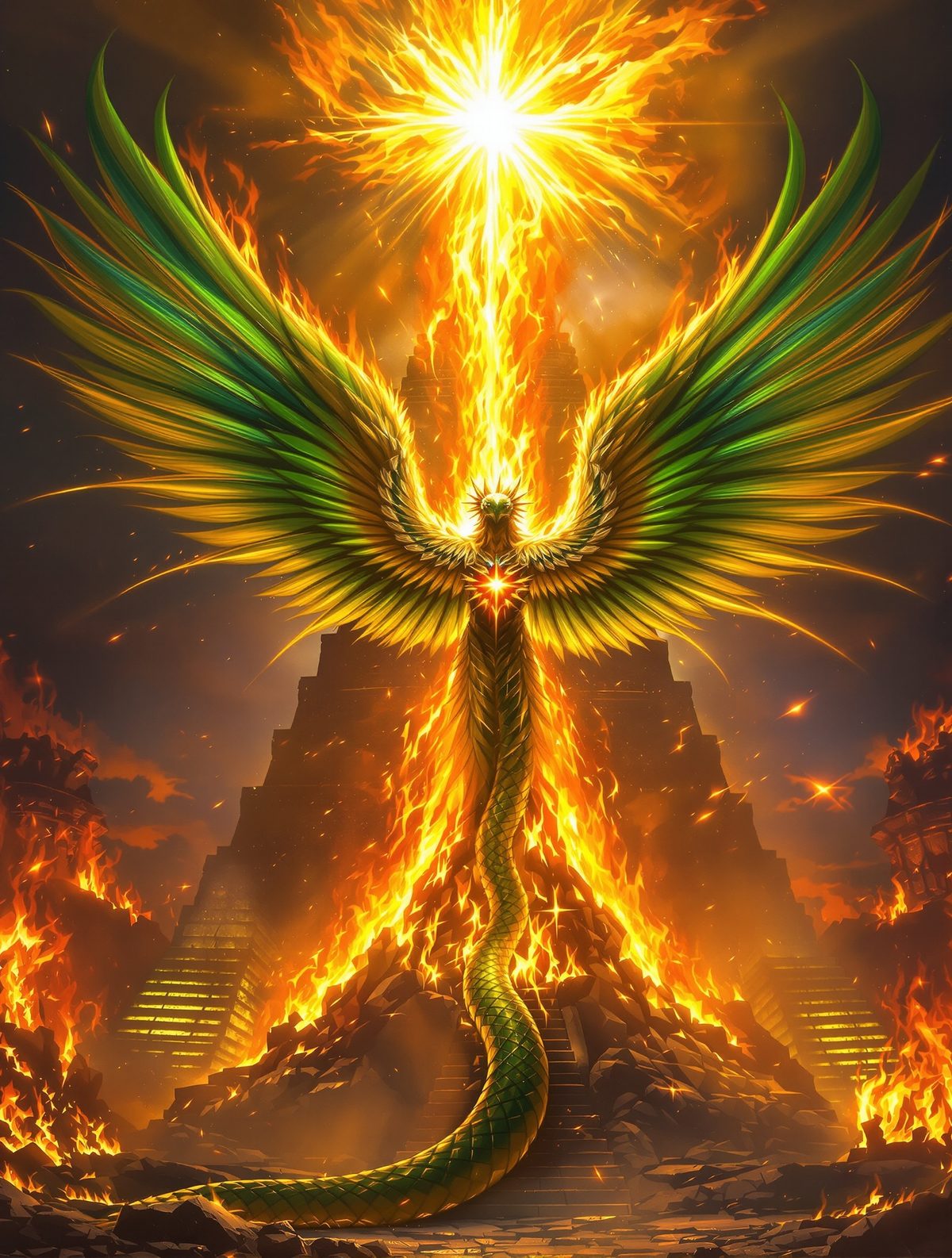
What happened next reads like the universe's first love story. As Boreas swirled around Eurynome, her dance began to change. No longer dancing alone in the void, she now had a partner—albeit an invisible one. The ancient texts describe how she reached out and grasped the north wind, molding it with her hands into a serpentine form she named Ophion.
This transformation of wind into serpent represents one of mythology's most sophisticated metaphors. The serpent, a creature that moves without limbs, embodies pure motion—the perfect physical manifestation of invisible wind. Moreover, in ancient Mediterranean cultures, serpents symbolized wisdom, eternity, and the cyclical nature of time. By shaping Boreas into Ophion, Eurynome wasn't just creating her first companion; she was establishing the fundamental principles of time and wisdom that would govern her universe.
The ancient sources describe their courtship in terms that blur the line between cosmic event and divine romance. As Eurynome danced with Ophion coiled around her, their union generated such creative energy that it began to manifest as physical reality. Some versions of the myth, preserved in fragments by the 1st-century CE writer Apollodorus, suggest that their cosmic dance lasted for eons—though time itself was still being defined by their movements.
Here's a detail that often surprises modern readers: in many early versions of this myth, Ophion is described as initially believing himself equal to Eurynome, even claiming credit for creation itself. This led to the first cosmic conflict, with Eurynome ultimately asserting her supremacy by banishing the presumptuous serpent. This element of the story may reflect ancient cultural memories of transitions between different religious systems, with older goddess-centered beliefs giving way to more male-dominated mythologies.
From Dance to Universe: The Mechanics of Divine Creation
The next phase of Eurynome's creation process reveals sophisticated ancient thinking about cosmology. According to the preserved myths, after establishing her dominance over Ophion, Eurynome took the form of a dove and laid the Universal Egg upon the primordial waters that had somehow emerged during her dance. She then commanded Ophion to coil around this egg seven times and incubate it until it hatched.
The number seven wasn't chosen randomly. Ancient Mediterranean cultures considered seven the most sacred number, representing completeness and perfection. It appears in creation myths across multiple civilizations: the seven days of creation in Hebrew tradition, the seven levels of heaven in Mesopotamian cosmology, the seven generations of gods in Hittite mythology. Eurynome's myth may preserve one of the earliest uses of this symbolic number in Western creation narratives.
When the Universal Egg finally hatched, out spilled everything that would comprise physical reality: sun, moon, planets, stars, earth, mountains, rivers, and all living creatures. But here's where Eurynome's story diverges dramatically from later Greek creation myths. Unlike the violent overthrows and generational conflicts that characterize stories of the Titans and Olympians, Eurynome's creation was fundamentally harmonious. Everything emerged from a single source—her cosmic dance—and maintained connection to that original creative rhythm.
Archaeological evidence from Minoan Crete (roughly 2700-1100 BCE) includes numerous artifacts depicting dancing goddesses, serpents, and egg-like symbols that may represent artistic interpretations of this creation myth. The famous "Snake Goddess" figurines found at Knossos, dating to around 1600 BCE, show female figures with serpents coiled around their arms—possibly representations of Eurynome and Ophion that predate classical Greek mythology by nearly a millennium.
The Lost Throne: Why Eurynome Faded from Memory
Given the cosmic scope of Eurynome's role in creation, why did her story become so obscure? The answer lies in the complex religious and political transformations that swept through ancient Greece between 2000 and 800 BCE. As Indo-European-speaking peoples (the ancestors of classical Greeks) migrated into the Mediterranean region, they brought with them patriarchal religious systems centered on sky gods like Zeus.
The process wasn't immediate replacement but gradual syncretism. Eurynome didn't disappear overnight; instead, she was systematically demoted. In later classical mythology, she appears as merely one of Zeus's many consorts and the mother of the three Graces. Her cosmic significance was stripped away, her creation myth relegated to the category of "primitive" beliefs that civilized Greeks had supposedly outgrown.
However, traces of her original supremacy lingered in unexpected places. The mystery religions of ancient Greece—particularly those centered at Eleusis—preserved goddess-centered creation narratives that scholars believe may have descended from the original Eurynome myth. Even Plato, writing in the 4th century BCE, references ancient stories of a primordial goddess whose dance created the movements of the celestial spheres.
The Roman poet Ovid, in his Metamorphoses (8 CE), includes subtle references to creation beginning with divine movement and rhythm, possibly echoing much older traditions. Similarly, the Orphic Hymns—religious texts attributed to the legendary musician Orpheus—describe creation in terms that remarkably parallel Eurynome's story, suggesting these ancient memories persisted in esoteric religious traditions long after mainstream mythology had moved on.
The Rhythm of Reality: Why This Ancient Dance Still Matters
In our age of scientific cosmology and quantum physics, what relevance does an ancient story about a dancing goddess hold? Perhaps more than we might initially assume. Modern physics has revealed that at the subatomic level, reality consists of vibrations, frequencies, and wave patterns—not unlike the rhythmic movements of a cosmic dance.
String theory, one of the leading frameworks in theoretical physics, proposes that the fundamental particles of matter are actually tiny vibrating strings. The different frequencies of these vibrations determine what kind of particles they manifest as—essentially suggesting that reality is, quite literally, composed of cosmic music and dance. Eurynome's ancient myth, with its emphasis on movement and rhythm as the foundation of existence, seems remarkably prescient.
Moreover, the story of Eurynome offers something our current creation narratives often lack: a sense of creative joy and purposeful artistry in the formation of the universe. Where modern cosmology describes a Big Bang followed by random processes of stellar and planetary formation, Eurynome's myth presents creation as an intentional, beautiful, artistic act. Reality isn't an accident—it's a masterpiece choreographed by divine consciousness.
Perhaps most importantly, Eurynome's story reminds us that creation is an ongoing process, not a one-time event. Just as her dance brought forth the first stirrings of wind and life, our own movements through the world continue the creative process. Every choice we make, every relationship we form, every work of art we produce adds new steps to the cosmic choreography that began in that primordial void.
The goddess who danced reality into existence may have been forgotten by the textbooks, but her rhythm continues in every heartbeat, every turning planet, every spiral galaxy wheeling through space. In remembering Eurynome, we remember something essential about the nature of existence itself: at its core, reality is not a machine but a dance, not a problem to be solved but a movement to be joined.