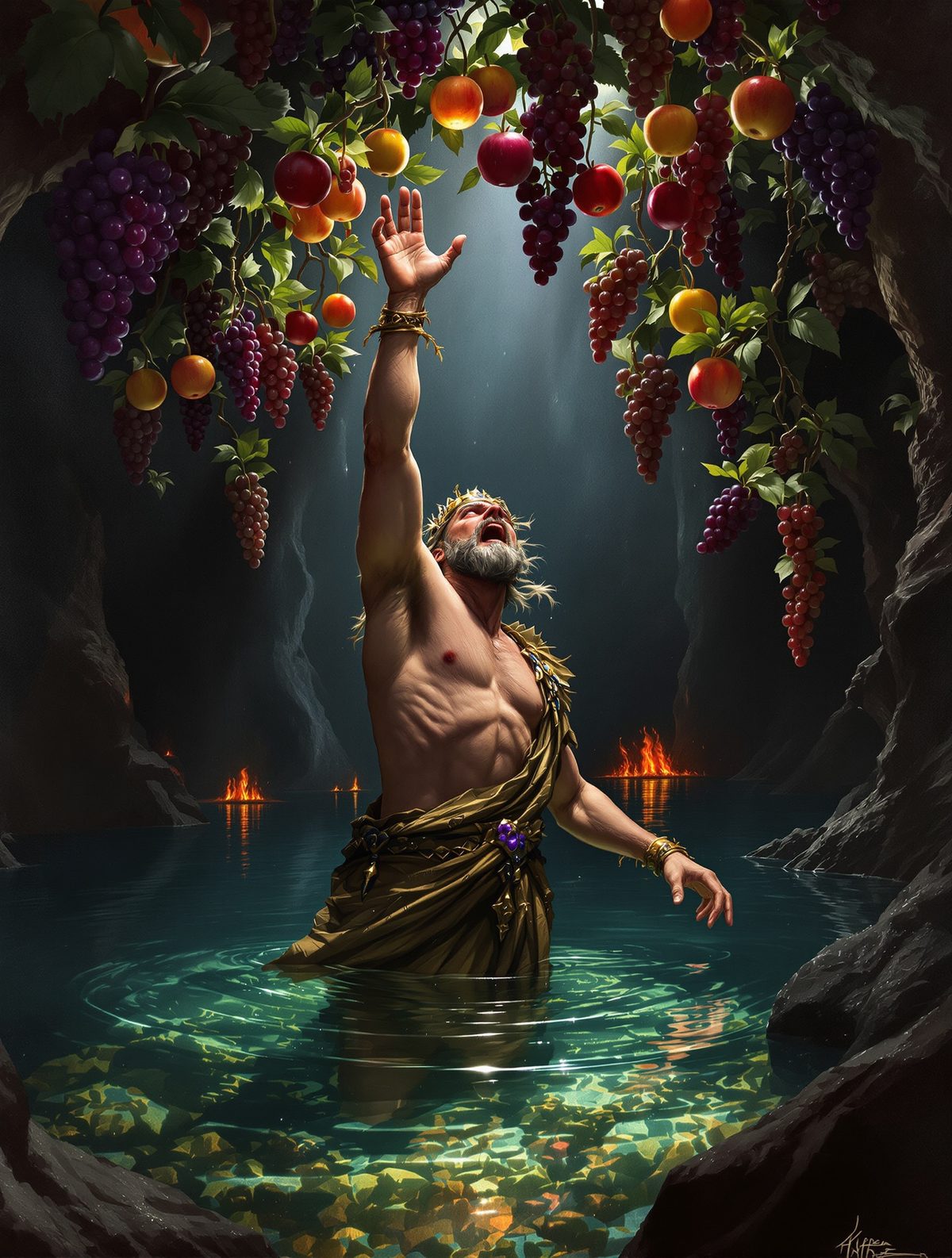
Imagine standing waist-deep in cool, clear water beneath a tree heavy with ripe fruit, yet dying of thirst and starvation. Every time you bend to drink, the water vanishes. Every time you reach upward, the branches dance away from your desperate fingers. This isn't a nightmare—it's eternity. And it's the fate of one man whose hubris led him to commit the most heinous crime imaginable: serving his own child's flesh to the gods themselves.
The name Tantalus has echoed through millennia, giving us the word "tantalize"—to torment with the sight of something desired but out of reach. But the true story of this ancient king reveals layers of horror, divine justice, and psychological torment that make modern thrillers seem tame by comparison.
The Golden King of Sipylus
In the shadow of Mount Sipylus in ancient Lydia, around the 13th century BCE according to classical sources, ruled a king so wealthy and favored that he dined with gods. Tantalus wasn't just any mortal ruler—he was the son of Zeus himself, born to the nymph Pluto (not to be confused with the later Roman god of the underworld). His kingdom sprawled across the fertile valleys of what we now call western Turkey, where archaeological evidence suggests a thriving Bronze Age civilization.
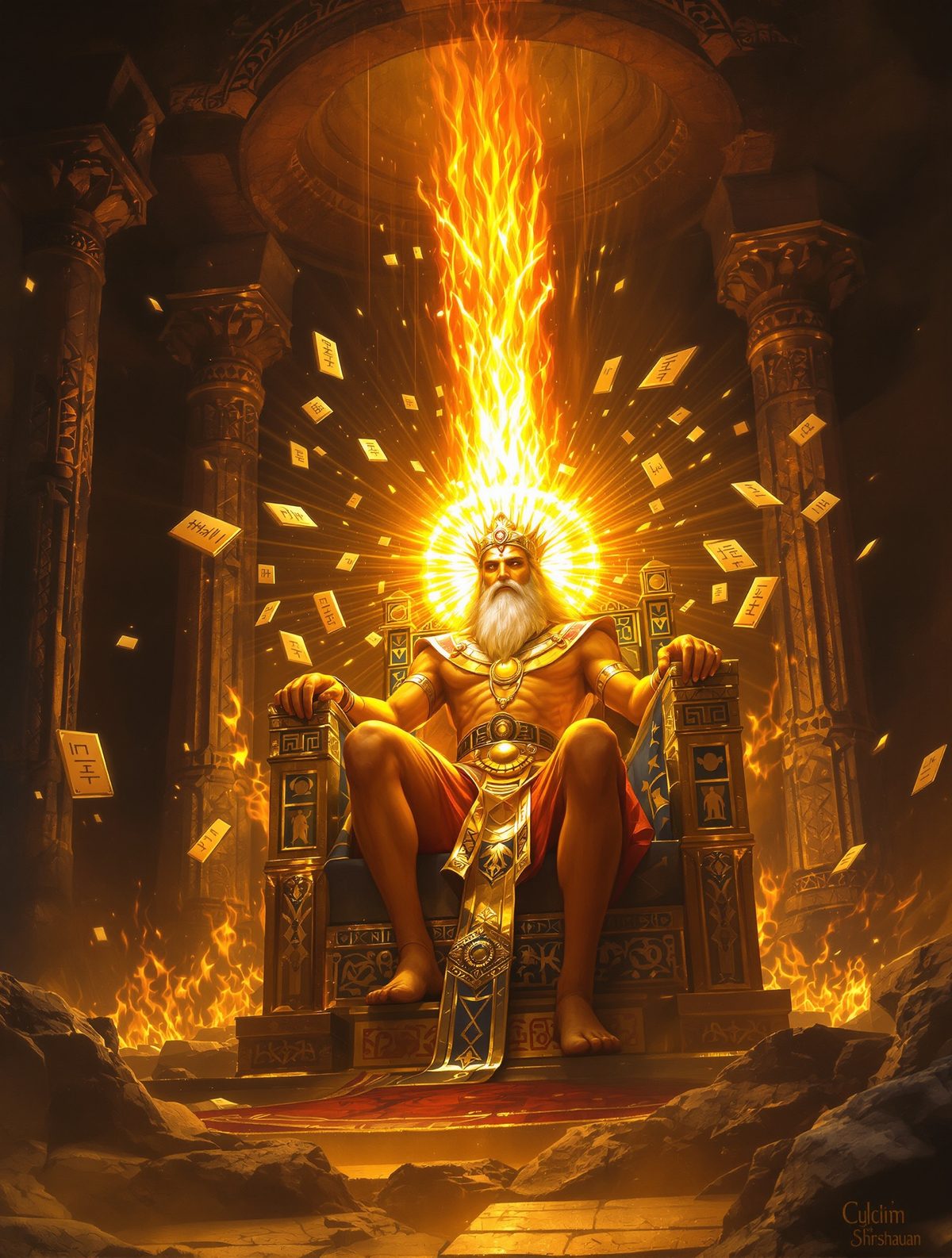
What set Tantalus apart from other legendary kings wasn't just his divine parentage, but his unprecedented access to Olympus. Ancient sources describe how he alone among mortals was invited to the gods' banquets, sharing ambrosia and nectar at the celestial table. The playwright Pindar, writing in the 5th century BCE, claimed that Tantalus heard the gods' secret plans and learned their divine wisdom—privileges that would ultimately corrupt his judgment.
But here's what the textbooks rarely mention: Tantalus wasn't content with merely receiving divine favor. Ancient fragments suggest he actively stole from the gods, smuggling ambrosia and nectar back to earth to share with mortals. Some versions claim he even stole a golden dog sacred to Zeus, hiding it in his palace. These weren't just acts of theft—they were cosmic violations that threatened the very order separating divine from mortal realms.
The Dinner Party from Hell
The crime that sealed Tantalus's fate occurred during what should have been the ultimate honor: hosting the Olympian gods at his own palace. Ancient sources differ on his motivation—some claim it was arrogance, others suggest madness, and a few hint at a calculated test of divine omniscience. But all agree on the horrifying details of what transpired in that dining hall nearly three millennia ago.
Tantalus murdered his own son, Pelops, a boy described in ancient texts as extraordinarily beautiful. But the king didn't simply kill the child—he dismembered him, boiled his flesh in a massive cauldron, and served the resulting stew to his divine guests. The scene, as described by the Roman poet Ovid, was one of unspeakable horror: a father carving up his own offspring with the same care he might use preparing a sacrificial ox.
The gods' reaction was swift and decisive. Most immediately recognized the abomination placed before them, their divine senses recoiling from the cursed meal. Only Demeter, distracted by grief over her missing daughter Persephone, accidentally consumed a piece of Pelops's shoulder before realizing what she had done. The goddess's anguish over this unwitting cannibalism added another layer of cosmic horror to Tantalus's crime.
What happened next reveals the full scope of divine power. The gods didn't simply punish Tantalus—they performed a miracle that demonstrated their absolute authority over life and death. They gathered the pieces of Pelops, placed them in a sacred cauldron, and restored the boy to life. Demeter crafted a new shoulder of ivory to replace what she had consumed, creating the first prosthetic limb in mythological history.
The Architecture of Eternal Suffering
Tantalus's punishment wasn't exile or death—it was something far more creative and terrible. The gods banished him to Tartarus, the deepest section of the underworld, where they constructed a personalized hell that would torment him for eternity. The sophistication of this punishment reveals the Greek understanding of psychological torture millennia before modern psychology existed.
The classical description places Tantalus in a pool beneath a fruit tree, but archaeological evidence from ancient Greek art suggests the scene was far more elaborate. Painted pottery from the 6th century BCE shows him surrounded by multiple trees bearing apples, pears, pomegranates, and figs—all fruits associated with divine sustenance. The water around him appears crystal clear and deep, suggesting abundance rather than scarcity.
But here's the diabolical genius of the punishment: it operates through hope. Tantalus isn't simply denied food and water—he's given the perpetual promise of relief, only to have it snatched away at the crucial moment. The water doesn't disappear permanently; it recedes just enough to avoid his lips, then returns to tantalize him again. The fruit branches don't break off; they bend away with seemingly conscious malice, then return to dangle within apparent reach.
Some ancient sources add even more layers to his torment. The geographer Pausanias, writing in the 2nd century CE, claimed that a massive boulder hung suspended over Tantalus's head, threatening to crush him if he ever stopped reaching for the fruit or water. This detail transforms his eternal punishment from mere want into active terror—he cannot even rest in his suffering.
The Ripple Effects of Divine Justice
The curse of Tantalus didn't end with his personal punishment. His crime created what scholars now recognize as one of mythology's most dysfunctional family legacies, spreading violence and tragedy through generations like a hereditary disease. The House of Tantalus became synonymous with transgression, revenge, and divine retribution that would inspire Greek dramatists for centuries.
Pelops, despite his miraculous resurrection, carried the trauma of his father's betrayal into his own reign as king of Pisa. His ivory shoulder became a symbol of divine intervention, but also of the permanent scars left by family violence. Archaeological evidence from Olympia suggests that Pelops's descendants, including the infamous Atreus and Thyestes, continued the family tradition of serving human flesh at dinner parties—though they targeted enemies' children rather than their own.
The psychological implications fascinated ancient Greek audiences. Here was a king who possessed everything—wealth, divine favor, immortal friendship—yet risked it all to test whether gods could be deceived. Modern scholars interpret this as an early exploration of what psychologists now call "sensation-seeking behavior" in individuals who have achieved ultimate success but find normal experiences no longer stimulating.
Perhaps most remarkably, some ancient sources suggest that Tantalus's punishment wasn't entirely passive. Fragments of lost plays hint that he occasionally received visitors in Tartarus—other condemned souls who would describe the outside world, adding psychological torture to his physical suffering by letting him know exactly what he was missing.
The Psychology of Eternal Want
What makes Tantalus's fate particularly haunting is how precisely it mirrors his crime. He violated the sacred bond of hospitality by serving tainted food to guests, so he was condemned never to eat. He abused his role as a father, so he was denied the basic comfort that even infants receive. He tested the gods' knowledge, so he was given perfect knowledge of his own perpetual suffering.
Ancient Greek audiences would have immediately recognized the justice in this symmetry. The concept of lex talionis—punishment that mirrors the crime—wasn't just legal principle but cosmic law. Tantalus's eternal tantalization wasn't arbitrary cruelty but precise moral mathematics, calculated to match his transgression exactly.
But the story also explores deeper questions about desire and satisfaction. Tantalus had achieved what every mortal dreamed of—divine friendship, unlimited wealth, a secure kingdom. Yet none of it was enough. His crime suggests that for some individuals, no amount of genuine blessing can satisfy the hunger for more, for different, for forbidden.
Why Tantalus Still Torments Us Today
Three thousand years after ancient Greeks first told this story, we live in our own age of Tantalus. Social media feeds us endless streams of lives that appear more fulfilling than our own, always visible but never quite attainable. Consumer culture promises satisfaction through the next purchase, the next upgrade, the next experience—yet the promised contentment recedes like water from Tantalus's lips.
The myth's enduring power lies not in its supernatural elements but in its ruthless psychological insight. Tantalus represents every person who has sabotaged their own happiness through the compulsive need to test boundaries, to see how much they can get away with, to prove that rules don't apply to them. His eternal punishment reminds us that some forms of desire are inherently self-defeating—the more desperately we grasp, the more completely satisfaction eludes us.
Perhaps most unnervingly, Tantalus's story suggests that the greatest torments aren't inflicted by external enemies but by our own ungovernable appetites. In a world of unprecedented abundance, millions still experience the peculiar modern anguish of having everything yet somehow feeling empty. We reach for digital fruit that dissolves at our touch and bend toward streams of validation that vanish when we need them most.
The ancient Greeks gave us Tantalus as a warning about the seductive power of transgression and the terrible precision of cosmic justice. Today, he serves as something even more urgent: a mirror reflecting our own relationship with desire, satisfaction, and the eternal human hunger for more than we can ever truly possess.