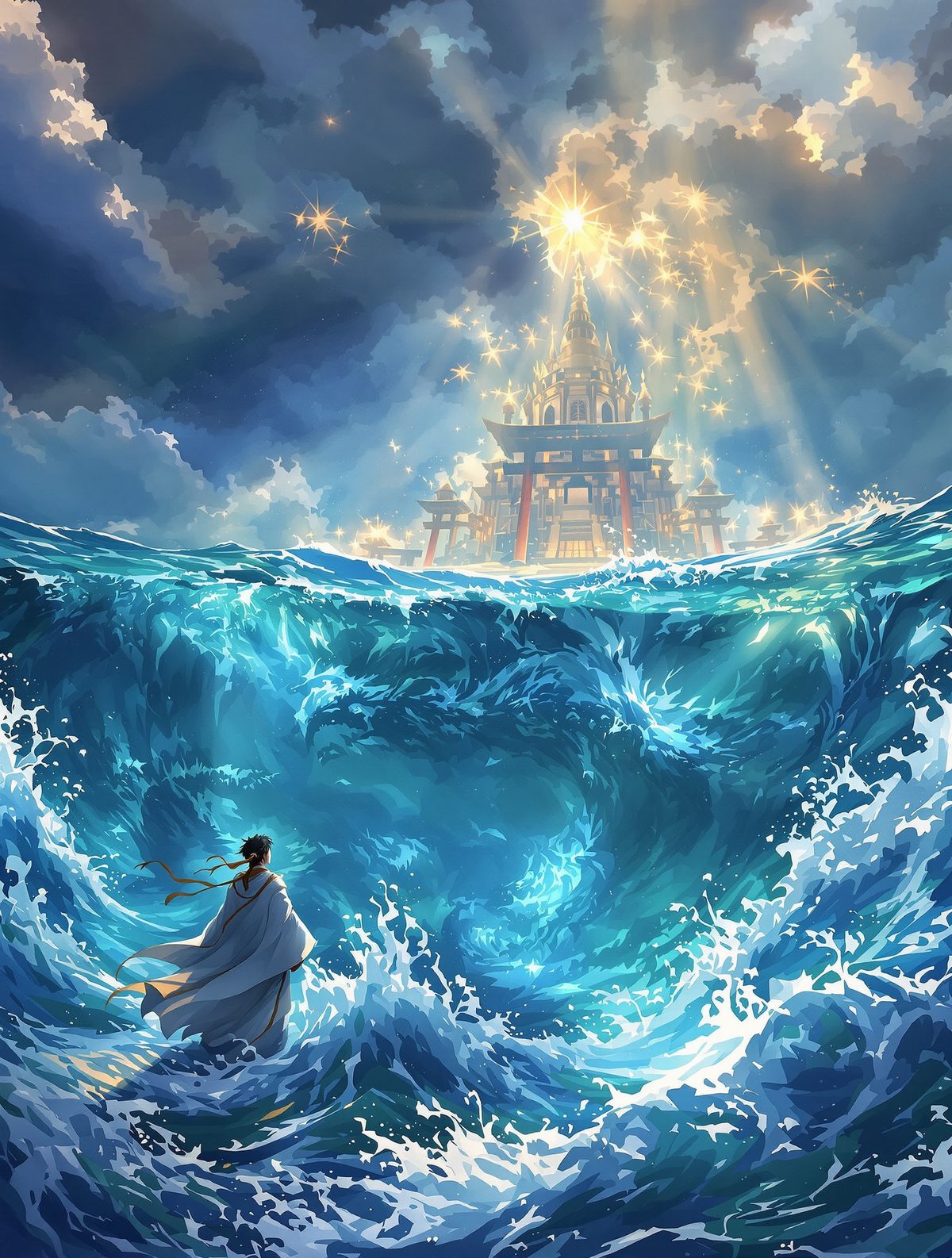
Deep beneath the churning waters of ancient Japan, where sunlight dissolves into eternal twilight, stood a palace more magnificent than any earthly emperor could imagine. Its coral walls gleamed with the captured light of ten thousand pearls, and its halls echoed with the whispered secrets of the sea. This was the realm of Watatsumi-no-kami, the Dragon King of the Ocean—and it was here that a desperate young prince would venture, risking everything to retrieve a single, seemingly insignificant fishhook that would determine the fate of Japan itself.
The tale that unfolded in those mystical depths wasn't just another family quarrel between divine brothers. It was the origin story of Japan's imperial bloodline, a creation myth that would echo through millennia and shape the very soul of a nation. Yet most people today know nothing of Prince Hoori's underwater odyssey—one of the most spectacular adventures in all of world mythology.
The Brothers Who Divided Heaven and Earth
In the dawn of the world, when the islands of Japan were still young and the boundary between gods and mortals remained gossamer-thin, two divine princes ruled over complementary realms. Hoderi-no-mikoto, known as Umisachihiko ("Luck of the Sea"), commanded the ocean's bounty with supernatural skill. His fishing expeditions never failed, his nets always groaned with silver-scaled abundance, and his enchanted fishhook—forged by the gods themselves—could summon any creature from the depths with a mere cast.
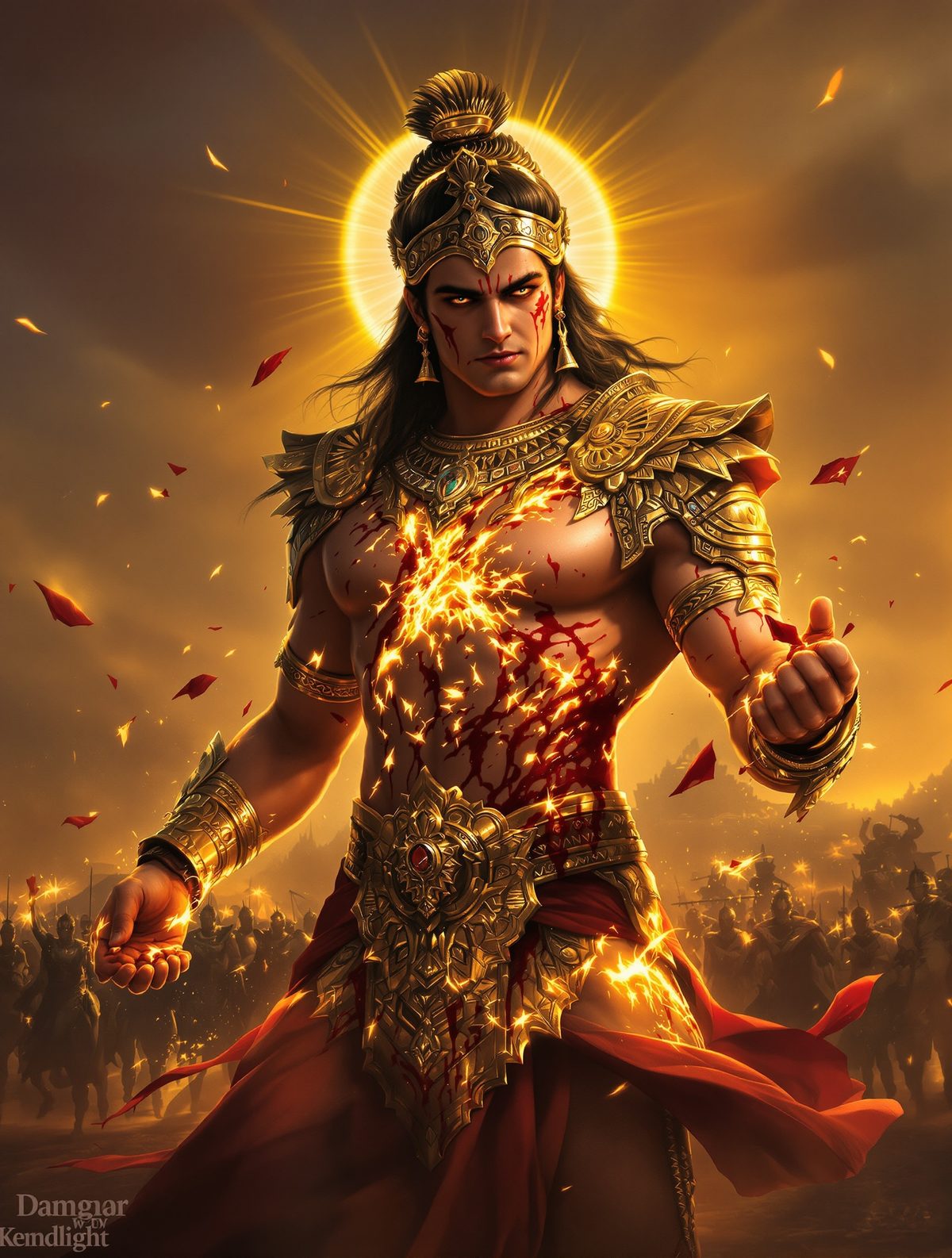
His younger brother, Hoori-no-mikoto, called Yamasachihiko ("Luck of the Mountain"), possessed equally divine mastery over the hunt. His arrows never missed their mark, his bow sang with celestial power, and the forests yielded their treasures at his command. For countless seasons, this perfect balance maintained harmony between sea and land, between the brothers who would one day father the imperial line of Japan.
But even among gods, curiosity can prove fatally seductive. One morning, as dawn painted the eastern sky in shades of pearl and coral, Hoori gazed out at his brother's domain—the vast, mysterious ocean that stretched beyond the horizon. "Brother," he called out with the casual confidence of immortal youth, "let us trade our tools for a day. I would learn the secrets of your watery realm."
Hoderi hesitated. The magical fishhook had been entrusted to him by their divine ancestors, its power both precious and perilous. But brotherly affection overcame caution. "Very well," he agreed, handing over the enchanted tool that gleamed like captured starlight. "But guard it well—this hook has drawn forth creatures from the deepest trenches, where even sunlight fears to venture."
When Divine Pride Meets Mortal Consequence
What followed was perhaps the most expensive fishing trip in mythological history. Despite his divine nature, Hoori discovered that mastery over land creatures granted no special insight into the ocean's mysteries. Cast after cast yielded nothing but frustration. The enchanted hook, which had never failed his brother, seemed to mock his efforts with its stubborn refusal to attract even the smallest fish.
As the sun climbed higher, Hoori's casts grew more desperate, more forceful. He waded deeper into the surf, the sacred hook glinting as it arced through increasingly ambitious throws. It was on one such cast—launched with all the frustrated strength of a divine prince—that disaster struck. The line snapped like gossamer, and the irreplaceable fishhook vanished beneath the waves with barely a splash.
For a moment that seemed to stretch across eternity, Hoori stared at the innocent-looking water that had just swallowed his brother's most precious possession. The ocean suddenly felt less like a playground and more like a vast, indifferent grave that had claimed something irreplaceable.
When Hoderi learned of the loss, his rage shook the very foundations of heaven and earth. Here was no mere sibling spat—in Japanese mythology, sacred objects carried profound spiritual significance. The fishhook represented not just a tool, but a divine covenant, a link between the gods and the natural world. "Find it," Hoderi commanded, his voice carrying the fury of tsunami and typhoon. "Bring me back my hook, or face eternal exile from both sea and land."
Desperate attempts at substitution failed. Hoori crafted five hundred replacement hooks, then a thousand, each forged with painstaking care. But Hoderi rejected them all. Only the original would satisfy his divine wrath, and the original lay somewhere in the ocean's unknowable depths.
The Salt-Old-Man and the Path Beneath the Waves
As Hoori wept beside the shore, his tears joining the eternal rhythm of the waves, an ancient figure emerged from the sea foam. This was Shiotsuchi-no-oji, the Salt-Old-Man, whose beard flowed like ocean currents and whose eyes held the wisdom of countless tides. In Japanese mythology, such figures often appear at crucial moments—cosmic janitors who clean up the messes made by gods and heroes alike.
"Young prince," the ancient one observed with the dry humor of someone who had witnessed countless divine catastrophes, "the ocean gives up its secrets only to those brave enough to seek them in their proper place. Your brother's hook lies not in these shallow waters, but in the palace of Watatsumi-no-kami himself."
The Salt-Old-Man's solution was as elegant as it was terrifying. From rushes and bamboo, he wove a magical basket so tightly constructed that not even water could penetrate its walls. "This vessel will carry you safely to the sea king's realm," he explained, "but know that few mortals—even divine ones—return unchanged from such a journey."
As Hoori stepped into the mystical craft, the ocean opened before him like a liquid flower. Down, down he descended, past schools of fish that glowed like living jewels, past coral formations that resembled underwater cities, past the last traces of sunlight into a realm where different laws governed reality itself.
In the Palace of the Dragon King
The palace of Watatsumi-no-kami defied every earthly comparison. Its towers spiraled upward like frozen waterspouts, their surfaces inlaid with every treasure the sea had ever claimed. Gardens of kelp swayed in ethereal currents, tended by fish that moved with purpose and intelligence. The very water here felt different—thicker, more alive, charged with divine energy that made Hoori's skin tingle with each breath he somehow managed to take.
But it was not the Dragon King who first greeted the lost prince. Instead, a vision of such breathtaking beauty approached that Hoori forgot his desperate mission entirely. Princess Toyotama-hime, daughter of the sea, moved through the water with fluid grace, her long hair flowing like silk currents, her eyes holding depths that rivaled her father's ocean realm.
Love—immediate, overwhelming, and utterly inconvenient—struck both divine beings like a typhoon. Here was romance on a cosmic scale, the kind of instant attraction that reshapes destinies and topples kingdoms. For three days and nights, Hoori forgot everything—his brother's anger, his impossible quest, even his own name—lost in the wonder of this underwater princess who laughed like tinkling shells and spoke with the voice of distant waves.
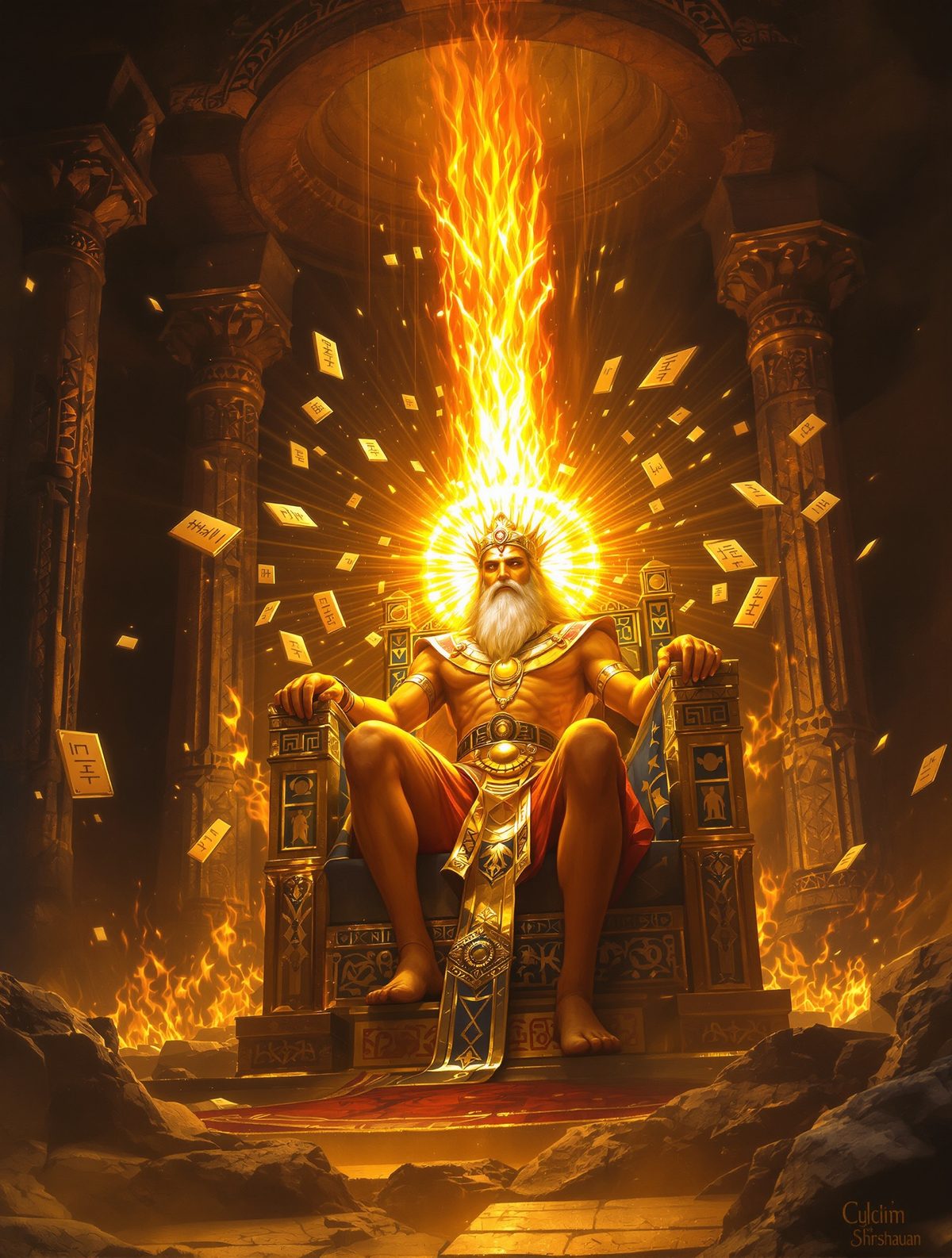
When Watatsumi-no-kami finally received the love-struck prince, the Dragon King's reaction surprised everyone. Perhaps divine love transcends even the most carefully guarded treasures, or perhaps the sea king recognized the working of fate itself. Not only did he welcome Hoori as a son-in-law, but he also solved the mystery of the missing fishhook with casual ease.
"A red sea bream swallowed your brother's hook," the Dragon King explained with the matter-of-fact tone of someone used to keeping track of every object in his vast domain. "The fish has been complaining of throat pain for days." A simple divine command later, the enchanted fishhook was retrieved, slightly corroded but still radiating its celestial power.
Gifts of Power and the Price of Divine Love
But Watatsumi-no-kami was far from finished. Recognizing that his new son-in-law faced more than just a brother's anger, the Dragon King bestowed gifts that would reshape the balance of power in the heavenly realm. Two magical tide jewels—the Shio-mitsutama (Tide-flowing jewel) and the Shio-hirutama (Tide-ebbing jewel)—granted Hoori control over the very oceans themselves.
"Should your brother's anger persist," the wise sea king counseled, "use the flowing jewel to flood his lands. When he begs for mercy, use the ebbing jewel to show your compassion. In this way, you shall establish both your power and your benevolence."
Three years passed in the underwater paradise like a single, perfect dream. But even divine princes cannot escape destiny forever. The call of the upper world grew too strong to ignore, and with promises of eternal love, Hoori finally departed his sea palace, bearing his retrieved hook and his oceanic gifts of power.
The confrontation with Hoderi unfolded exactly as the Dragon King had predicted. The older brother's rage melted into terror as divine floods threatened his domain, then transformed into grateful submission when the waters receded. The magical fishhook, returned at last, seemed almost anticlimactic compared to the cosmic powers Hoori now commanded.
The Tide That Shapes Eternity
This ancient tale resonates across millennia because it captures something profoundly human within its divine framework. How many of us have borrowed something precious from a sibling, only to lose it through carelessness? How many have discovered that the journey to make things right transforms us more than we ever imagined possible?
But Hoori's story operates on levels far deeper than simple family drama. In Japanese imperial mythology, this underwater adventure established the divine right of the emperor, whose bloodline allegedly traces back to Hoori's union with the sea princess. Every Japanese ruler for over two millennia claimed descent from this love story that bloomed in coral halls beneath the waves.
More broadly, the tale explores the price and power of crossing boundaries—between elements, between realms, between the familiar and the utterly foreign. Hoori's transformation from careless borrower to master of the tides mirrors our own potential for growth through adversity, suggesting that our greatest mistakes might actually be doorways to undreamed-of possibilities.
In our modern age of environmental crisis, the story carries special resonance. The Dragon King's casual omniscience about his oceanic realm—knowing instantly which fish had swallowed the hook, understanding the interconnected nature of all sea life—offers a vision of harmony between conscious intelligence and natural systems that we've largely lost. Perhaps, in our own desperate quest to restore what we've carelessly lost or damaged, we too need to venture into foreign realms, to seek wisdom from powers we don't fully understand, and to discover that love and respect might be more powerful tools than force or technology alone.
The fishhook was retrieved, the brother's anger appeased, and the empire's divine bloodline established. But the real treasure Hoori brought back from the depths was the knowledge that some journeys change us so completely that we return as entirely different beings—carrying within us the power to command tides, the wisdom of ancient kings, and the transformative force of love that bridges even the vastest depths.