The morning sun cast long shadows across the battlefield as the greatest archer who ever lived prepared to give away the very thing that made him invincible. Karna, son of the Sun God himself, stood before what appeared to be a humble brahmin beggar. But this was no ordinary supplicant—this was Indra, King of the Gods, disguised in mortal rags and asking for a gift that would require Karna to peel away his own flesh with his bare hands.
In the vast tapestry of the Mahabharata, perhaps no moment captures the tragic nobility of dharma quite like this: a warrior so bound by honor that he would literally tear the skin from his body rather than break his word. What happened next would echo through eternity, a testament to both divine cruelty and mortal courage that modern readers rarely encounter in sanitized retellings.
Born of Divine Fire: The Armor That Was Flesh
Karna entered the world already wearing his death sentence. Born to the unmarried princess Kunti through her invocation of Surya, the Sun God, he emerged from his mother's womb encased in golden kavach (armor) and kundal (earrings) that gleamed like captured sunlight. These weren't mere accessories that could be removed at will—they were fused to his very being, as much a part of him as his bones or beating heart.
The armor, known as the Kavacha-Kundala, rendered Karna virtually invincible in battle. Ancient texts describe it as "tejomaya"—made of pure radiance—forged from the cosmic fire that burns at the heart of the sun itself. Unlike earthly armor that could be pierced, dented, or worn down, Karna's divine protection regenerated instantly, deflecting weapons and absorbing the impact of even supernatural attacks.
But here's what most people don't realize: the armor's integration with Karna's body was so complete that it had developed its own network of nerves and blood vessels. Sanskrit texts hint that it pulsed with his heartbeat and grew with his body, a living extension of his divine heritage. This wasn't simply a matter of taking off a particularly well-fitted breastplate—removing it would be tantamount to surgical amputation without anesthesia.
The Divine Deception: When Gods Resort to Trickery
Indra, the storm-god king of the devas, found himself in an unprecedented position. His own son, Arjuna, would soon face Karna in single combat during the great Kurukshetra War, and even Indra's divine weapons might prove useless against the Sun God's armor. The solution he devised reveals something rarely discussed in polite theological circles: sometimes, even gods must resort to outright deception to achieve their ends.
Knowing Karna's reputation for never refusing a request for charity—a trait that had already earned him the title "Daanveer" (the charitable one)—Indra disguised himself as an elderly brahmin. The timing was crucial: he approached Karna during the warrior's daily worship of Surya, when refusing a brahmin's request would be not just rude, but cosmically sinful.
The scene, as described in the Vana Parva section of the Mahabharata, is almost cinematically detailed. Karna stood waist-deep in the sacred Ganges, water streaming from his muscular frame as he completed his morning ablutions. The golden armor caught the early light, creating dancing reflections on the river's surface. When the disguised Indra approached, Karna immediately recognized something otherworldly about this "beggar"—Sanskrit texts mention that birds fell silent and the very air seemed to thicken with divine presence.
The Impossible Choice: Honor Versus Self-Preservation
What happened next reveals the fundamental difference between mortal and divine ethics. Indra, still maintaining his brahmin disguise, made his request with calculated precision: he asked for Karna's kavach and kundal as dana—religious charity that, once promised, could never be withdrawn without destroying one's spiritual merit across multiple lifetimes.
Karna's response demonstrates why he remains one of mythology's most complex figures. Despite recognizing the supernatural nature of his visitor and understanding exactly what was being asked of him, he didn't hesitate. The Udyoga Parva records his words: "Ask, and it shall be given. For what is this body but a vessel for dharma, and what is dharma without sacrifice?"
But here's the detail that makes this moment truly extraordinary: Karna knew he would die. Ancient commentaries suggest he had received prophetic dreams showing his death at Arjuna's hands, dreams that became increasingly vivid as the armor began to separate from his consciousness. Some Sanskrit scholars argue that the armor possessed a form of sentience, and that removing it would be like losing a vital organ—which, in many ways, it was.
The Peeling: A Divine Surgery of Self-Sacrifice
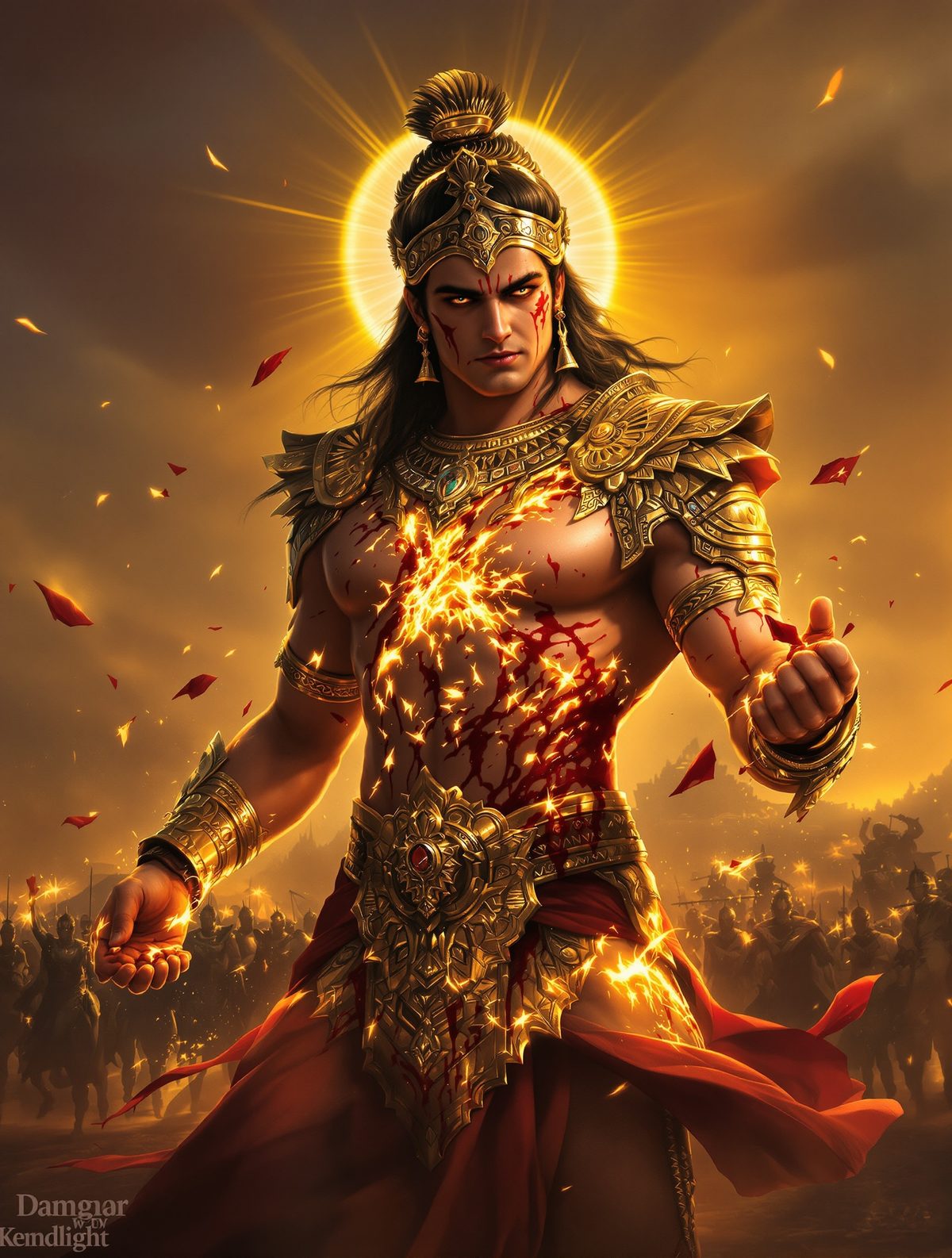
The actual removal of the armor represents one of the most viscerally disturbing scenes in all of Hindu mythology, yet it's typically glossed over in popular retellings. Karna didn't simply unbuckle cosmic armor—he performed surgery on himself, peeling away layers of divine flesh with the same methodical precision he brought to archery.
Using a blade blessed by Surya himself (the only instrument capable of cutting divine matter), Karna began the process that would take him three full days to complete. Starting with the edges where the armor met normal flesh, he carefully separated golden skin from mortal tissue. Ancient texts describe the sound as "like tearing silk made of lightning"—a high, musical note that could be heard across vast distances.
Perhaps most remarkably, Karna never stopped smiling throughout the ordeal. Witnesses described his face as radiating an inner light that grew brighter as each piece of armor came away. The pain, according to later accounts, was beyond human comprehension—imagine every nerve ending being slowly severed while remaining conscious and alert. Yet Karna maintained perfect composure, even engaging in philosophical discussions with the disguised Indra about the nature of sacrifice and duty.
The blood that flowed wasn't entirely mortal. Where it touched the ground, golden lotus flowers bloomed instantly, and some texts claim these flowers still appear at the site during certain astrological alignments. The armor itself never lost its radiance, continuing to pulse with warm light even after separation from Karna's body.
The Revelation and the Curse's Mercy
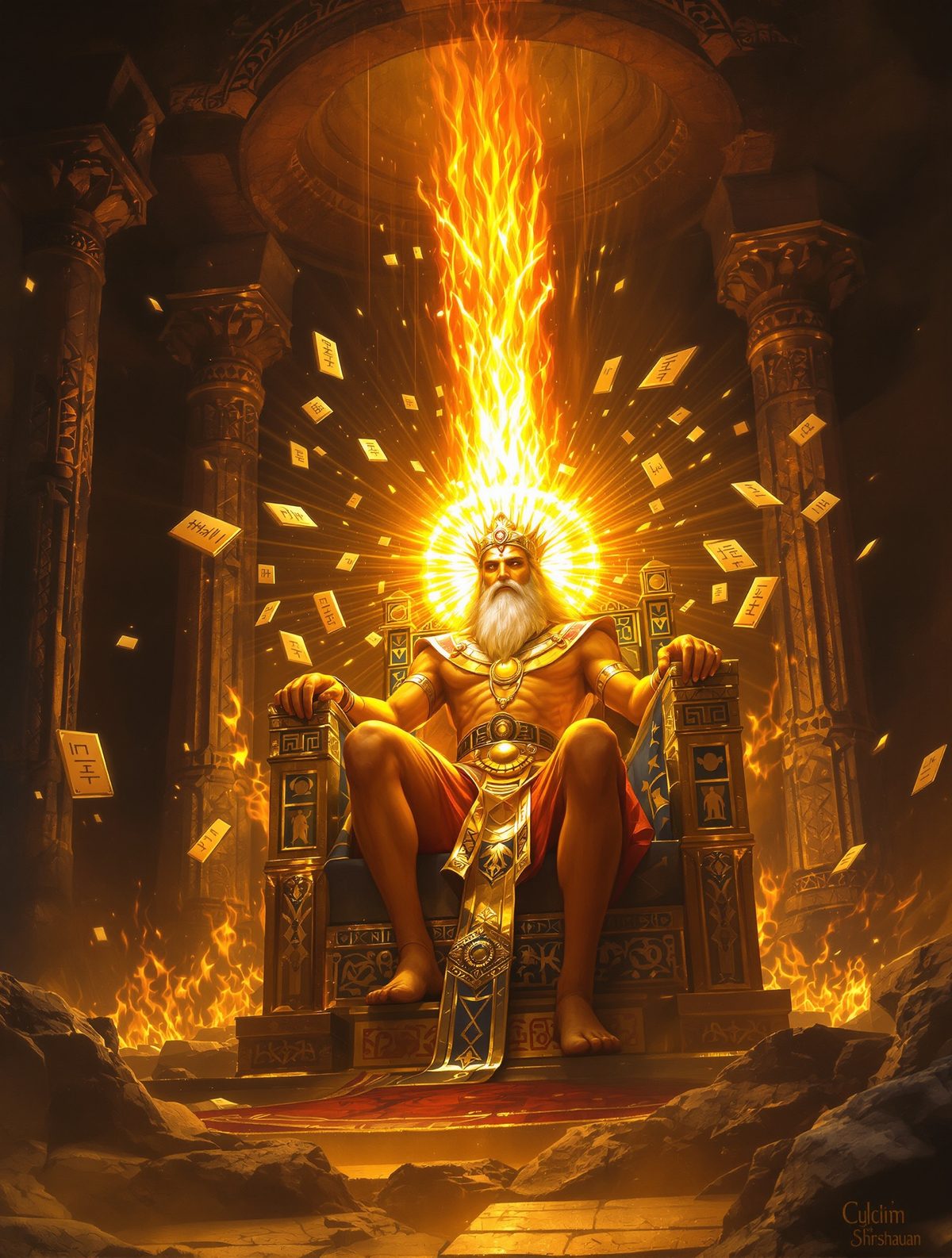
Only after Karna had completely removed both armor and earrings did Indra reveal his true identity. Standing before the now-vulnerable warrior in his full divine glory, crown of storms crackling with lightning, the god king experienced something unprecedented: shame. The sight of Karna's mutilated but unbowed form, golden blood still seeping from wounds that would never fully heal, moved even the King of Heaven to tears.
Indra's attempt at compensation reveals the complex ethics of divine intervention. Unable to return what he had taken (the armor could only be removed once), he instead gifted Karna the Vasavi Shakti—a divine spear capable of killing any single opponent, even another god. The catch? It could only be used once, and Indra secretly hoped Karna would waste it on a lesser foe before facing Arjuna.
But Karna understood the deeper game being played. His response, recorded in multiple manuscript traditions, shows why he transcended his role as mere antagonist: "Keep your spear, Lord of Storms. You have given me something far more valuable—the knowledge that even gods fear mortal virtue enough to resort to deception."
The Price of Divine Heritage in a Mortal World
Karna's sacrifice illuminates a truth that resonates across millennia: sometimes the greatest strength becomes the greatest vulnerability, and honor can be indistinguishable from self-destruction. In our modern world of calculated advantages and strategic withholding, his absolute commitment to dharma seems almost alien—yet perhaps that's exactly why we need to remember it.
The warrior who literally gave the flesh from his bones to honor a promise challenges our contemporary understanding of self-preservation versus principle. In boardrooms and political halls, on social media platforms and in daily interactions, we're constantly weighing personal cost against moral obligation. Karna's story suggests that the moments when we choose principle over self-interest—especially when no one is watching—define not just our character, but our cosmic significance.
Most importantly, his tale reminds us that true invincibility isn't about being untouchable—it's about being willing to be wounded in service of something greater than ourselves. In peeling away his divine armor, Karna didn't become weaker; he became eternal.