In the sacred lotus ponds of ancient China, where pink petals drift like fallen stars across mirror-still water, few would imagine they were witnessing the raw materials of resurrection. Yet according to one of China's most extraordinary legends, these delicate flowers would become the flesh and bones of a reborn deity—a child warrior whose suicide had shattered the heavens themselves.
The story of Nezha's lotus rebirth isn't just mythology; it's a profound meditation on transformation, sacrifice, and the price of divine justice that has captivated Chinese audiences for over a thousand years. But the version most people know barely scratches the surface of this tale's shocking depths.
The Price of Divine Rage
Picture a seven-year-old boy—but not just any child. Nezha possessed strength that could topple mountains and a temper that burned hotter than the forges of heaven. Born with three heads and six arms, wielding cosmic weapons like toys, he was the son of Li Jing, a military commander serving the mythical Shang Dynasty around 1600 BCE.
The trouble began innocently enough. Young Nezha decided to bathe in the East Sea, but his divine nature meant that even this simple act sent shockwaves through the ocean. The Dragon King's crystal palace trembled like a house of cards. Enraged, the Dragon King dispatched his third son, Ao Bing, to investigate.
What happened next would make headlines in any era: a playground dispute escalated into cosmic warfare. When Ao Bing confronted the boy, Nezha's response was swift and merciless. With his Heaven-and-Earth Ring—a weapon that could flatten entire armies—he struck down the dragon prince with a single blow. Not content with victory, Nezha then extracted the dragon's tendons to craft a belt, displaying the casual brutality that would define his legend.
The Dragon Kings of the Four Seas had ruled China's waters for millennia. They commanded typhoons, controlled rainfall, and held the power of life and death over countless mortals. Never had anyone dared to kill one of their princes. Their retaliation was swift and absolute: they would flood the entire region, drowning millions unless Li Jing surrendered his monstrous son.
A Son's Ultimate Sacrifice
Faced with his family's destruction and the death of countless innocents, Nezha made a decision that would echo through Chinese literature for centuries. In a moment of startling clarity, this child-god who had never shown mercy to enemies chose the ultimate act of filial piety.
"I alone committed the crime," Nezha declared before his horrified parents. "I will not let my troubles harm my father and mother." With these words, he drew his sword—not against another enemy, but against himself.
The suicide was methodical, almost ritual in its precision. Nezha first cut his own flesh, then his bones, finally dismantling his divine body piece by piece. Each cut was an offering, a payment in blood and bone to spare his family from the Dragon Kings' wrath. As his spirit separated from his destroyed form, he spoke his final words: "Now I give back my body to my parents. I have nothing more to do with you."
What makes this scene so powerful in Chinese culture is its inversion of expected roles. Here was a child-deity, possessed of power beyond imagination, choosing powerlessness. A being who had shown no restraint in battle demonstrated perfect self-control in death. It was the ultimate expression of xiao—filial piety—taken to its most extreme conclusion.
The Immortal Master's Workshop
But death, as it turns out, was merely an inconvenience for a spirit as fierce as Nezha's. His ghostly form sought out his master, the immortal sage Taiyi Zhenren, whose cave-laboratory existed somewhere between heaven and earth. Taiyi was no ordinary hermit—he was one of the Twelve Golden Immortals, practitioners of the deepest cosmic mysteries.
When Nezha's spirit materialized in his master's sanctum, weeping ethereal tears and begging for restoration, Taiyi faced an unprecedented challenge. Traditional resurrection was impossible; Nezha's body had been completely destroyed, returned to his parents as promised. Conventional materials—flesh, blood, bone—were bound by the laws of mortality and decay.
But Taiyi Zhenren was a master of transformation, and he recognized that this crisis demanded innovation. His solution would become one of the most beautiful and bizarre acts of creation in all mythology. If mortal materials were inadequate, he would use something divine: the sacred lotus.
The choice wasn't arbitrary. In Chinese philosophy, the lotus represents purity emerging from mud, transformation from the basest materials to the most beautiful. Its roots anchor in dark earth, its stems rise through murky water, and its flowers bloom pristine in sunlight—a perfect metaphor for spiritual transcendence.
Resurrection Through Sacred Botany
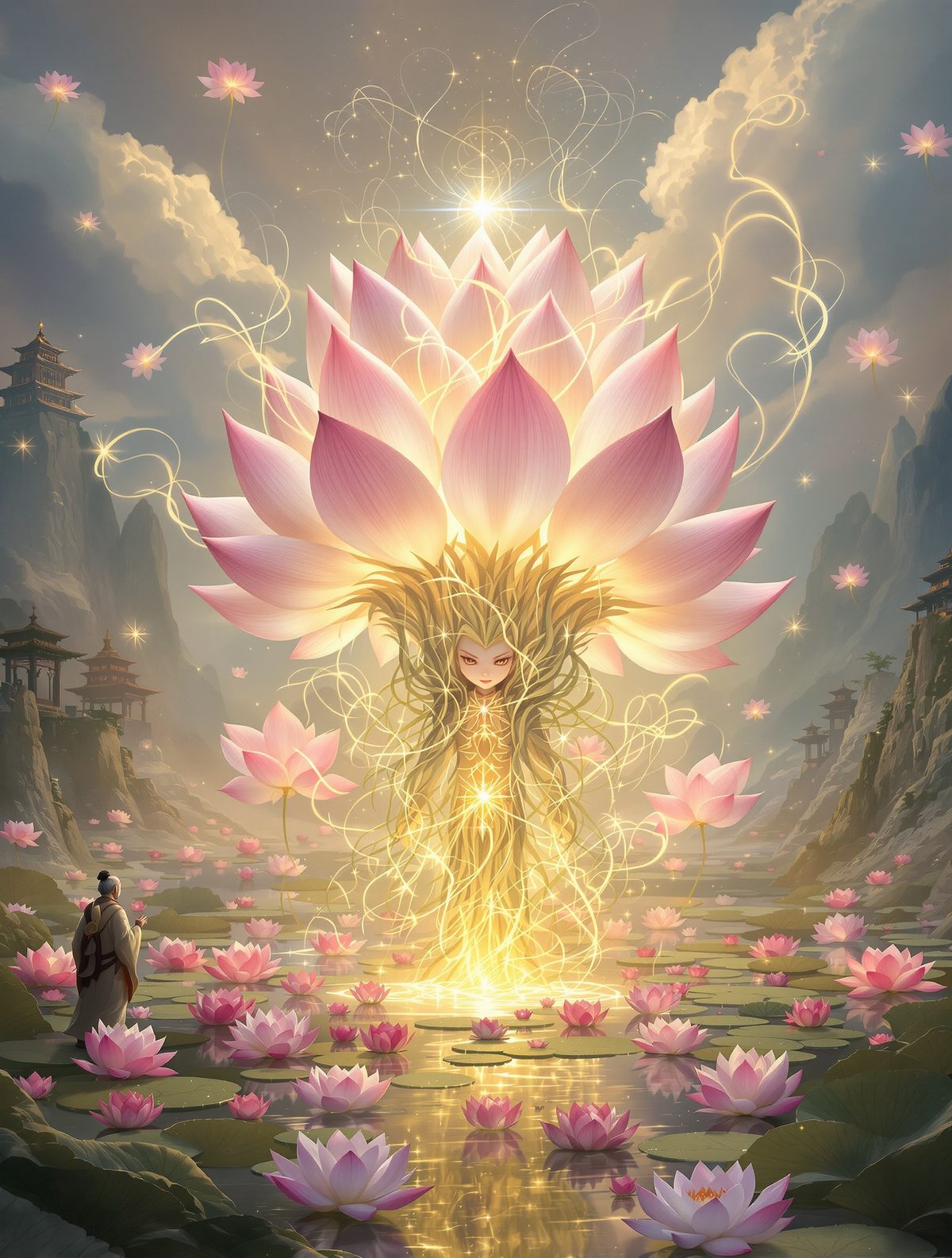
What followed was perhaps the most unusual act of divine craftsmanship ever recorded. Taiyi gathered lotus stems, each as thick as a man's arm, their hollow chambers filled with sacred essence. For bones, he wove them into a skeleton that was stronger than iron yet light as bamboo. The stems' natural joints became Nezha's new elbows, knees, and wrists—flexible, unbreakable, and infused with the plant's innate resilience.
For flesh, the immortal master employed lotus petals, but not as one might imagine. Through alchemical processes that blurred the line between science and magic, he transformed the delicate pink and white petals into living tissue. Each petal retained its essential nature—soft, pure, capable of renewal—while gaining the properties of human skin and muscle.
The most remarkable detail, often omitted from simplified versions, is what Taiyi used for blood: lotus milk, the sweet nectar that flows within the plant's stems. This ethereal fluid would circulate through Nezha's new body, carrying not just life but the plant's spiritual properties—its connection to water, earth, and sky.
The reconstruction took seven days and seven nights. As Taiyi worked, chanting incantations that had never been spoken before, the lotus materials slowly took human form. But this wasn't mere resurrection—it was evolution. Nezha's new body would be stronger than his original, immune to conventional weapons, and capable of regeneration like the lotus itself.
The Lotus Prince Reborn
When Nezha's spirit finally merged with his lotus body, the transformation was complete but not without complications. His new form retained all his original powers—the cosmic strength, the divine weapons, the ability to grow additional heads and arms at will. But now these abilities were filtered through plant consciousness, creating unexpected quirks.
He could photosynthesize sunlight for energy, making him less dependent on food. His lotus-petal skin was nearly indestructible, healing instantly from wounds. Most remarkably, he could now control plant life, summoning forests or commanding flowers to bloom with a gesture. The Dragon Kings had thought death would end their troubles with Nezha—instead, it had made him more powerful than ever.
But the lotus body came with its own challenges. Ancient texts hint that Nezha's emotions became even more intense, perhaps reflecting the lotus's symbolic association with passionate enlightenment. His anger burned brighter, but so did his capacity for compassion. He remained a child in mind but now possessed wisdom that came from having died and been reborn.
The irony wasn't lost on anyone: in trying to destroy his family, the Dragon Kings had pushed Nezha toward a sacrifice that ultimately made him their most formidable enemy. His lotus rebirth became the foundation for countless future adventures, as he wielded his new botanical powers in battles that would shape Chinese mythology for generations.
The Eternal Bloom of Transformation
Why does this thousand-year-old tale of botanical resurrection still captivate us today? Perhaps because it speaks to humanity's deepest anxieties and hopes about transformation, sacrifice, and renewal. In an age where we're reshaping our bodies through technology and medicine, Nezha's lotus rebirth feels surprisingly contemporary.
The story suggests that true change requires destruction of the old self—not just modification or improvement, but complete dissolution followed by reconstruction from entirely different materials. Nezha couldn't simply heal from his wounds; he had to die completely and be rebuilt from the ground up, using materials that embodied the qualities he needed: purity, flexibility, and the power of regeneration.
Modern readers might see echoes in everything from organ transplants to gender transition to the way we reinvent ourselves through technology. Like Nezha, we're learning that the most profound transformations require us to let go of what we were to become something unprecedented. The lotus body reminds us that sometimes the most beautiful and powerful versions of ourselves emerge not from perfecting what we have, but from daring to become something entirely new.
In the end, Nezha's resurrection isn't just a myth—it's a meditation on the courage required to destroy and rebuild ourselves in pursuit of who we're meant to become. And in that sense, we're all potential lotus princes, carrying within us the seeds of our own transformation.